Yashica TLR
yashicatlr.com
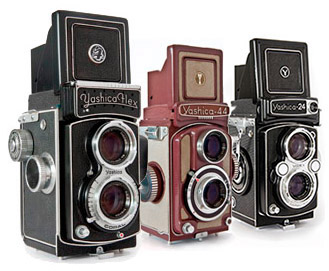
Pigeonflex, Yashima Flex, Yashica Flex, Yashicaflex & Yashica Models
ピジョンフレックス ヤシマフレックス ヤシカフレックス ヤシカ
Contents
(Scroll down or click on links. Use sidebar for other pages.)
This Site
Yashica's Other Formats (& Some Other Makers)
The Challenge
My Approach - Data Sources & Scope
Other Resources - Manuals & User Guides
About Me
Contributors & Other Acknowledgements
Site Format
Copyright Notice
This Site
The first camera made by the fledgling camera maker, Yashima, later to adopt the name of its Yashica cameras, was a twin lens reflex (TLR) taking twelve 6 cm x 6 cm negatives on 120 format film (note, not related to the Tokyo based Yashima microscope maker founded in 1935). It used a separate viewing lens matched to the taking lens below it, the camera front panel moving in and out to achieve correct focus. The view through the waist level finder is very similar to what the taking lens is seeing except that although the view is correct side up, it is reversed left to right, courtesy of the 45 degree mirror (hence “reflex”). Like most similar Japanese TLRs, it was patterned on the German made Franke & Heidecke Rolleicord. Yashica went on to make movie cameras, sub-miniature cameras and various categories of 35 mm cameras and in 1959, it even claimed to be the “largest manufacturer of cameras and photographic products in Japan”, but the offspring of the first model would continue in production for the next 33 years.
The schematic below, adapted from a Yashica brochure, has the appearance of a Yashica D/635 but is generally applicable to all Yashima/Yashica models and typical of Rolleicord influenced TLRs:
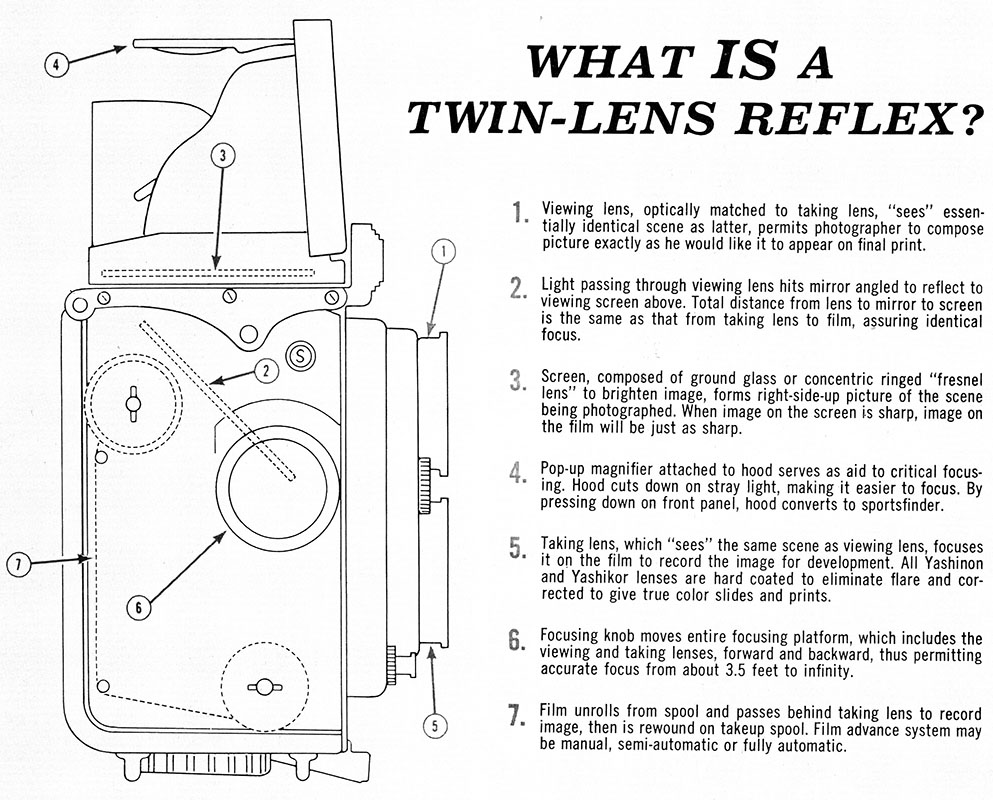 (Click on diagram for larger view)
This site is dedicated to understanding and preserving the details and development history of the company's TLR cameras from the first model Pigeonflex introduced in early 1953 through to the Yashica Mat-124G which ended manufacture in 1986:
 1.jpg)
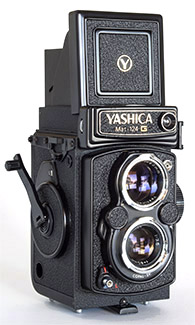
Both 6x6 cm 120 film and 4x4 cm 127 film format TLR cameras are covered. As a group, the 4x4s were commonly referred to as “44” and with later user manuals and boxes for the 6x6s, Yashica started adding “66” to the names.
Whilst the content is possibly of greatest interest to collectors, my original intent was to help anyone that wanted to identify a Yashica TLR model or find out more about the camera that they had acquired. To that end I started the Pigeon Loft page to contrast the Yashima made version to its successors but it has since become a full-fledged story in its own right, featuring a number of companies and their contributions and even a 35 mm camera, the Pigeon 35 (my excuse is that it binds some of the TLR threads together).
The story of Yashica is a story of post-War Japan and development of the Japanese photographic industry - keep that context in mind when thinking about Yashica history.
I hope that I have also added enough information for users, meaning actual photographers, to find the site interesting.
Yashica's Other Formats (& Some Other Makers)
Although I originally had no intention of exploring Yashica cameras other than TLRs, I have tried to fill in some of Yashica's milestones and corporate background, at least up to the time of the last TLR in 1986, including its 1975 bankruptcy and 1983 takeover by Kyocera. In the process, I discovered that the company's first movie camera, the Yashica 8 which is also its first non-TLR product, directly links Yashica and lens maker Zunow, famous for starting the 35 mm aperture wars with an f/1.1 lens and also releasing the first SLR with an internally controlled fully automatic aperture. Yashica's first 35 mm camera, the fixed lens rangefinder Yashica 35, arrived only a few months later and eventually led to the very successful Electro 35 model. Along with the updated Yashica 8T/8T-2 movie camera, it surprises us with the lens name “Yasinon”, before very quickly changing to “Yashinon” (“Yashinon” lenses appeared on those cameras before the Yashica-Mat). Then there was the Nicca acquisition and Yashica's re-imagined Leica copies, the YE and YF which seemed to kick start Yashica down the SLR path. I found the story of its first attempt, the Pentamatic, and the move to the M42 mount compelling, largely untold and relevant to Yashica's corporate fortunes.
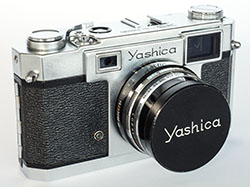
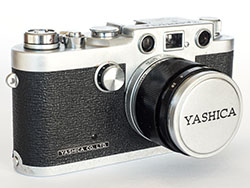
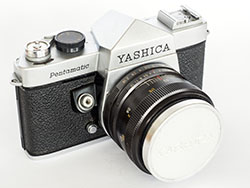
I have added separate pages pages to tell those individual stories more completely than their brief mention in the TLR narrative. The links to those pages are only available on the sidebar of this page and from the Yashica - Success & Failure page. Except for the Yashica YE & YF, the pages belong to this site. The Yashica YE & YF link will take you to a different site.
Originally, the YE and YF story included their Nicca ancestors which then grew into a page by itself. In the process, the focus shifted from being related to Yashica to being about examples of Japanese Leica copies more generally. Those pages have now become part of a separate website, leica-copies-japan.com.
The Challenge
To clarify my reasons for developing this site and justify why my take on early Yashica model history is sometimes at odds with other sources, I need to explain what I believe are some of the key issues in regard to the history of Yashica TLR models.
If you are not interested in all the historical detail and controversy and just want to look up a particular model, go to “66 Models” or “44 Models”, as appropriate or the table “Yashica TLR Models & Specifications Table”. The sidebar links to the pages of the site, think of them as chapters.
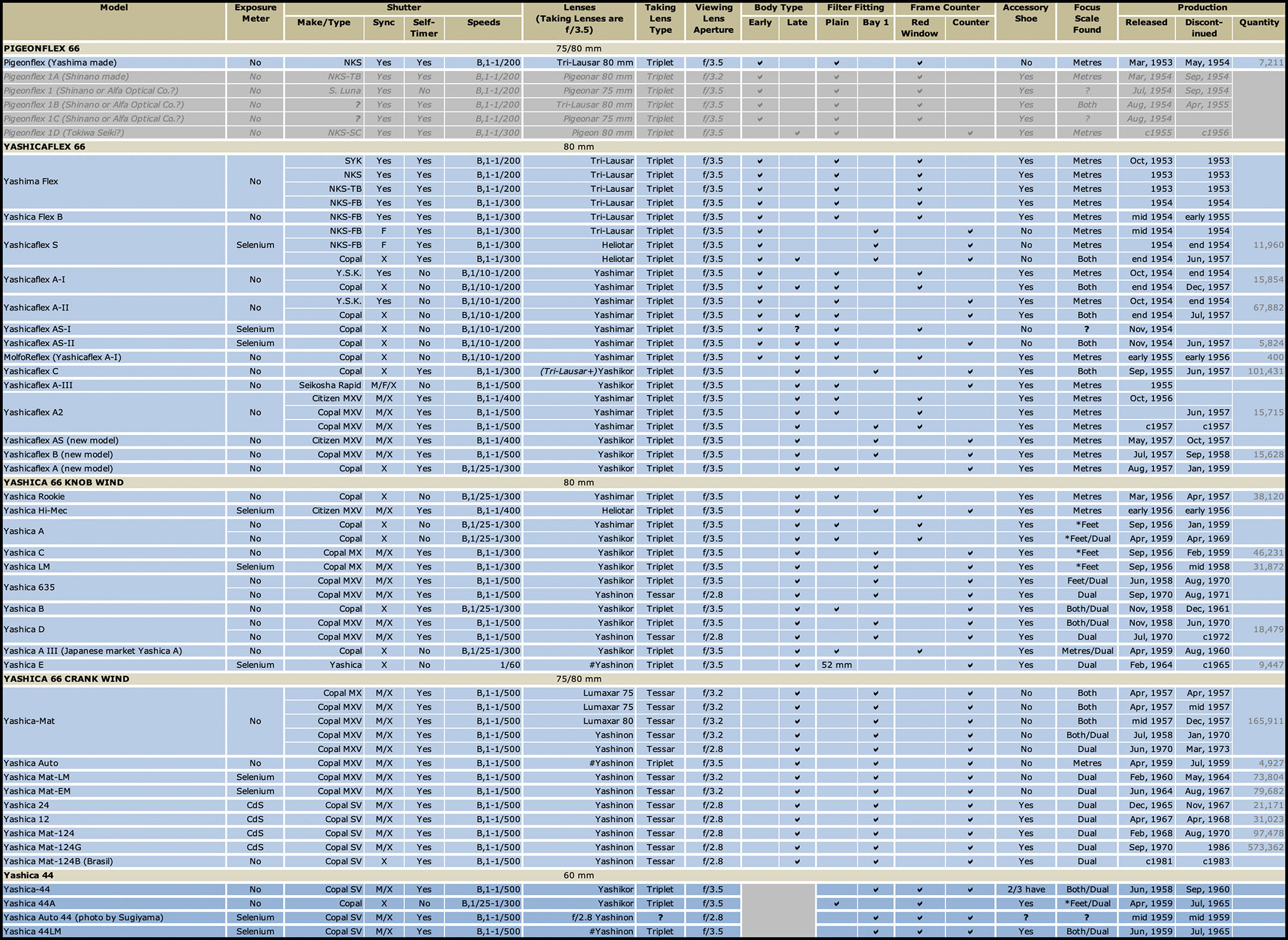
The information on this site developed out of frustration at the lack of accurate model detail available on the Yashica TLRs, particularly the Yashicaflex series and the first of the Yashicas. Many prominent sites have obviously incorrect information, bloggers broadcast the mistakes more widely, eBay sellers often use these sites for quick identification and you can see how wrong thinking has grown. In fact, I cannot think of one significant website, or reference work, where it is not possible to demonstrate some degree of mistaken identity and/or chronology (and that also applies to the other models I have chosen to cover).
The problem is that in the beginning, Yashima was just another insignificant business, with unproven credentials, trying to establish a toehold in the burgeoning but very competitive post-War photographic industry. There would not have been too many magazine articles or other commentary about the early company or its products, at least until the innovative Yashica Flex model S arrived on the scene. Even then, TLRs for the masses were already becoming passé in a crowded market. Unfortunately, Yashica seems to have done little to formally document its own history and what there may have been, seems to have been lost with the Kyocera takeover.
The issues with popular sites, recognised reference sources and specific examples are covered in the next page, The Problem of Dates & Names.
My Approach - Data Sources & Scope
Except for non-controversial dates, background information about the Company and general matters, I have tried not to rely on third party sources or existing narrative on websites, at least without testing it in some way. My main sources for details about cameras have been user manuals, ads, brochures, catalogues and observing cameras displayed on the internet and offered at on-line auctions (currently, there are over 5,500 cameras in my TLR databases with serial numbers and trim details listed and with photos of many more examples). For the Yashicaflexes and earlier models, I have come to rely heavily on Japanese brochures and websites. Plus I have a few representative examples starting with the Pigeonflex and other early models.
Throughout the site, I have tried to present evidence and explain my reasoning but inevitably, there will be some guesswork. I hope that I have made it clear when that occurs. When conflicting information turns up, I try not to assume that one view or the other is wrong. More often than not, the problem is about interpretation and the question becomes “why?” I have found that whenever I have made assumptions based on “logic”, I have inevitably been proven wrong by real events when they have become clearer. Nevertheless, I have made some leaps of logic on the Pigeon Loft page (and maybe a little on the Pentamatic page). That doesn't affect Yashima history or models but I do apologise in advance to those interested in the later Pigeonflex models - be prepared for my theories to be proved totally wrong!
This website is a team effort and along with a group of long-term collaborators, there is a steady stream of correspondents with interesting examples of cameras, stories etc.
Other Resources - Manuals & User Guides
I have focused on camera models and their development rather than camera operation which is all basically similar and is well documented in user manuals. PDFs of manuals for many models are available for download with donation from OrphanCameras.com. On the 66 Models and Ownership pages of this site are links to PDFs of the historically interesting, but hard to find, early Yashicaflex S, Yashicaflex A, Yashicaflex AS, combined Yashicaflex A & C and Yashica Auto user manuals plus selected other models, some of which are subtly different to OrphanCameras.com versions. A general resource, the first edition of the Focal Press Yashica Twin Lens Reflex Guide by W.D. Emanuel is available for download from 3106.photography but please ignore the model development history completely - the Yashica D and 635 did not develop from the Yashica A. That will be explained elsewhere.
About Me
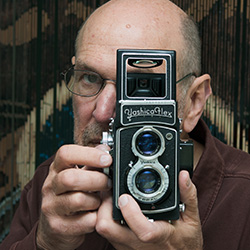
My name is Paul Sokk. I am an Australian of Estonian descent. Since 2003, my photography, mainly amateur, has been pretty much digital. Before then, it was 35 mm. I first became interested in photography as a teenager in the 1960s. In the early 1970s, as well as weekend wedding work, I undertook two years of commercial photography training based around the 4"x5" view camera before deciding not to give up my day job. Then in the early 2000s, after not having had a darkroom for many years, I found the digital workflow liberating in terms of regaining control but I did miss the look and feel of metal, fully mechanical cameras from my earlier days. As therapy, I acquired a couple of early folders and some 35 mm cameras. Then I decided that I needed to try the 120 6x6 experience, something that had so far eluded me. A Yashica TLR was the first affordable TLR that came up on eBay and now some more have joined it, “for research”, you understand. Since then, I have come to admire the Yashica TLR as an effective photographic tool available to almost anyone, both then and now, not to just those with deep pockets.
Although, in my view, Yashica managed to get the balance between quality and mass market affordability more right than any other TLR maker, that hasn't made me a die-hard fanboy either. I know that there are better and/or more interesting TLRs and I don't just mean the Rolleis. Also, my interest in cameras extends to all types, brands, formats and media. In other words, I hope that my views are balanced. I don’t consider myself to be a real collector either - some of my representative examples are distinctly more “interesting” than collectible. After becoming intrigued because I owned one, I saw the opportunity to fill in the gaps in the Yashica TLR story and to correct some of the misconceptions that have developed. Inevitably, it has also lately piqued my interest in some of the early Yashica 35 mm models. The site started small and it's grown, helped by the fact that I am a bit obsessive. My 35 year career in government administration will probably not surprise anyone.
Site Language
As it is an Australian site, I try to conform to standard Australian (i.e. largely British) spelling e.g. metre, grey, colour and amateur, unless something is specific to the US market. When it comes to translation of the “official” colours noted in Japanese manuals and brochures, I use capitals and the US form of “Gray” for two reasons; Yashica's focus on the US market by the late 1950s and my original translation was arranged by US contributor Tom Heckhaus (since confirmed by other sources). When I refer to focusing scales, I use the words “metre” and “feet” which distance measures appear on the focusing knobs rather than e.g., “metric” and “imperial” scales - “imperial” is probably confusing for some cultures. Note, with TLRs, Yashica uses “M” to indicate metre but where the full word appears on early 35 mm lenses, it is spelt “meter”. It could be the US spelling (which would be odd as the US doesn't use metric weights and measures for its official measurement system) or more likely, the German spelling arising from the historical copying of German cameras (Germanic languages also spell it “meter”). Whatever the source, it seemed to be adopted by the whole of the Japanese photo industry. Regardless, I'm sticking to the British/French/ISO/WTO/IOC and NATO standard on this one (mainly because most of the site was in place before this became an issue).
Contact Details
I can be contacted by email at paulsokk@live.com.au and am happy to discuss things Yashica or debate any of my conclusions - if there is better information, I will readily accede. Any contributions used, e.g. ideas, words or images, will be acknowledged. I am also on the lookout for manuals, brochures, ads, books etc that refer to the Pigeonflex to Yashicaflex period or accessories generally and also to The Mystery Models. These could be either original, paper copies or electronic copies.
Some correspondents have asked me “how much is my camera worth?” This is one area where I have very little expertise. I am not a collector as such and am not familiar with sales on specialised auction sites. Most of my research is web based and any views I have about value, and please note that most of the time I am not thinking about value unless buying something for myself, are derived from on-line auctions. My principal response is to refer correspondents to the completed listings history of such auction sites. And remember, a camera, or any item, is only worth what someone will pay for it at the time that it is offered for sale. McKeown says something similar but with a bit more authority. If you have an interesting camera and are happy to share serial numbers and perhaps a photo, I will be pleased to try to help but I can tell you now that there will be no magic number at the end. Also, before you contact me, please read the guide that I have prepared, “Valuation & Selling”, on the Ownership page.
Contributors and Other Acknowledgements
The first iteration of this website was as a page accessed from Barry Toogood’s Yashica page of his excellent www.TLR-Cameras.com site. Barry and I did not, and it seems still do not, agree on a number of historical aspects but nevertheless, he very generously encouraged me to develop my ideas and then hosted the result. I am indebted to him for both the idea that has become Yashica TLR and the work he put into dealing with my dozen or so revisions which ended up as, I think, three distinct iterations of that original page.
My decision to turn my page into a site evolved from becoming involved with two amazing Yashica TLR collectors; Tom Heckhaus from the US and Leigh Harris from Australia. These guys are serious collectors with many years experience with Yashica TLRs and other collections. All three of us have come to share a similar view of Yashica TLR history and I know that Leigh and I have both gone down similar blind alleys in our respective pasts. Some of Tom’s information, including photos, had already appeared on my page courtesy of Barry. Some of the information concerned Yashicaflex history and I used a poor quality photo of a user manual from a well known auction site to illustrate the point. At that stage, none of us had contacted each other. Later I found out that Leigh had bought the user manual (and camera that it came with) - serendipity.
Many of the photographs on this site are courtesy of Tom Heckhaus – in fact I have used Tom’s photos to maintain some consistency in look. Some of the photographs are courtesy of Leigh – he has some unique examples. Correspondent and exposure meter aficionado Simon A. Spaans provided details and photographs of the differing exposure meter arrangements on the Yashicaflex S and Yashicaflex AS plus I have used some of his information in clearing up the origin of Yashica branded accessory meters.
A more recent recruit to the band of contributors is Göran Årelind from Sweden. Göran is a dedicated user of film cameras but in the process, has collected more Yashica TLRs than he cares to admit to, including a trio of MolfoReflexes, and has become quite skilled in repairs and restoration. Many of the photographs of accessories, as well as a number of cameras, are his and he has also provided me with brochures and ads. He has been investigating MolfoReflex history which has led him to a wider review of Yashica marketing and the rise and fall of TLR cameras in Sweden. More recently, he has added an article on Shutter Speed Testing.
Another new contributor is Sandu Baciu from Canada. He and his wife Alina have an extensive collection of Yashica TLRs including early models. In a very short time, quite a number of his photos have appeared all over the site and he was the inspiration for the “The Pigeon Loft” page with both his Yashima and Shinano Pigeonflex models and the “Prototypes & Specials” page with his Yashica Mat-124G based stereo camera. Sandu has managed to identify a number of unusual features and variations and has provided photos of previously unobtainable items like Pigeonflex, Yashima Flex and Yashica Flex B lens caps.
Chris Whelan from the US became a regular contributor during 2014. Several of his cameras are featured on the site as are his cases, boxes and documents. A very rare Yashicaflex S user manual and a black box for the model are particular highlights. His interests so far have been the earlier models and collecting complete kits where possible plus also chasing brochures, ads and marketing stuff such as the early 1960s Yashica sailor boy and cigarette lighter that can be found in the Marketing Paraphernalia section. Chris' contributions are helping to fill out some of the detail and adding to the richness of the site. In more recent times, his interest in Yashica 35 mm cameras and particularly the Pentamatics has infected me too and we are on a joint journey of discovery which extends to the Yashica, Nicca and Leotax Leica copies.
I have used photographs and articles, with permission, from a number of correspondents and these are acknowledged accordingly. Most of the remaining photographs are mine except where I needed to show critical detail and had nothing suitable available. In those cases, I have used photos found on the net and acknowledged that (generally from auctions that have ended and/or Japanese sites and therefore impossible to follow-up). I have not used complete images of items or displayed full serial numbers in order to maintain anonymity of owners and not devalue the possible worth of the original image itself. If I have upset anyone by doing so, please contact me with image details and some proof of ownership and I will take immediate steps to remove, or if you are agreeable, to credit the image appropriately. My site is entirely non-commercial and therefore I am not seeking to derive any benefit from it other than expanding the knowledge base of Yashica TLRs. Hopefully, you will support me in this.
I am indebted to Karl F. Kahlau, author of the book Collector's Pictoral Encyclopaedia & Value Guide to 6x6 TLR Cameras, who has very kindly allowed me to use material from his book and in particular, to both use and critique the Production List of Yashica 6x6 TLRs based on original Yashica/Kyocera information.
I recently came across a Japanese site, TLR66.com, at http://tlr66.com/souko/yashicaflex-miwake.php. It has an article about recognising Yashicaflex models. The site is not overly detailed and the Google translation is appalling but my conclusions seem to be in step with that site’s information. One mistake it does make though is to call the Yashicaflex AS-II a “Yashicaflex AS” and the Yashicaflex AS-I a “Yashicaflex ASII” (I can see how that can happen, for example, if only relying on Yashica's “Yashicaflex Directions for Use Model A & C” - it confused me as well). Where there is conflict or I have relied on that site’s information, I have noted it.
Other sources including, Camera-wiki.org, are acknowledged where the material is referred to.
Site Format
Essentially, this site loosely follows a format of context setting, model identification, model naming and related historical and marketing considerations, camera bodies and 66 model trim changes, lenses, shutters, serial numbers, Sugiyama's influence, Yashicaflex A series complexities, trim and specification changes by individual model and serial number for 66 models, Yashica 44 series development, and finally, 44 model details. The Pigeonflex started it all and the change from Yashima to Shinano production is not so clear cut so I have added the "The Pigeon Loft" to explore these models further. Then there are also some prototypes and specials worth mentioning. I have included a page to consolidate access to brochures, the sort of thing that all of us like to peruse and which also support some of the claims on this site. To these I have added a page on lens caps, cases and boxes and other pages for accessories and more practical issues for anyone contemplating their first foray into Yashica TLR ownership. Finally, but not least, are profiles of the significant contributors to this site.
Because I become a little obsessive about things, you may find that what you thought was set in concrete one day, is subtly changed the next. I think about things, receive correspondence, find things on the net and find faults with my writing - it's a dynamic process. That only applies to the information. I'm under no illusions about the amount of traffic that sites such as this generate and therefore I am unlikely to want to spend time redesigning and adding bells and whistles. That is why I have attempted to keep the layout style simple. Like a book really.
There will be situations where I make changes to one section and forget to make changes to another corresponding section so that apparent contradictions will surface. Over time, I tend to find most of these but please feel free to remind me and point out any other mistakes.
Although not optimised for lower resolution devices, I have tried to keep things as friendly for all viewing resolutions as possible. Note that the site was developed on a 1920 x 1080 monitor. Many laptops and tablets display at less than that and in some cases, side by side images may end up one above the other. The main shortcoming is the display of tables, some will be truncated.
Copyright Notice
Ownership and control of usage rights of material provided by others, including photos and other images, remains exclusively with the original owners. Don't use without permission. Images that are not acknowledged are mine (or I'm guessing, in the public domain regarding the manuals) and I don't mind if they are used non-commercially, providing the use is not inappropriate or contrary to the purpose of this site. Copying tables or text for use on any other site without prior permission is expressly forbidden. Linking to the first page of this site is OK providing that the use is not inappropriate or contrary to the purpose of this site. Please ask permission for any other linking.
The best way to keep everybody happy is to ask first, a reasonable request will almost certainly get a “yes” providing I have the rights to grant it.