Model Names
(including the change from Yashicaflex to Yashica)
Contents
(Scroll down or click on links.)
Yashimaflex or Yashima Flex?
“Old Model” and “New Model”
Naming Conventions
Special Nameplate & Other Marks
From Pigeonflex to Yashicaflex to Yashica
Yashimaflex or Yashima Flex?
The Pigeonflex name was always one word. But was it “Yashimaflex”, as it is almost always commonly found these days, or “Yashima Flex”? The same question can be asked of the first “Yashica Flex” models, more commonly called “Yashicaflex B (old model)”, and “Yashicaflex S” or is it “Yashica Flex B” and “Yashica Flex S”, all three of which use the same script on the nameplate (see “Bodies and Lenses” and also “66 Models”). Almost. Eight examples and an ad featuring a very early type Yashimaflex nameplate have turned up on Japanese websites. These clearly use the single word form in a style reminiscent of the Pigeonflex.
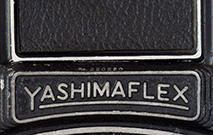
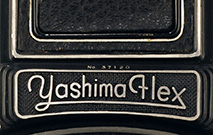
(Right image courtesy of Tom Heckhaus)
However, the change of nameplate occurred very early in that model's life and I think that it is clear that the name on these initial three models was two separate words at the time they were current - up to a point, which I will come to in a moment. One could argue backwards and forwards about the script used and whether a break is intended or not – a few sites have the split form including the NSW State Library in regard to an image taken in 1954. Japanese websites use both single and two word forms of all the Yashicaflex models. These are Yashima Flex and Yashica Flex model B boxes:
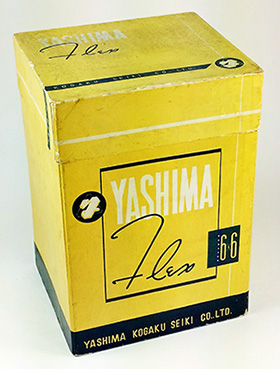
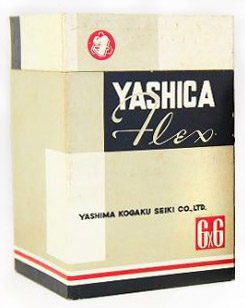
(Left image courtesy of Chris Whelan, right is detail from larger web image)
This Yashica Flex S, one of the first in my database with Copal shutter, still has the short strap holders i.e., the first body type. It is probably from the end of 1954, or at the latest, the beginning of 1955. Here is it its box and features/instruction sheet which speak for themselves.
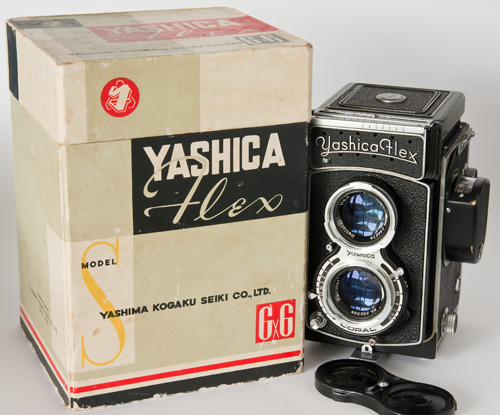
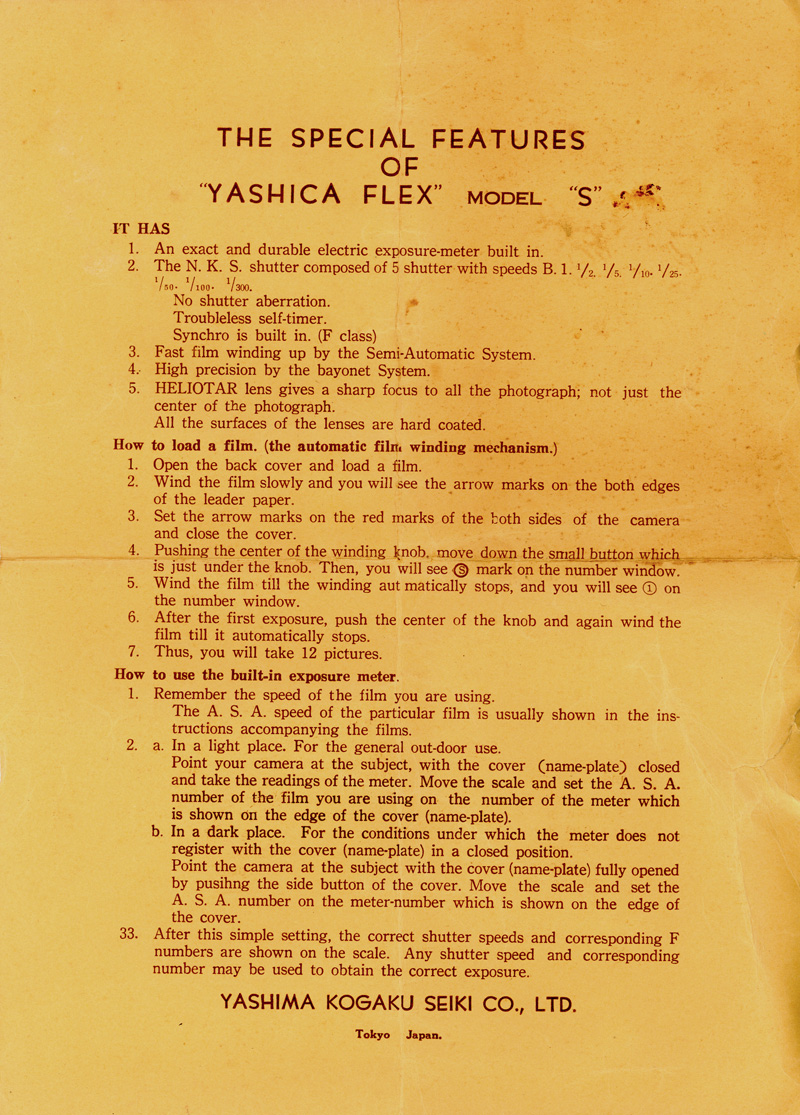
(Click on Features sheet for full size view)
Just after the change to the new body type, the box changed to match its new contemporaries.
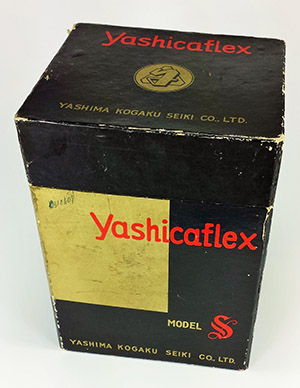 (Image courtesy of Chris Whelan)
From the Yashicaflex A series onward, including the Yashicaflex A-I, A-II and AS-II (AS-I remains unseen), the name on the nameplate, “Yashicaflex”, is clearly one word. However, even Yashima was in a quandary. A complete Yashicaflex A-I kit included this box with single word form and the manual (covers both A-I and A-II models) which jumps between two word and single word forms:
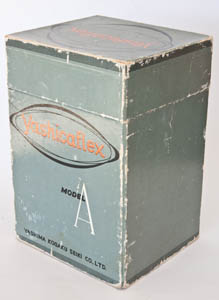

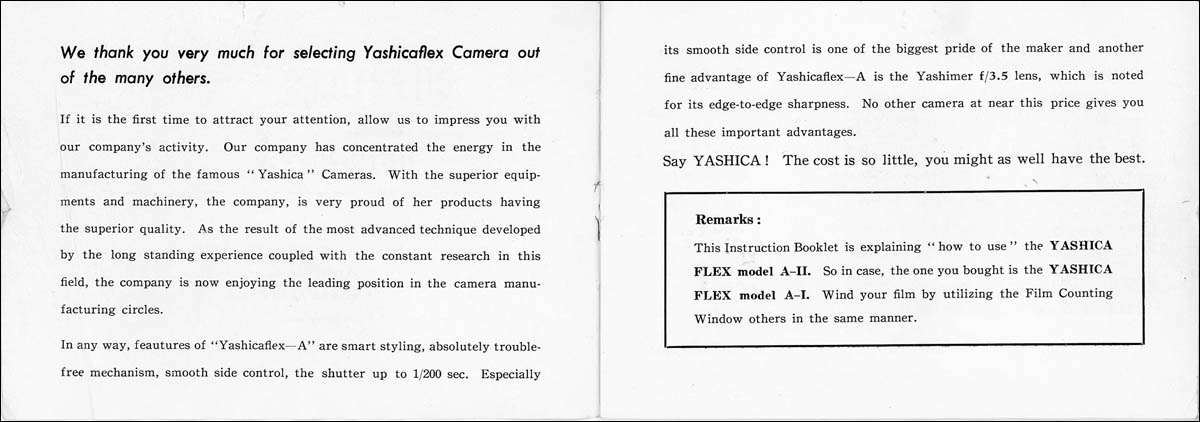
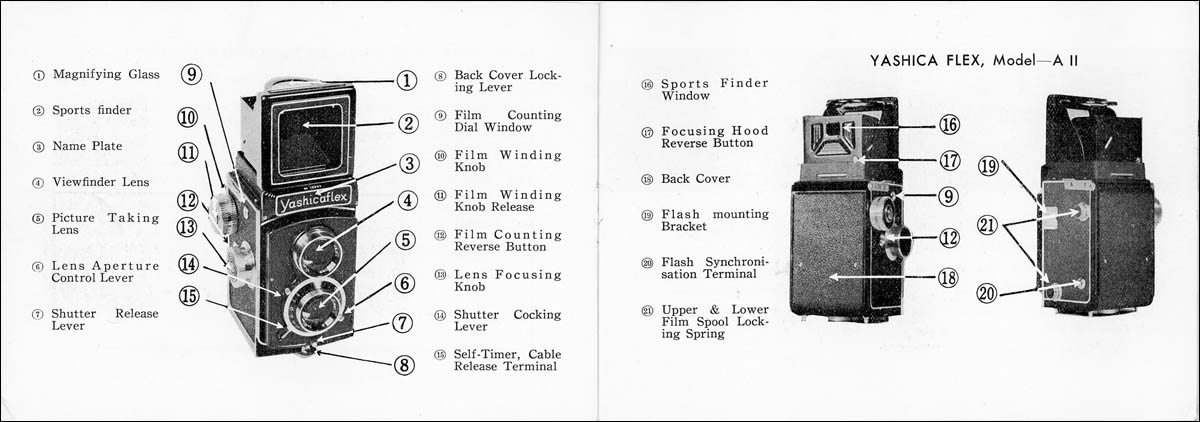
(Click on manual pages for larger view)
The following ad is for the Yashima Flex and Yashica Flex S in the December 1954 edition of Swedish photography magazine Nordisk Tidskrift för Fotografi (the Yashima Flex and Yashica Flex S together is strange, the Yashima Flex is thought to be from an earlier period):
.jpg)
(Document image courtesy of Göran Årelind, also appears in Yashica and 66 Models pages)
(Click on ad for larger image)
By the March 1955 edition of Swedish magazine Foto, importer Molander & son was using the single word form of “Yashicaflex S” and “Yashicaflex B”:

(Document image courtesy of Göran Årelind, also appears in Yashica and 66 Models pages)
The Yashica Flex model S nameplate hadn't changed but clearly, Yashima had created a marketing dilemma for itself with two forms of the name.
Regardless of the nameplate style, I suspect that in common usage, the two word form changed to single word form for all models at, or just after, the time of the Yashicaflex A-I/A-II release in late 1954. On this website, I am going to use the two word form of “Yashima Flex” when referring to the model generally or the later version in particular and “Yashimaflex” when specifically referring to the first type. The model that came after will be simply “Yashica Flex model B”, or if I am lazy, “Yashica Flex B ”. Although the Swedish ad of 1955 above referred to “Yashicaflex B”, it was near the end of its model life and probably only a few months after the change in late 1954 at the earliest. On the other hand, the evidence suggests that the “Yashica Flex model S” changed towards the beginning, or in the middle, of its life and therefore, contrary to what I have advocated in the past, I am generally going to use the single word form of “Yashicaflex model S”. However, please note that the two word form of “Yashica Flex model S” is also correct (at least for the earlier examples of this model, possibly all those fitted with NKS-FB shutters) and there are situations where I may prefer to use it, especially for early examples.
“Old Model” and “New Model”
I am generally not going to muck around with “old” as in Yashica Flex B (old model). For me, Yashica Flex B and Yashicaflex B are clear enough differentiators. I assume that the “old/new” nomenclature is collector invention and certainly, both the boxes and a Japanese guarantee certificate for the later camera state “Yashicaflex model B”. Actually, one side of the box has “Yashicaflex model B” and the other, “Yashica model B”. There is no mention of “new” anywhere. However, whilst most of the time, I see no reason to use “old”, I have succumbed and will use “new”.
In 1957, Yashima released three Yashicaflex models (the last) which recycled earlier names without any commonality between the earlier and later models; Yashicaflex AS (earlier models are Yashicaflex AS-I and AS-II but boxes and combined user manuals frequently refer to just Yashicaflex AS), Yashicaflex B (earlier model is Yashica Flex B) and Yashicaflex A (earlier models are Yashicaflex A-I and A-II but boxes and combined user manuals frequently refer to just Yashicaflex A). To make life easier for everyone, I will add “(new model)” so the later camera will become , “Yashicaflex AS (new model)”, “Yashicaflex B (new model)” and “Yashicaflex A (new model)”. However, note that the part in brackets is not part of the official name and don't feel that you have to use those terms. In some places, I have not used “(new model)” for various reasons which may or may not be obvious, e.g., inside other brackets, but context will tell you which version it is.
Note also that “Yashicaflex B (new model)” is in common usage on most sites, “Yashicaflex A (new model)” is used on those few sites that have identified the camera model and “Yashicaflex AS (new model)” is probably only used on this site. I think that can be partly attributed to the fact that Sugiyama didn't identify the earlier AS-I and AS-II models so he didn't have the need to use the term and also, probably because of Sugiyama, a lot of people seem to be unaware of the AS-I and AS-II models, thinking that they are early versions of the Yashica Flex S.
Naming Conventions
I think it is important in terms of historical accuracy to acknowledge Yashima/Yashica practice and reflect that in discussions about the cameras. Sometimes it is difficult because the company was less than consistent in its own usage.
Yashica Flex and Yashicaflex
With Yashicaflexes, the model name was not on the nameplate or anywhere else on the camera, except for the early Yashicaflex C where “Model C” was found inside the camera at the bottom near the film feed chamber (later examples do not have this). The early manuals, ads and a number of boxes I have seen usually refer to, e.g. “Yashicaflex model A-II” (not “AII” as commonly found on the web). Note, initially but very briefly, Yashima used the form, “Yashicaflex Model-A II”. Both forms appear in the Yashicaflex A manual above. In the Yashicaflex AS manual, sometimes the word “model” is dropped. The camera boxes continued to add “model” into the Yashica period but it was dropped from export literature when the Yashica A, C and LM were released in 1956. Later Japanese market Yashicaflexes tend to eschew “model” (see From Pigeonflex to Yashicaflex to Yashica below and Japanese brochures on the Brochures page) but this page from a brochure circa 1958 maintains the earlier convention:
 (Document scan courtesy of Chris Whelan)
For convenience, particularly in tables etc, and with a nod to modern practice, I have often used the shorthand form “Yashicaflex A-II”, but sometimes, I will use the full description for early models because it seems more appropriate and is a reminder of what is correct. Sometimes Yashima used lower case for the “m” in model and sometimes upper case. You will probably find both on this site because sometimes I will be copying from a Yashima document and sometimes I will be simply confused.
Also, Yashima seemed to use “Yashicaflex A” and “Yashicaflex AS” in the generic sense when referring to models A-I and A-II and models AS-I and AS-II respectively (see “Yashicaflex A Series”). I will try to stick to using the specific model names.
The Yashicaflex A2 is difficult. Japanese brochures from the period call it both “Yashicaflex A-2” and “Yashica A-2”, the boxes say “A2” and now an example has surfaced with guarantee document with machine printed “A2” and another document, which may be a brochure, with “Yashica A2” on the cover. Seems like an each way bet as to which is correct. I have adopted “A2”.

Yashica
Yashica names on nameplates usually use the hyphen between the name and the model, e.g. “Yashica-635”, although the “Yashica LM” is an exception. In manuals and ads however, for most models Yashica invariably does not use the hyphen between the name and model and that includes the crank wind Yashica 24 and 12. Both the Yashica E nameplate and user manual cover use “Yashica-E” but inside in the text, there is no hyphen. However, this is one model where in brochures, Yashica does sometimes use “Yashica-E”. For consistency and ease, I won't use the hyphen for Yashica names, including the E, and will stay with e.g. “Yashica A”.
Note that “Yashica” boxes until around 1965 still use the Yashicaflex convention of e.g. “Yashica model A”.
Yashica-Mat and Yashica Mat-XXX
Yashica Mat varieties are confusing. The original meterless model was written as “Yashica-Mat” on both the camera and in some later literature. Originally, it was going to be released as “Yashicamat” and appears that way on the camera nameplate on the first user manual cover, the printed name on the covers of early user manuals generally as well as inside text, on early boxes and in early ads. However, all early Japanese ads, brochures and the user manual clearly separate the name into “Yashica” as the camera and “Mat” as the model. There are also quite a few later English language examples where Yashica calls it “Yashica Mat” without the hyphen. When the Yashica Mat-LM was introduced, it was still written as “Yashica-Mat” on the camera and an early ad has “Yashica-Mat LM”. However, an early brochure printed in Japan has “Yashica Mat-LM” and a later one from around 1964 (it includes the Yashica E) advertises the two Mats as “Yashica-Mat” and “Yashica Mat-LM”, a convention that seems to apply to all subsequent metered Mats (EM, 124 and 124G - the 24 and 12 are as for “Yashica”). Whilst there are some options, I will use “Yashica-Mat” and “Yashica Mat-LM”, “Yashica Mat-EM”, “Yashica Mat-124” and ”Yashica Mat-124G” etc.
Yashica 44 Series
Text inside the original 44’s English language user manual uses “Yashica-44” which is what I initially decided to go with too for that model. However, common use is without the hyphen and then I discovered that Yashica documents in Japanese also don't use the hyphen. Inside the 44A and 44LM manuals is “Yashica 44A” and “Yashica 44LM”. I have recanted and on this site, I am now consistent with “Yashica 44”, “Yashica 44A” and “Yashica 44LM”.
Special Nameplate & Other Marks
Either of two marks, or possibly both, are sometimes found on the top edge of some Yashica TLR nameplates (or alternatively for the <EP>mark, inside the accessory shoe or other places). Neither is restricted to only Yashica cameras. There are also marks of a different type found on some ever ready cases.
The ® Mark
A long time ago, Leigh Harris convinced me that these were worth tracking and he was correct. The ® mark is the international Registered Trademark sign indicating that some aspect/s of the camera, usually name and/or logo, has/have been officially registered in a country and is/are protected from use by others by law. This is a Yashica 44A nameplate:
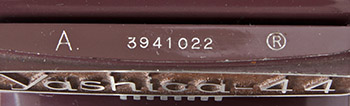
On 66 models, it is usually on the extreme left. It first appeared in 1956 or 1957 and disappeared in early 1960 (near the beginning of 6 digit numbers beginning with “6”). The marks appeared on most examples of a model, but not necessarily all, within the period but not on all models. The Yashicaflex models from this period, the A (new model), AS (new model) and B (new model), do not seem to have them. Although both the Yashica A and C (as well as the 635, B, D and Yashica-Mat) have the marks, I can't find them on the companion Yashica LM. Why should some models have the marks and not others?
My research suggests that cameras intended for the domestic Japanese market usually don't have the marks. That includes both complete model ranges and also individual examples from broadly available models. That takes care of the Yashicaflexes but doesn't explain the Yashica LM which seemed to be an export only model intended for the same markets as the Yashica C.
Some collectors record the trade mark sign with the serial number. Whether the ® is there or not doesn't excite me too much but combined with knowing whether a camera has a focusing scale in feet or metres and whether the film speed reminder is in DIN or ASA, it does help to tell us a little more about what market the camera or the model was produced for.
In the order of appearing in my database (66 first, then 44):
Yashica A & Yashica A III
The first three Yashica A examples in my database, 303xx to 304xx, don't have the mark. The next camera, 320xx and all subsequent cameras until, but not including, the last block of six digit numbers beginning with “6” just before “A” prefixed numbers begin, seem to have the mark. It is very relevant to note that until dual focusing scales, all Yashica As either had focusing scales in feet, or if the scales were metres, then the film speed reminder scale was in DIN. Either way, production from this period was destined for export. On the other hand, Yashica A IIIs from the same period have focusing scales in metres and ASA film reminder scales suggesting domestic consumption. Yashica A IIIs do not have the ® mark.
Yashica C
I can't really tell with the really early cameras but by 800xxx, all the nameplates have the mark. The few with metre focusing scales have the 10 flag DIN film speed reminder scales (plus two late ones with dual DIN/ASA scales) so it seems to be an export only model.
Yashica-Mat
The first three cameras, 570xx to 574xx, with focusing scale in metres, and the next cameras up to 628xx with feet focusing scales, don't have the mark yet.
The ® mark commences between camera 628xx and 638xx and like the Yashica A, the mark ceases when six digit numbers beginning with “6” start just before “MT” prefixed numbers begin. However, initially at least, the marks only appeared on nameplates of cameras with focusing scales in feet (the very significant majority). The cameras with focusing scales in metres without the marks were probably intended for the Japanese market. Later cameras before dual scale knobs arrived almost invariably had focusing scales in feet but the one exception in metres also has the ® mark - European export?
Yashica 635
All the cameras up to 6 digit numbers beginning with 6 (just prior to the prefixed number series) appear to have the mark. There are no Yashica 635 examples in my database with metre focusing scales even though the model appears to have been advertised in Japan.
Yashica B
Both cameras with metre and feet focusing scales up
to 6 digit numbers beginning with 6 (just prior to the prefixed number series) appear to have the mark. This model was unlikely to have been sold in Japan which had the same spec Yashicaflex A (new model).
Yashica D
The pattern is similar to other cameras. The
® mark appears on cameras with feet focusing scales up to just before or just after the start of 6 digit numbers beginning with 6 and that is just before prefixed numbers start. No camera in my database with focusing scales in metres has the mark.
Yashica Auto
So far, only found with focusing scales in metres and believed to be a domestic Japanese market model. Yet the two very earliest examples have the ® mark! Perhaps some were destined for Europe? None of the others have the mark (all fit into the period that trade marks were in use).
Yashica Mat-LM
The first camera in my database is the one in the user manual and has serial number 4110043 with the trade mark. Production cameras start with 6 digit numbers beginning with 6. The first, 620xxx, has the ® mark but as with other models, the later 6 digit numbers beginning with 6 no longer have the marks.
Yashica 44
The early grey cameras, just under half the Yashica 44 examples, all have
feet focusing scales and all these seem to have the mark. Meter focusing scales begin with the first coloured examples. Some of the cameras with metre focusing scales also have the mark but ones without it are mainly from Japanese auction sites. Surprisingly, there is also an example with focusing scale in feet without the mark - perhaps the knob could have been changed later or the camera was intended for sale in Japan. The last few cameras have 6 digit numbers beginning with 6 and dual focusing scales. None of these has the trade mark.
Yashica 44A
At first glance, the Yashica 44A
seems to be another export only model but there is evidence, including Sugiyama, that the 44A may have been released in Japan in 1960, some 12 months after the rest of the world. Until dual focusing scales about halfway through my 44A database, all but four cameras have focusing scales in feet. Of the four, three are brown examples found in Sweden and the fourth is black, probably also from Europe. All the examples with feet and metre focusing scales seem to have the ® mark until, as with other models, just before 6 digit serial numbers starting with 6 are introduced.
Yashica 44LM
The Yashica 44LM seems to have been available in all markets. Both cameras with feet and metre focusing scales have the trade mark except for examples without the red window - there is every indication that these are Japan only versions. The first 5 examples with 6 digit number starting with 61 (1960, January) do have the ® mark but subsequent cameras from 620xxx to 660xxx (1960, February onward) don't have it.
The <EP> Mark
Contributor Sandu Baciu has alerted me to the <EP> mark appearing on small numbers of Yashica TLRs. In the mark proper, the letters are in a closed diamond and in later versions from 1960, there is a centred dot between the E and the P (other camera makers featured the dot from the beginning). The mark was applied to cameras and other items sold Japanese tax free, typically through US Military Exchange stores (Army Post Exchange, or PX, Navy Exchange, or NEX, and also Air Force and Marines stores) on military bases in Japan as a way of stopping their sale, or resale, to Japanese citizens. There was an earlier related <CPO> mark as well which seemed to end in late 1949, too early for any of the Yashima made TLRs. Camera-wiki.org has a little background but the introduction year of the <EP> mark and it being phased out from 1955, plus some other things, don't fit with the actual evidence of my research detailed on the Canon rangefinder page of my Leica Copies Japan website.
The practice is believed to have been introduced in 1953 (which fits with my Canon, Nicca and Minolta databases) and to have lasted into the early 1970s. However, there is a more recent Yashica Mat-124G with serial number 7105xxx and original black accessory shoe with the mark (in white). I date that camera from October 1977, it is certainly a fair way into 124G production:
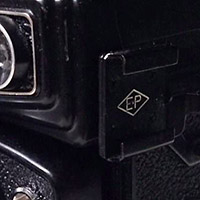 (Detail from larger web image)
I also have photos of a Yashica FX-2 released in 1976 with the mark on both its film wind lever and lens and a Canon FD lens with a 1982 date code so the system probably did last a little longer than some have thought.
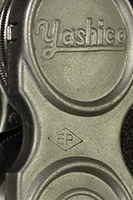
Obviously, only a relatively small number of cameras, either random or in small batches, will receive such marks and who knows which models Yashica wanted to sell through these outlets or which models the outlets wanted to sell? The earliest example that I have seen is on this very late Yashica Flex B lens cap from probably late 1954 or early 1955:
 (Detail from larger web image)
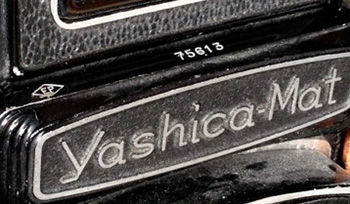
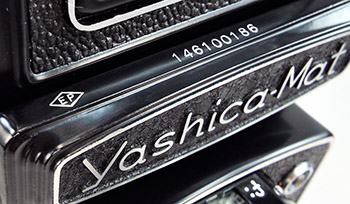
Generally, the favourite location became the accessory shoe, unless the model didn't have one, such as the crank wind models before the Yashica 24. Sandu's Yashica-Mat, which is from 1957, is below left (the serial number seems a little older than the camera, probably caused by pre-stamped nameplates being held until the next PX store order - just a guess) and Chris Whelan's Yashica-Mat from October 1960 is on the right:
(Images courtesy of Sandu Baciu)
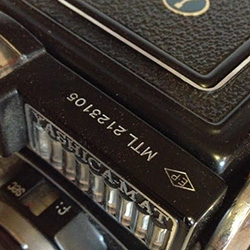
The mark on the left below is on the meter assembly of Sandu's 1962 Yashica Mat-LM and on the right, on the focusing side strap holder of his early production 1964 Yashica Mat-EM which has the serial number on the side instead of the rear of the focusing hood of later examples.
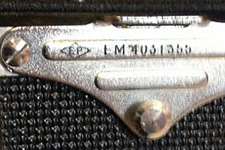
(Images courtesy of Sandu Baciu)
The accessory shoe with the EP mark below belongs to a Yashica 635, camera ST 4050429 from 1964:
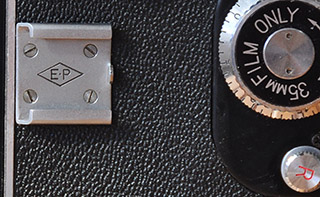 (Image courtesy of Göran Årelind)
The Yashica 635 seems to have most examples in my database with three from between late 1959 and early 1960, nine in the 1961 to 1965 period, two in 1967 and another in1969. Before that, one of the last Yashica LMs from 1958 also has it in the shoe. Sandu has a Yashica 44LM with the mark in the shoe however, Leigh Harris' 1958 Yashica 44 has the mark on the focus knob retainer, presumably because the accessory shoe is the removable type, as does a 1959 Yashica 44A, no doubt because it already has “Japan” in its shoe. Yashica 44 below:
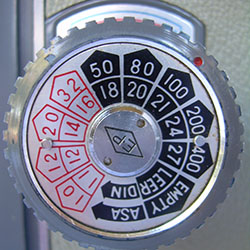 (Image courtesy of Leigh Harris)
Case Marks
Contributor Sandu Baciu has noticed that some ever ready cases have a mark on the bottom. They are mainly found on cases from the mid 1950s to perhaps the early 1960s. Sandu has two Yashica Mat-LM and two Yashica D cases with the marks and I have the TK marks on two Yashica Mat-LM cases and an earlyish Yashicaflex C case.
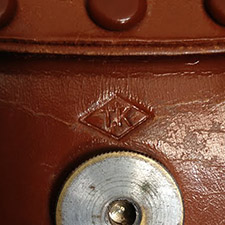
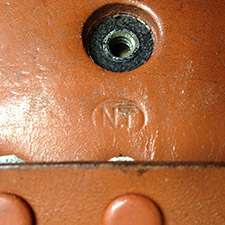
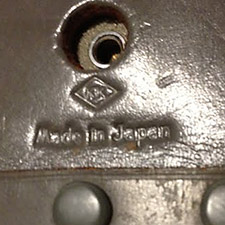
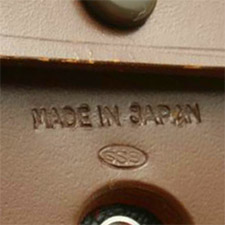
(Images 1 to 3 courtesy of Sandu Baciu, image 4 detail from larger web image)
Left to right, the marks are TK (Yashica Mat-LM), NT (Yashica Mat-LM), KK (Burgundy Yashica D) and what looks like GSS (Yashica A). TK is by far the most commonly found one.
The purpose of the marks is unknown. It's possible, perhaps probable even, that Yashima/Yashica outsourced its ever ready cases. Correspondent Chris Whelan believes that the marks are the trademarks of ever ready case makers and cites the similarity of the marks to trademarks used by Japanese tin toy makers. Its a logical theory that I find appealing but unfortunately, there is no evidence one way or the other. We don't know that Yashima/Yashica definitely outsourced, we don't know if multiple players were involved and we don't know if Yashima/Yashica would have allowed or encouraged suppliers placing trademarks on its finished product. Even if all those things applied, there still may be another reason for the marks that half a century later, we, outside of Japan, can't guess at.
From Pigeonflex to Yashicaflex to Yashica
On the Yashica page, we have already seen how Yashima moved from producing the Pigeonflex for distribution by Endō Sashin Yōhin to itself marketing and distributing a slightly revised version as the Yashima Flex and how this became the Yashica Flex Model B. As noted in the above sections, the name soon changed to the single word form of Yashicaflex. The company set up its New York subsidiary, Yashica Inc., in 1957 and changed its own name to Yashica when it bought Nicca in 1958.
The Change from Yashicaflex to Yashica
I am guessing that like nearly all the other TLR manufacturers, Yashima probably put “flex” at the end of their cameras’ name to try to suggest a connection to Rolleiflex rather than simply a shortening of “reflex”. In either case, the “flex” suffix is almost uniquely associated with TLRs. By 1956, Yashima was getting ready to both export more seriously and move into other formats and products, initially 8 mm movie cameras. Yashima probably wanted to move away from the TLR-centric “Yashicaflex” name to a brand name suitable for all its products, and/or it wanted to distance itself from copying the Rolleis. However, both “Yashicaflex” and “Yashica” named models were released between 1956 and 1958. Why? Both were similar to each other, yet different, as if from a slightly different time period. I am fairly certain that the coexistence of the “Yashicaflex” and “Yashica” names is somehow connected to export issues but how?
Domestic and Export Models
The early models up to very early versions of the Yashica Flex S had metre markings on the focus scale. From late 1954 or more probably, early 1955, some models had scales in feet and some in metres and some had examples of both until dual scale knobs arrived in about 1959. In 1954, the Yashica Flex S introduced film speed reminders (previously, film type) to the film winding knob. These only used the ASA scale until 1956 when a DIN scaled knob began appearing on a small number of cameras with metre focusing scales. Dual DIN/ASA scales replaced the earlier type in 1958.
Initial production was for the domestic market - that doesn't necessarily mean only the Japanese themselves, disposable income was still limited at that stage. The feet focusing scales, introduced in 1954 or 1955, represent sales to almost entirely Americans (the UK still had stringent import restrictions and countries like Australia were insignificant), initially perhaps to US Service personnel stationed in, or transiting, Japan and then increasingly through export. As time went on, the metre focusing scales represent mainly domestic Japanese consumption. Initially, small numbers with ASA scales were exported to Sweden at least but then, from 1956 to 1958, cameras exported to Europe were fitted with the DIN film reminder knob as well as the metre focusing scales. The numbers found are relatively very small indicating that the US was the main export market by far. Also, the cameras found with both the metre and DIN scales together are amongst models that either are otherwise feet scaled or there there is a mix of scales but never with cameras with only metre and ASA scales together, again highlighting that models with predominantly metre and ASA scales together were almost certainly destined for domestic consumption only.
Sugiyama's Feet & Metres
I am also going to enlist Sugiyama’s assistance, noting that his book was aimed primarily at Japanese collectors. Sugiyama ignores the Yashicaflex A-I and AS-II. The Yashicaflex A-I examples in my database are predominantly feet scaled. Only 9 of 32 AS-II examples with readable scales in my database have a metre scale and at least 4 with metre scales have the later DIN scaled film reminders with the others not discernible or from before introduction of the DIN knobs. On the other hand, he does include the Yashicaflex A-II which has over 50% of examples with metre scales. I’m not proposing this as something definitive, merely an indicator of market focus for these models at the time and Sugiyama's priorities.
The first Yashica models were the Rookie and Hi-Mec. The Rookie was basically a late model Yashicaflex A-I with top speed increased from 1/200 to 1/300 and provision added for shooting 6 cm x 4.5 cm images. The Hi-Mec added a new shutter and updated exposure meter to the Yashicaflex S although lens and shutter specs-wise, its later close cousin, the Yashica LM, was more of a Yashicaflex C/Yashica C with meter. In other words, there was nothing very special except the new names. The Rookie was mentioned by Sugiyama, the Hi-Mec not and maybe it never made it into full production. Both have metre scales and are unique amongst “Yashica” models in this regard (except for the later Yashica A III and Auto which belong to the post-Yashicaflex era) and are part of my theory further down. The Yashica A, C and LM and were introduced later in 1956. The Yashica A is a little more complicated but the three generally had feet focusing scales (the A changed later to dual scale). The only Yashica C and LM exceptions had DIN scaled film reminders. Sugiyama ignores the Yashica C and LM completely even though the closely related Yashicaflex C predecessor, which can be found with either scale but predominantly has a metre scale, gets two entries.
His only reference to the Yashica A is as a “Yashica-AIII” (Yashica documentation calls it “Yashica A III”) from 1959. The A III model is a domestic only variant of the Yashica A – there is no hood logo and it has either metre or dual focusing scales (see “66 Models”). There are 11 standard Yashica As with hood logos and metre scales compared to 62 with feet scales in my database before changing to dual scale. Four of the five examples with scales in metres and with the earlier style film speed reminders have the European export 10 flag DIN film speed reminder scales and the fifth is not visible. The balance of the six cameras with metre scales have the later dual DIN/ASA reminder scales and could have been destined for either the domestic market or European export. If all that is confusing, all that I am simply saying is that early production of the Yashica A was for export only.
By trim and feature set, the Yashicaflex A2 came at the same time as the three export Yashicas and the Yashicaflex A (new model) appeared later. These both have metre scales (both are small sample sizes). Both, but particularly the A (new model), are rare in the West but according to Sugiyama, common and Japanese web sites seem to bear that out to some degree at least. In the West, the Yashicaflex AS (new model) and its close relative, the Yashicaflex B (new model), are rare beasts. According to Sugiyama, they are relatively common. They are certainly common on Japanese web and particularly, auction sites, the B more so. No prizes for guessing that they have predominantly metre scales (four Yashicaflex B examples in the database do have feet but their serial numbers are very close and seem like part of a small batch, perhaps for sale to overseas visitors). The Yashica B is another model ignored by Sugiyama. This came in both scales before changing to dual scale but as Japan had the equivalent Yashicaflex A (new model) and quite a few Yashica Bs have turned up in Europe including Sweden, I still think that this was mainly an export model.
The Change from Yashicaflex - My Theory
For any of the reasons noted earlier and in connection with a planned export thrust into the US, in early 1956, Yashima decided to drop the “flex” from “Yashicaflex”. As usual with other releases, the new model(s) would be introduced to the domestic market first. The Yashica Rookie was first. For some reason, the new metered camera and meterless companion (the cameras that became the Yashica LM and C) would not be sold on the domestic market. The pre-production export camera with the meter was initially called “Yashica Hi-Mec” on the nameplate, possibly with the full name of “Yashica Hi-Mec Model S”. Its companion may have been called simply “Yashica Hi-Mec” - why otherwise add “Model S” inside the model with a meter? We know from Yashima advertising that a pre-release preview was given to US dealers in mid-1956 a number of months before the Yashica A, Yashica LM and Yashica C were released to the American public.
My guess is that the original names were not well received (who wants to be branded a novice, even less than competent maybe, and “Hi-Mec”, well the less said, the better). Also determining that the ability to shoot 6 cm x 4.5 cm negatives was not a killer feature and unnecessarily contributed to costs, for the export market, Yashima renamed the “Yashica Rookie” as the “Yashica A” and dropped the ability to shoot dual format. The other two cameras were renamed “Yashica LM” and “Yashica C”. Even more worryingly, Japanese consumers were not relating to the new “Yashica” brand name the same way that they had embraced “Yashicaflex” and made Yashima successful and perhaps the company was erring on the side of caution after a loss of face with the Americans. After barely more than a year, the Rookie was replaced by the Yashicaflex A (new model), a name reincarnated from the past.
The box below belongs to the second last Rookie in my database, although it is the same as several others. Note that it says “Yashicaflex” on the side. My thought is that whilst Japanese consumers were confronted with the “Yashica” nameplate, they were comforted with the “Yashicaflex” on the box (the reverse applied to the next cameras). Note that under the Rookie name is “For Jr.”, presumably meaning “For Junior”. This is strange and perhaps an artefact of the planned US release. Text on boxes for Yashima's cameras only planned for domestic sale were all still in English but for the majority of Japanese consumers, the words had little meaning. Why add “For Jr.” which was probably unfathomable?
.jpg) (Image courtesy of Sandu Baciu)
(Image courtesy of Sandu Baciu)
The guarantee document, mainly in Japanese, identifies the model as the “Yashicaflex model R”, again emphasising that the word “Rookie” perhaps had no meaning for Japanese customers.

It is possible that leveraging the success of the “Yashicaflex” brand name for the domestic market was planned from the outset - that may be why the Rookie got the “Yashica” nameplate whilst the box still drew attention to the Yashicaflex heritage. However, for some reason, the strategy appeared to be reversed for the next releases which returned “Yashicaflex” to the nameplate and instead used “Yashica” for advertising and other marketing. In any case, future domestic models for the next two years would retain the “Yashicaflex” nameplate and the “Yashica” nameplate would be reserved for export versions, effectively duplicating some models. Additionally, the domestic versions would draw their names from earlier successes and also make links in other ways even though the models were worlds apart in specification and functionality.
At the same time that the Yashica A, C and LM were released internationally in late 1956, the Yashicaflex A2 was released domestically. There is no export counterpart. Its name is sometimes written as “Yashicaflex A-2”. Is it coincidence that the name is not dissimilar to the “Yashicaflex A-II”, a very successful model in Japan? Boxes exhibit both “Yashica A2” and “Yashicaflex A2” on different sides and advertising brochures refer to “Yashica A-2” but the nameplate of the camera in the picture has “Yashicaflex”:
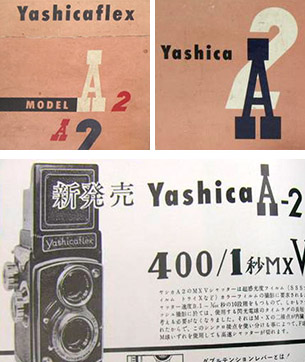 (Detail from larger web images - also appears in “66 Models”)
In the two instances that I have seen the confusingly named Yashicaflex AS (because of the earlier AS-I and AS-II models) with its Japanese language user manual, the name on the cover of the manual is “Yashica Model AS” whilst on its box it is “Yashicaflex Model AS”.
.jpg) (Detail from larger web image - also appears in “66 Models”)
(Detail from larger web image - also appears in “66 Models”)
It is now certain that the “Yashicaflex Model AS” box was used for both the AS (new model) and earlier AS-II (see here). Its nameplate is identical to a late Yashicaflex A-I or A-II (as was the Yashicaflex A2 nameplate) even though the earlier Yashica Rookie, A and C and Yashica-Mat had the new Yashica oval style which would also appear on the later Yashicaflex B (new model) and even the earlier Yashicaflex C had a full oval surround on the nameplate. The ever-ready cases for the Yashicaflex AS (new model) and A2 look identical to the earlier Yashicaflex A-II and A-I cases respectively (a style which had been superceded by Yashicaflex C and Yashica Rookie, A, C and LM cases and the new Yashica-Mat style had already been released). An attempt to emphasise the connection to earlier Yashicaflex models? The name of the Yashicaflex AS (new model) successor, the Yashicaflex B (new model) also recycled the name of an earlier, successful model as did the Yashicaflex A (new model).
Yashicaflex B (new model) box:
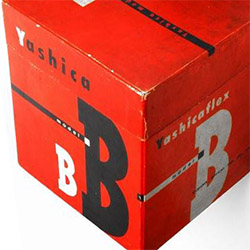 (Detail from larger web image)
One side it has “Yashicaflex”, the other has nothing but the lid has “Yashica” on that side. As noted in Lens Caps, Cases & Boxes, the box for the later lower spec export Yashica B is quite different colour scheme wise.
Contributor Leigh Harris has provided scans from a Japanese Yashica brochure (I now have the same brochure). Be warned, these will meddle with your mind. The camera with the Yashicaflex nameplate that I have identified as the Yashicaflex A (new model) is displayed with the title “Yashica A”. That probably explains why the Japanese market version of the Yashica A that we, outside of Japan, are familiar with, is called the Yashica A III. And what I think is the Yashicaflex A (new model) that the Japanese advertise as the Yashica A was sold outside of Japan as the Yashica B. The Yashicaflex A (new model), Yashica A and Yashica A III share the same box.

(Document image provided courtesy Leigh Harris)
Next, there is the Yashicaflex B (new model) already noted for its box with dual names. As on the box, it is advertised as a Yashica B although it would be completely familiar to us if it was called a Yashica D instead.

(Document image provided courtesy Leigh Harris)
Given the confusing clash of names, it is absolutely 100% certain that the above cameras with Yashicaflex nameplates were never meant to be sold in the same markets as those with Yashica A and Yashica B nameplates (even though the Japanese Yashica A III has “Yashica A” on its nameplate!). It is less certain, but nevertheless highly probable, that whilst Yashima was giving Japanese consumers the familiar Yashicaflex nameplate, it was trying to introduce the new name “Yashica” by association with the older, successful one. At the time, each market was separate and there was little opportunity for confusion. That is not the case today with the internet and on-line auctions crossing every border and Yashima/Yashica's cleverness from 1956 to 1959 probably looks like a mess to our 21st century minds. A modern equivalent is Canon with its Kiss DSLRs in Japan, Rebel equivalents in the US and more conservative names in the rest of the world.
Domestically, the Yashicaflex A (new model) and Yashicaflex B (new model) were released in 1957 and their export equivalents, the Yashica B and Yashica D were released in 1958. There would be no more Yashicaflexes (apart from the intriguing continuation of the Yashicaflex name on Yashica 635 ever-ready cases for some years to come) but by this time, Yashica had changed, or was about to change, its own name and “Yashica” was gaining acceptance as a 35 mm and a home movie camera brand.
Evidence of Sorts
A forum discussion on photo.net in 1999 refers to an ad for the Yashicaflex S and AS models found in a 1955 magazine (presumably US) and there is a March 1956 Popular Photography review of the Yashicaflex S. However, I have copies of a number of US Yashica ads from 1956, 1957 and 1958 and various models are mentioned but no more Yashicaflexes. Also only early models of Yashicaflexes appeared in Swedish ads, i.e., no Yashicaflex C, A2, A (new model), AS (new model) or B (new model). There are no ads found for the Rookie or Hi-Mec in either western market.
.jpg)
Below is part of a page from a 28 page (including covers) Japanese language brochure full of hints and marketing and advertising the Yashicaflex C, Yashicaflex A2 and Yashica Rookie. The publishing date is 15 December 1956 (pages also appear on this site with scenes from the factory floor and in the Yashicaflex A2 section). The page includes an extract from a December US review of the Yashica C including reference to the Yashica LM:
.jpg)

That extract also appears in a very similar 1957 brochure published after the release of the Yashica-Mat and after the change to 80 mm lenses (see Brochures page). If the Yashica C and LM (and the Yashica A before the A III version) were available in Japan, why weren't they advertised in either brochure? They don't appear in any other brochure or ad that I have found either.
Yashicaflex “Inferior”?
Some people view Yashicaflexes and Yashica 6x6 TLR models as different but coexisting generations and I have even seen them referred to as “inferior” and “weaker”. I can see no evidence of anything other than a change in marketing strategy. In the 1956 to 1958 period, some similar models with different names existed at the same time. It was only for a relatively short period. The Yashicaflex cameras were not inferior or technically different to the cameras with new names, they both just represented a point in time in the normal development cycle and in some cases, they had a doppelganger. Apart from nameplate and minor trim, I can’t see any difference between the Yashicaflex B (new model) and Yashica D or Yashicaflex A (new model) and Yashica B.