Yashica 44 Series
(44, 44A & 44LM – see also “44 Models”)
Contents
(Scroll down or click on links.)
The Models and the Origins
Yashica 44 Production Timetable
The Models and the Origins
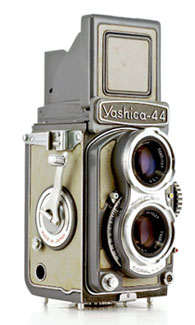
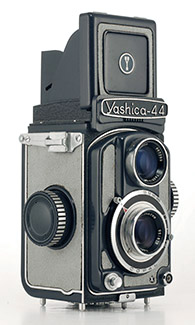
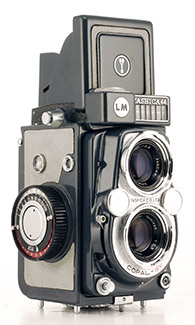
(Images Courtesy of Tom Heckhaus)
There were three, perhaps four Yashica 44 models: the Yashica 44 characterised by crank wind and Bay 1 filter mounts but without the self-cocking shutter or other sophistication of its Mat big brother; the simpler Yashica 44A, like the Yashica A but with knob wind and plain filter mounts, and the Yashica 44LM with selenium exposure meter, Bay 1 mounts and a knob wind which had more in common with the crank operation on the Yashica 44 than the knob on the 44A. The Yashica 44 was available with metalwork in eight colours, the other two in a more limited livery. There is also the photograph of the mythical Yashica 44 Auto in Sugiyama's book (similar to the 44LM but with f/2.8 lens and crank wind).
In September 1957, Franke & Heidecke reintroduced a completely new version of their pre-war 127 film baby 4x4 Rolleiflex as the commonly referred to “Baby Rollei”. Until 1963, it was available only in an instantly recognisable light grey colour (from the RolleiClub, site seems to be defunct). This was the camera that started the short-lived 127 film “super-slide” boom. Super-slides use the same size slide mounts, 2” x 2”, and hence projectors, as 35 mm slides but are considerably larger in image area, approx. 38 mm x 38 mm compared to approx. 34 mm x 23 mm. The format was initially proposed by an employee of US Rollei distributer, Burleigh Brooks Inc.
A number of Japanese companies producing TLRs responded almost immediately. According to Camera-wiki.org, first to be announced in magazines were the Yashica 44 and Topcon Primo-Jr (badged and marketed as the Sawyer’s Mark IV in the US) in May 1958 (see Shashin Kōgyō cover) but also according to Camera-wiki.org, as the Primo-Jr was advertised in the same month and the Yashica 44 not until July, the Primo-Jr was first to market. This conclusion contradicts views expressed on some other sites including the Camera-wiki.org entry for the Yashica 44 which claims that it was the first Japanese 4x4.
Models were also released by Minolta (Miniflex), Ricoh (Super 44, Ricohmatic 44), Tougodo (Toyoca, Kino, Halma, Laqon, Tower, Prinz 44s) and Walz (Automat 44). The Yashica 44 was a pretty and solidly built camera but as always, it was built with price and the mass market in mind. That is why it is relatively common compared to the others, some of which included f/2.8 lenses, shutter cocking linked to film wind and innovation as with the Ricohmatic and Minolta Miniflex. Except for the greenish blue of the Miniflex, the others were either black models, grey models or available in either black or grey. The availability of different colours is what makes the Yashica 44 unique.
There is conflicting data about release dates and periods of overlap of the three Yashica 44 Models. It is quite clear from both their serial numbers and advertising that both the 44A and 44LM were released by the middle of 1959 (see “Yashica 44 Production Timetable” below).
There is relative consensus that the Yashica 44 was a short-lived model. Apart from the litigation issues noted in the following paragraph, it was also relatively expensive for its rather limited feature set compared to both its bigger siblings and peers from other manufacturers. Serial numbers suggest 1965 end dates for both the 44A and 44LM and this is supported by three separate Yashica ads where both cameras are displayed together with the Yashica E released in 1964 and one of the ads claims to be from 1965.
The original Yashica 44 had a crank wind (but unlike the Baby Rollei knob wind, the crank was not linked to the shutter) and at first, was only available in light grey. The visual similarities to the Baby Rollei were remarkable and Franke & Heidecke and their main US distributer (not for the 11 western states), Burleigh Brooks, Inc., decided to take Yashica to court. There are references on several Japanese sites but little detail. According to a 1997 post on the Rollei User Group forum, issue Number 1 of Volume 1 of the trade journal, Camera News of West Germany, noted that after litigation lasting 12 months, Yashica promised to make the camera in colours other than grey. A later, related post claims that prior to settlement of the case, Yashica had marketed the camera as the “Yashica Baby Gray” and afterwards were forced to use its official name, “Yashica 44” (I haven't seen any such adds but I have seen “adds a baby” and “new baby”). The Japanese Wikipedia Yashica entry confirms the litigation and adds that the 1959 settlement was signed by the presidents of the two companies in the Sheraton Hotel, Philadelphia, USA.
Of the 127 Yashica 44s in my database, the first 57 are light grey. Whilst the proportion of different coloured cameras (seven colour combinations were listed in a 1958 ad in Asahi Camera magazine and also in a 1958 Japanese Yashica brochure but an eighth metalwork colour, black, is also found) increases from that point on, light grey ones seemed still to be produced right up to the end of the model run which initially appeared to have been mid-1959. That would still fit the litigation settlement but a later batch by both serial number and new trim and including some light grey examples would place those cameras in 1960 (see below and 44 Models page). It is possible that the later light gray examples were not available in the US. The Yashica 44 was superceded by the 44A and 44LM, neither of which offered light grey.
It has to be said that although the litigation undoubtedly took place, the details are a little murky now and have to be taken with a grain of salt. For example, if the light grey colour was such an issue, why weren't the other Japanese makers included in the litigation? Is it possible to sue over colour? And the first of the other seven colours started appearing only a few months after production, not after the 12 months of litigation.
Design Cues
I have already mentioned the apparent similarity of the grey Yashica 44 to the Baby Rollei. The similarity is most striking from the front whilst the sides and back are more conventionally Yashica 66 model inspired (in other words, originally Rolleicord inspired):
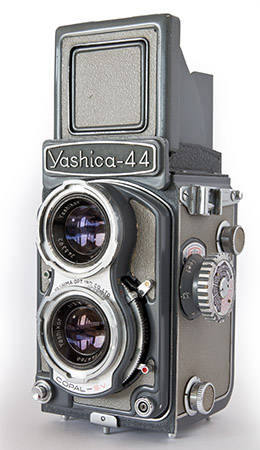
However, whilst there is no doubt that Yashica was seeking to cash in on the interest in the Baby Rollei with an economy version, to put the situation into perspective, neither the specs nor design details could be called “copies”, the issue was more a marketing “ambiance” with colour being a key element. In reality, the design, features and target market were probably more different than when comparing most 1960s rangefinders, SLRs or even 21st century DSLRs.
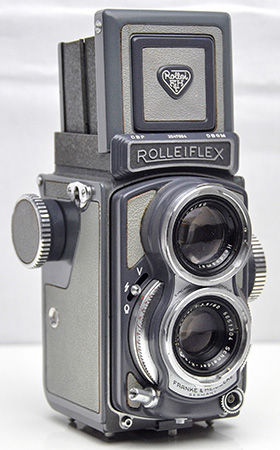
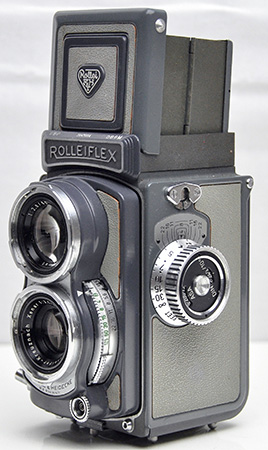
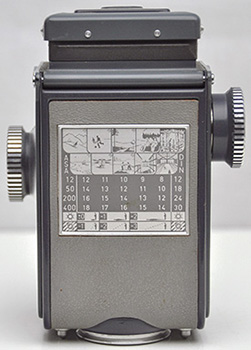
(Images courtesy of Göran Årelind)
The Yashica 44LM is considered by some to be the ugly duckling with its meter and more angular design but look more closely and ignore the front. It is the carcass of this later model that has been inspired by the Baby Rollei.
.jpg)
.jpg)
It is knob wind, albeit the knob is in a different physical location but look more closely and you will notice the similar style angular inlaid leatherette panels in the slab metal sides. In a change for Yashica, both cameras have the camera back inset between the sides rather than closing over them and instead of combined strap holders and hinge plates, both use strap posts attached to the body sides (the Rollei's are removable but the impression is the same). Neither has spool knobs and even the DoF scale is similar (Rollei curved, Yashica flat). After the battle of the colours, is this an example of simply more copying, or is it Yashica upping the ante with control wheels and exposure meter and thumbing its nose at Franke & Heidecke?
Yashica 44 Production Timetable
Contemplating both my database, and Swedish and Dutch ads which have turned up, I think it is possible to be fairly precise about the production timetables of the three commonly found models (not the 44 Auto which remains a mystery).
The Yashica 44 was released between May (announcement) and July1958 (advertisement). Japanese magazine Shashin Kōgyō (meaning Photographic Industry) No. 91 of November 1959 has the Yashica 44LM as its cover photo (Camera-wiki.org). Based on advertising, trim and 1959 serial numbers, series production seemed to cease by July 1959 by which time both the 44A and 44LM had most probably been released. However, as noted above and detailed in Late Examples on the 44 Models page, there are six cameras in my database which by both later trim and serial number places them at, or between, May and September 1960.
Based on advertising and serial numbers, I believe that the Yashica 44LM lasted until the second half of 1965 (it appears in a brochure with the Yashica 24 and without the 44A) and that the 44A probably ceased earlier in 1965. Both cameras had appeared with the new Yashica E which was probably in 1964.
Based on trim and other indicators, my initial belief had been that the 44A was released a little before the 44LM in 1959. If I am correct about serial number date codes, series production of the 44A began in April 1959, the 44LM in the user manual was produced in March 1959 (probably part of a pre-production batch) and series production commenced in June 1959. Release dates can be different to production commencing.
I have copies of 1958 and 1959 US ads with just the Yashica 44 and several 1959 ads with the Yashica 44A. A Sears catalogue from an unknown year lists both the Yashica 44 and Yashica 44A as does the Popular Photography Equipment Directory 1960 with the Yashica 44LM in neither (lead times have to be allowed for publications). I have found one 1960 ad for the 44LM. Later ads and catalogues usually have the 44A and 44LM together. The 1961 Sears catalogue refers to the “Baby Yashica 44A” and “new Yashica 44LM”. Below is an extract from a Yashica US brochure which seems to cover most Yashica products including all TLRs on sale in the US in 1959 except for the Yashica 44LM and the Yashica Mat-LM which some sources claim was released in September 1959 but I think was early 1960:

European ads strongly imply that the introduction of the 44A and 44LM models occurred earlier and more quickly than what may be interpreted from US advertising.
Here is an ad featuring the Yashica 44 from the June 1959 edition of Swedish magazine Foto:

(Document image and dates courtesy of Göran Årelind)
Here is an ad from the July 1959 edition of the same magazine:

(Document image and dates courtesy of Göran Årelind)
These ads confirm that both the Yashica 44A and 44LM were available in the middle of 1959. Together, they suggest that there was a very sudden end to the Yashica 44 model and that perhaps the 44A and 44LM were released at, or near, the same time. This seems to be in keeping with the evidence from serial numbers.
The Dutch ad below is from page 277 of “het tweede fotoboek” by Dick Boer, published also in the northern summer of 1959 by Focus N.V., Haarlem. The text at the bottom of the ad translates to “Yes, your camera's name is Yashica”. It seems that in Holland at least, all three models were available simultaneously, even if only briefly.

(Document image and information courtesy of Norman Beierle)
Note that the Models 44 and 44A are named back to front (type-setting error probably).
An anomaly is this brochure from Japan. It features all three 44 models but whereas I previously thought that the brochure was from 1959, it is a later version of a brochure that could only have been released in the second half of 1959 which only features the Yashica 44. There is a code on the back of this brochure that suggests 1960 and that seems to be consistent with similar codes where they appear. This would fit with Sugiyama's claim of a 1960 release for the Yashica 44A (but only in Japan) and may go some way to explaining the apparent 1960 start up of Yashica 44 production after production seems to have ceased, i.e. Yashica 44 production seems to have finished in about September 1959 (by both serial numbers and trim) and then restarted, with updated trim, for about 5 months commencing in about May 1960 - it may have remained on sale but stockpiles carried it through for the intervening 7 months or so:
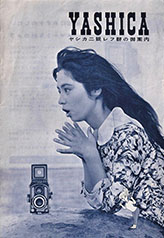 (Brochure scan courtesy of Chris Whelan)
(Click on cover to view full brochure as PDF)
There is a Japanese 44LM brochure with a code on the back that suggests 1959. Together with the Japanese advertising mentioned above and Sugiyama's confirmation, a 1959 Japanese release is almost 100% certain.
Confirming the evidence of US ads, a Yashica 44A with serial number 3981xxx, which looks like an August production code, has surfaced at auction with its original Yashica US “Certificate of Guarantee” dated 17 December 1959. Its serial number puts it at more than 1/3 of the way into my 44A database so an early 1959 release date is quite plausible. However, US reference to the 44LM in 1959 is still eluding me. Tom Heckhaus has pointed out that the litigation in the US by Rollei (Franke & Heidecke/ Burleigh Brooks) could possibly have had an impact on US availability and release dates. He is not saying that it did, but it is something to keep in mind.