Yashica the Company - Success & Failure
Contents
(Scroll down or click on links)
The Japanese Photographic Industry 1952 - 1953
A Language Observation
The Japanese TLR
The Yashica Story as Told by Yashica
The Beginning & Corporate Success According to Yashica
Yashica Tells a Different Story
The Company - Putting the Pieces Together
The TLR Company
Movies & the Zunow Connection (Yashica 8)
Yashica 35 Fixed Lens Rangefinder Camera (Yashica 35)
The Nicca Era (Yashica YE & YF)
Pentamatic SLR & the Move to M42 (Pentamatic)
Zunow Acquisition?
Polaroid
Other Models, Success and the Carl Zeiss Connection
Disaster & Ultimately, Failure
Volleyball Parallels Yashica's Fortunes
1st Factory, Suwa, Nagano Prefecture (until 1956)
2nd Factory, Shimosuwa, Nagano Prefecture (from 1956 to 1972)
3rd Factory, Okaya, Nagano Prefecture (from 1972 to Kyocera times)
Sagamihara Factory, Kanagawa Prefecture (unknown beginning to 1974)
Head Office, Tokyo (from August 1974, or maybe earlier)
Other Sites
Lake Suwa Factories Today
1956 Booklet
1957 Review of the Japanese Photographic Industry
Late 1950s, Beginning of 1960s Factory Operations
Hong Kong Production
Brazil Production
Marketing Campaigns
“Yashicaflex Photography” and Other Japanese Marketing Initiatives
The Cowboys are Coming!
The Yashica Sailor Boy
The Japanese Photographic Industry 1952 - 1953
Between the two World Wars, Japan had developed a photographic industry but it was still feeling its way, still a long way from being a player on the world stage. As an example, because of scale, or the lack of it, and raw materials costs, Japanese lenses were often more expensive than the more highly regarded German optics.
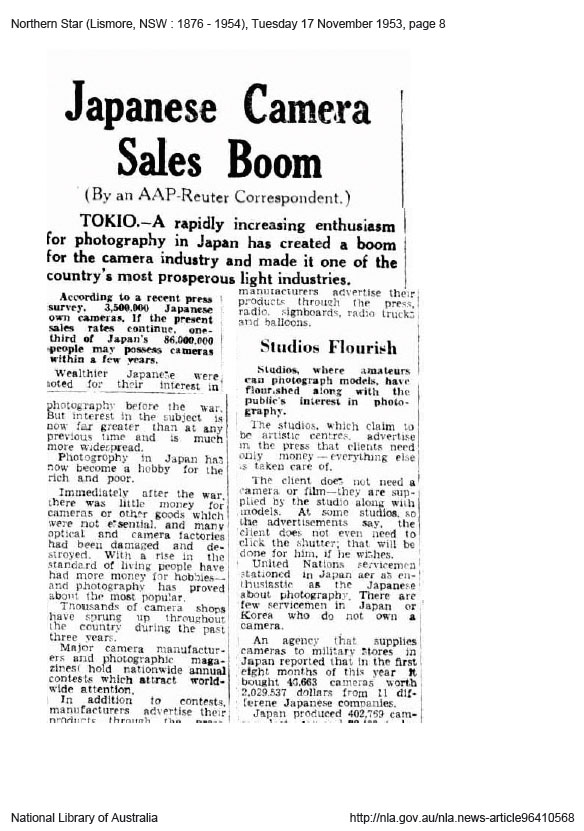
The second World War left much of the Japanese photographic industry destroyed or damaged. However, things changed quite quickly. Whereas before the War, photography had been the past-time of the wealthy and well to do, post-War, it was adopted by the masses. By early 1952, Japan was again an independent nation but the Korean War was in full swing. A snapshot of the Japanese love of photography and the impact of United Nations service personnel (the great majority being US servicemen) is provided in an article, “Japanese Camera Sales Boom” by an unknown AAP-Reuter correspondent, which appeared in the small New South Wales country town of Lismore newspaper, The Northern Star, on 17 November 1953:
(Article displayed in accordance with National Library of Australia policies)
(Click on article for full size PDF of both pages)
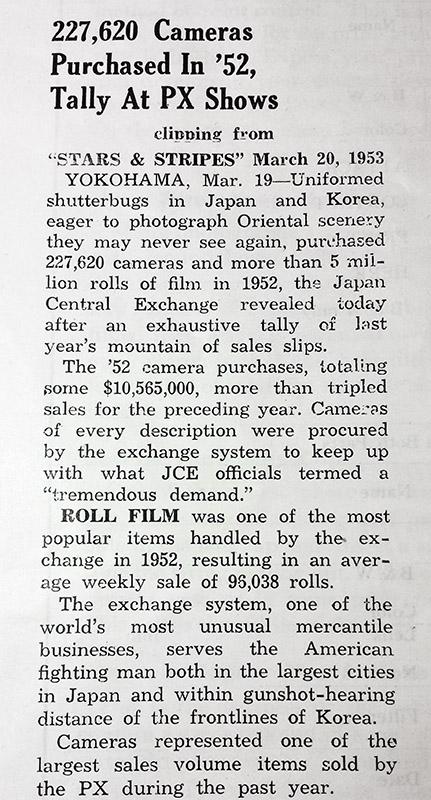
Clearly, at the time of writing, camera production was booming and export markets were already being developed by existing manufacturers. To put the Japanese photographic industry into perspective, quoting from the article, Japan produced 402,769 cameras in 1952 of which 72,483 were sold to United Nations forces. Whilst representing approximately 18% of production, it is likely that United Nations personnel would have been buyers of the more sophisticated and expensive models (some of the data in the article regarding monetary value does not compute for me). Also, I assume that the 18% represents “official” outlets like the US Army PX stores. In fact the article below puts forward quite a different set of figures. The scan is from the April 1954 first edition of “Orient Photography” and the article initially appeared in the 20 March 1953 edition of “Stars & Stripes”:
 (Scan courtesy of Chris Whelan)
(Click on article for larger image)
Whilst the first article quotes 72,483 Japanese cameras sold in 1952 to United Nations forces (in Japan only?), the second quotes 227,620 cameras sold through US PX stores in 1952 in both Japan and Korea. Presumably, Kodak and other US makers are well represented and PX stores may have carried European cameras as well. Both figures could be right but measuring different things, or one set might be wildly inaccurate. Regardless, we can accept that photography was very popular for both the Japanese population and overseas service personnel.
A Language Observation
Up to the end of the 1950s and probably beyond, there were few English speakers in Japan. Even today, the percentage of English speakers remains relatively low. In his book, “TLR Compendium”, Australian journalist and author Andrew Fildes notes that he is not aware of any Japanese camera, from at least the 1930s onward, that uses Japanese characters for its name and/or lenses and/or shutter, even those intended only for the Japanese domestic market. His question “why” remains unanswered but it does make life a little easier for linguistically challenged researchers.
In my experience, that applies to Yashima/Yashica products as well. It extends to all text found on the camera itself and most of the text on boxes, including boxes for domestic only models. One exception is the Yashicaflex C box which on one side of the lid has a large red rectangle with white Japanese characters “ヤシカフレックス” (“Yashicaflex”). This is in addition to the English name. On the other hand, early Japanese market brochures and user manuals use mainly Japanese characters - an early circa 1954 Yashica Flex brochure for models B and S only has the “B” and “S” in English as well as the shutter name “NKS-FB” and “B” for Bulb. By the release of the 1957 Japanese market Yashicaflex AS (new model), the user manual cover has the name in English. Contemporary brochures continue with Japanese characters with only model descriptors in English, e.g. “A-2”, but by 1958, the camera names, e.g. “Yashica” and “Yashica-Mat”, are in English too.
The Japanese TLR
Pre-War, 35 mm cameras were uncommon in Japan. There was the Leica inspired Canon with interchangeable lens, focal plane shutter and rangefinder. Also some odd side by side 35 mm TLRs produced by prolific post-War 6x6 TLR maker Tougodo. Post-War, the current Olympus website claims that the Olympus 35 I released in 1948 was “the first 35mm camera sold in the Japanese market.” What does that mean? The first without interchangeable lenses, focal plane shutter, rangefinder or a TLR viewing system. In other words, the first with fixed lens and between the lens leaf shutter, the basis of the modern 35 mm compact camera (Sugiyama says that even that is not quite correct). Much like the Pigeon 35 in fact. After that, the momentum started building fairly quickly. The main reasons for the initial slow take up were the quality of film emulsions, the need to enlarge whereas many people made do with contact prints from the larger formats and quality 35 mm cameras were more complex and expensive yet with potentially inferior results to their rivals.
Although the number of TLR models exploded post-War, pre-War there were up to 20, and maybe more. However, copies of German folding cameras seemed to have the larger share of the market, mainly in 6x4.5 cm format (half of the 6x9 cm format), known as “Semi” models in Japan, but also 6x6 cm. Of course, there were also fixed focus box cameras etc.
Why did Japan produce so many TLR models after the War? Obviously, the demand must have been there, probably helped by value for money considerations. Like the folders, the 6x6 TLRs used the larger 120 film. TLRs were represented by the German “hero models” of Rolleiflex and Rolleicord from Franke and Heidecke whilst the folders were “copies of”, “inspired by” or “adopted the features of” a range of European models by makers such as Zeiss, Balda and Welta. In other words, the folders represented greater variety, less standardisation and hence less opportunity for shared componentry. With TLRs, it was relatively easy for small firms with no previous photographic industry experience but with some technical skills to buy in parts from larger suppliers and simply assemble them into a working camera. Lenses and shutters are the two most obvious and complex components bought in but there is also evidence of common die-cast aluminium bodies and shared focusing hood components, camera backs and other parts. Design was easy – most TLR designers didn’t stray far from the early Rollei and in that early post-War period, pre-War German patents had no currency. Perhaps this type of production was even encouraged as part of the demilitarisation process.
One Japanese website lists 85 separate TLR brand names but there are probably more - some claim “hundreds”. As impressive as that sounds, according to Camera-wiki.org, the camera maker Tougodo, as well as producing the “Hobiflex”, used at least 21 of those names for its “Toyocaflex” TLR (mainly to give distributors their own brand)! Taiyoda and the company that became Topcon also used a number of brand names. And to put all that into perspective, there is a list of something like 135 brand names of pre-War and post-War Japanese Semi models (many from very small makers with no surviving examples).
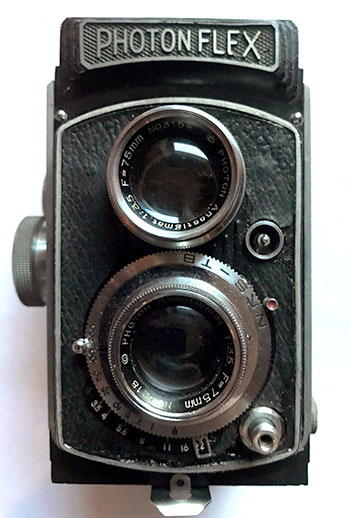
Most TLR names ended in “flex” and whilst I have come across some unusual ones like “Dorisflex”, “Elbow Flex” and “Merica Flex”, here is an obscure new name to me “Photon Flex” collected by contributor Sandu Baciu (perhaps related to the also little known Superflex):
 (Image courtesy of Sandu Baciu)
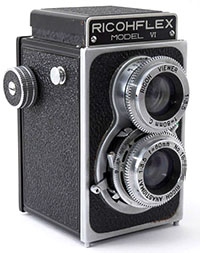
At one end of the spectrum of “real” TLR models (with matched, focusing viewing lens as opposed to the simple non-focusing viewfinders of cheap “pseudo” TLRs) were the pressed metal Richoflex models with geared lenses which owed more to the post-War Kodak Reflex interpretation of a TLR than any direct link to Franke & Heidecke:
 (Detail from larger web image)
(Note, not to be confused with the later die-cast Ricohflex Dia which evolved into the Ricoh Diacord, some versions with just “Ricohflex” on the nameplate.)
Nevertheless, quality shutters and respectable lenses featured and helped to popularise the TLR in the consumer end of the market. Many consider that it was the Richoflex that ignited the TLR explosion. There were quite a few Richoflex imitators too. From the top end of the market to just above the Richoflex and its clones were the models that, by and large and except for minor trim and lens and shutter specs, looked like either the Rolleicord, the Rolleiflex or something in between, the exceptions being the market top end cameras, the Fujicaflex, the later Mamiya C series and perhaps the Kowa made Kalloflex which all merely took inspiration from the German duo. From a distance, the similarities are remarkable, close up and in detail it is fairly obvious that some examples were better built, and hence more expensive, than others. Unlike the Rolleis, many featured film advance by red window and Bay 1 lens mounts were even rarer. Price was also somewhat reflected in their operational feel. However, the biggest quality and price differentiators were the lenses and shutters.
As an example, in August 1952, Olympus produced its first TLR. Although of undoubted quality and specs, it was more clone than “inspired by”. With control wheels, it looked like a cross between the 1958 Yashica D and trim wise, the Rolleiflex Automat. It also featured the Rolleiflex type viewfinder with a drop down mirror to allow horizontal eye level viewing through a lens in the back of the hood. Both viewing and taking lenses were f/2.8, the taking lens an F.Zuiko six element type. Impressive. As was the price, 52,000 yen. Compare this to the 14,800 yen of the first Yashima camera in 1953. Despite lowering the specs and removing features in subsequent models, the last Olympus TLR was released in June 1956.
The 1954 Fujicaflex was the only model produced. It was in a class of its own, the Rolls Royce of Japanese TLRs. The Art Deco flourishes and some novel design, including the combined film winding/focusing knob, at least differentiating it from the ubiquitous Rollei look-a-likes. It cost 65,000 yen whilst at the same time the Yashicaflex A-II cost just 9,500 yen. Contributor Chris Whelan has just acquired one and thought it would be fun to compare it to a Yashicaflex Model S representing the typical Japanese copy of the Rollei size and style TLR. This Model S is a later example but was also initially released in 1954 and cost 20,000 yen, less than 1/3 the price, whilst featuring the first built-in selenium cell exposure meter fitted to any Japanese camera and to the best of my knowledge, the first 120 format TLR in the world so equipped. The Yashicaflex C was basically the same camera without meter and cost 11,500 yen in 1955.
Helped by the pair of f/2.8 lenses (taking lens 5 elements in 3 groups), Fuji super-sized the camera which, according to Chris, weighs 1.323 kg with film whilst the Model S weighs 1.117 kg with film:
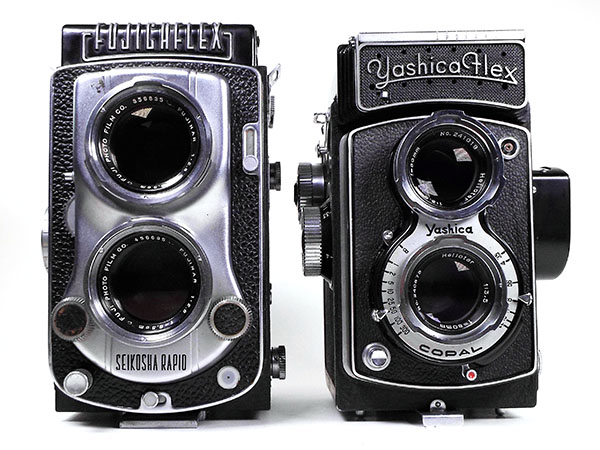
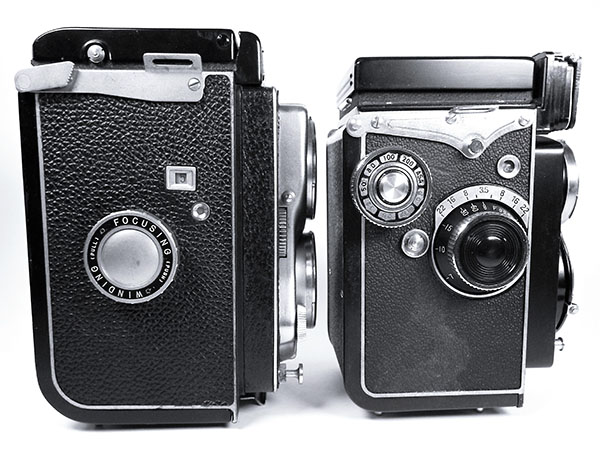
(Images courtesy of Chris Whelan)
Clearly, the Japanese appetite for TLRs didn't extend to expensive domestic models. As suggested earlier, the TLR's sales success was based on good image quality, easy contact printing for many and affordable prices in the post-War economy. Camera makers who thought that the market could and importantly, would, pay more for superior specs and features didn't find enough buyers and most abandoned that end of the the market relatively quickly and that's not just Fuji and Olympus. The exceptions were the Mamiya C series which offered unique features for the professional sphere and perhaps the Minolta Autocord, a slightly upmarket competitor for the Yashica-Mat.
The Yashica Story
The rise of Yashica is a fascinating story, amongst all the post-War camera maker startups, it was the only one to succeed long term and then became one of the major photographic companies in Japan. Only to be the first of the major companies to come crashing down, the seeds sowed by corporate greed and skulduggery in the early 1970s. It would make great reading but whilst we have a synopsis, no one has stepped up to write the detail.
The Beginning & Corporate Success According to Yashica
The following article appeared in the English language The Free Singapore Express, 24 November 1960, page 14. It is republished with the kind permission of Singapore Press Holdings Limited. I also want to thank contributor Chris Whelan for bringing it to my notice and retyping the article for me:
YASHICA - A DECADE AND IT'S AT THE TOP
The Yashica Company, within less than a decade, has risen to become in terms of production and sales the largest manufacturer of cameras and exporter of photographic products in Japan.
The driving force behind Yashica's amazing climb to this position is its president, 37-year-old Yoshimasa Ushiyama.
Mr. Ushiyama and his younger brother, Jisaburo, started things rolling when they established their factory at Suwa in 1946.
They expanded into watch parts and optical instruments and incorporated the business in 1949 as the Yashima Precision Machinery Company. Shortly after Mr. Ushiyama theorised that mass-produced, low-cost, high quality cameras would effectively break through the luxury barrier and take advantage of the deep, widespread popular interest, actual and potential, in photography.
Large Sales
The success of the early Yashica reflex cameras led to the company's decision to concentrate on the camera field. The large volume sales were the result of competitive low prices which in turn came from efficient mass production.
At the time when the top monthly production of rival companies was 500 cameras, Yashica was turning out 3,000 to 5,000 a month. The firm's cameras quickly moved to the top among some 40 competing brands.
The company's many firsts include the Yashicaflex A, and the Yashicaflex S, introduced in April 1955, which was the world's first reflex to incorporate an exposure meter.
Yashica still maintains its leadership in the twin-lens reflex field. Its cameras of this type still outsell all other brands combined in Japan. Yashica reflexes accounted for 68.8 per cent of all Japanese cameras of this type exported in 1959.
Note: Most sources claim that the Yashicaflex S was released in 1954. It appeared on the cover of Japanese magazine Photo Art (as translated), number 69 of August 1954 and independent corroboration comes from a December 1954 Swedish ad and a photograph of the camera taken in Australia in October 1954 (photograph and supporting evidence held by the State Library of NSW, Australia - see Yashicaflex S).
A portion of a slightly earlier article in English (unattributed as far as I know) is included in the Japanese language Yashica A III user manual published 5 April 1959:
 (Document image courtesy of Chris Whelan)
The text, including missing parts of words, is as follows (some I have only been able to guess at and some I just don't know):
The Yashica Story
The Yashica Company, within less than a decade, has risen to become in terms of production and sales the largest manufacturer of cameras and exporter of photographic products in Japan. The rapid progress of the company can generally be credited to the concentration of its research, design, engineering and production resources to satisfying one very important person - the customer.
Yashica's main offices in Tokyo have (quite?) possibly the only board room in (Japan, or, the world?) with colored charts showing by (age?), sex, occupation and other classifications what the customers for the (various?) Yashica cameras are like. In (an, or, the camera?) industry which has in the past (....?) stuck to traditions of limited production, high prices, passive methods of merchandising, and research along (classic?) lines, Yashica's policies of volume production, popular prices, up-to-........
........ with the development of precision industry in the area in which Yashica has played a major role, has earned for it the name of Japan's Switzerland.
The Ushiyama brothers, who (had?) considerable experience in ma(king?) valves and military precision instruments during the war, began turning out communications components and electrical testers (and?) meters. They expanded into w(atch?) parts and optical instruments(. They?) incorporated the business in 1949.......
Note: The first sentence of each article is the same. I would not be surprised if Yashica had some input into the stories. The claim that by 1959, Yashica was “the largest manufacturer of cameras and exporter of photographic products in Japan” has taken me somewhat by surprise. The obvious question is, “by what measure?” So far I have not been able to confirm the veracity of the claim. Also, the reference to the unnamed area as Japan's Switzerland is to the Lake Suwa region of Nagano Prefecture and the War-time employment was with valve maker Kitazawa (see The Factories below).
Yashica Tells a Different Story
When Yashica started direct selling in the USA in March 1975, New York subsidiary, Yashica Inc., sent dealers a 12 page glossy booklet, “Yashica, A New Horizon”, about the company and its history with a covering letter from its local president Kenji Sakuma dated February 25, 1975. These are the relevant two pages:
.jpg) (Scan courtesy of Chris Whelan)
(Scan courtesy of Chris Whelan)
It is a US marketing department product and either drew on suspect information already out there in the wild, or it became a source for some that appeared later.
There are embarrassing errors such as the company's June 1953 name change is incorrectly reported as being to “Yashima Optical Industry Company, Ltd.” (that change occurred in 1956 and was “Industries” rather than “Industry”). The 1953 change was to “Yashima Optical Precision Instruments Co., Ltd.” (Yashima Kōgaku Seiki Co., Ltd.). The release of the Pigeonflex is linked to the name change and June 1953 but that seems to forget about the approximately 2,000 (from serial numbers) examples with the earlier “Yashima Seiki Co., Ltd.” maker name on the nameplate (Camera-wiki.org says advertised from March 1953). There are other significant issues too.
Nevertheless, it does usefully provide confirmation of some details and dates which appear in other sources, details of new overseas offices etc and a straw man to test other claims against. It is best viewed as an additional resource that shouldn't take precedence over other evidence based conclusions. The timeline is reproduced below together with my comments (in brackets) highlighting any conflicts or items of note:
Historic Highlights at Yashica
December, 1949
A small company manufacturing component parts for electric clocks was established at Suwa Lakeside City in Nagano Japan with an initial investment of $566. The company was named Yashima Seiki Co., Ltd and had eight employees. (Note that the “they expanded into watch parts and optical instruments” and “began turning out communications components and electrical testers and meters....expanded into watch parts and optical instruments” of the first two stories has changed to the widely reported “parts for electric clocks”. What to believe? Is this the source for the electric clock stories? Also, the 1946 to 1949 period seems to have been forgotten.)June, 1953
The company name was changed to Yashima Optical Industry Company. Ltd. and the first Yashica camera, a twin lens reflex, the Pigeon Flex came off the production line. (Note, correct date for name change but wrong name and wrong date for Pigeonflex - see above.)October, 1954
The Yashica Flex-A was introduced. It was the first camera exported by Yashica and made the brand world famous. (Note, there was no actual Yashica Flex-A model, there was the A-I and A-II, the latter called the “A” in Japan. October seems correct but the earlier models, the Yashima Flex, Yashica Flex model B and Yashica Flex model S were all exported to Sweden at least. Although the A-II, as the A, sold in very big numbers in Japan, the A-I and A-II models never seemed to make a big splash on the world stage.)August, 1957
Yashica Inc. established in New York to manage sales and service for the entire United States.September, 1957
The first Yashica movie camera, the 8T-2 was introduced. The first two lens camera ever produced, the low price helped start the amateur movie making boom. (Note, wrong model, should be simply “Yashica 8” which was twin turret and sold with one lens mounted. Updated 8T-2 was released world-wide mid-1958. Details are confirmed in brochures accessible on this site and on the Yashica 8, 8S, 8T & 8T-2 page. As for the claim “first two lens camera ever produced”, I don't know which was the first Japanese camera but the official Canon Camera Museum tells us that its very similar twin turret 8-T movie camera was “marketed” in November 1956. In fact, the Yashica looks surprisingly similar in design to the twin turret Swiss Bolex B8 released in 1953, itself a development of the single lens 1942 Bolex L8. Triple turret 8mm cameras have been around since the 1930s including the budget friendly Kodak Brownie released in 1955.)April, 1958
Yashica 35, the first Yashica rangefinder cameras, 35 mm f/1.9 and f/2.8 were introduced.September, 1958
Company name changed to Yashica Co., Ltd. with employees numbering 1,982.November, 1958
Yashica expands its camera line by producing the Pentamatic, its first SLR and merges with Nicca Camera Co., Ltd. (It is possible, even likely, that the Pentamatic was announced towards the end of 1959, however, it wasn't released until 1960. In a 1985 article, Mikio Awano who wrote the Foreword to Sugiyama's book and whose name appears under the Nicca and YE/YF entries, says Nicca was acquired in May 1958 as does Japanese Wikipedia. Camera-wiki.org says June 1958, attributed to Lewis, Gordon, ed. “The History of the Japanese Camera”. It seems to me that perhaps the USA subsidiary has mixed up the dates.)September, 1959
Yashica International Corporation established to manage expanding overseas branches and agencies.August, 1961
Yashica Europe GmbH established in Hamburg to manage sales and service to Europe.December, 1965
The world's first electronic camera, the Electro 35 was introduced. Over 3 million Electro 35s have been produced during the past 10 years. (By the end of all its iterations some years later, it is claimed that 8 million were made.)May, 1968
Yashica Hong Kong Ltd. established.August, 1968
One of the largest lens manufacturers in Japan, the Tomioka Optical Company was merged into Yashica Co., Ltd. (What it neglects to say is that Tomioka was acquired from Japan Film Machines Co., Ltd., a subsidiary of the J. Osawa Group trading company, which had acquired the previously independent lens maker in 1960. See Tomioka on the Lenses & Shutters page.)December, 1972
Okaya Factory Complex dedicated. (According to UK importer Photax brochure, the factory was put into full production on 15 October 1972. “Dedicated” probably means formal ceremony.)August, 1974
Yashica's modern headquarters completed in Tokyo.December, 1975
Mr Shiro Kaneko, former Nissho-Iwai executive appointed president of Yashica Co., Ltd. (Prelude to Yashica's bankruptcy, see Disaster & Ultimately, Failure below.)March, 1975
Yashica Inc. begins direct distribution in the United States.
The People
The Founding Brothers
Very little is known about the people involved except that, as noted above, the business was started by two brothers, Yoshimasa Ushiyama and younger brother, Jisaburō. Brazilian visa records from 1957 tell us that Yoshimasa was born in Nagano on 18 July 1922 to parents Yasumasa and Takeko Ushiyama. Yoshimasa went on to become president of the company and later, as company chairman, had a key role to play in our story to come. He died on 5 November 2000.
Not much is known about Jisaburō. He is listed as publisher of Yashima's Yashicaflex and Yashica Mat Photography guides until at least the 1 December 1957 reprint of the Yashicaflex B version. In around 1960, he was listed as the company's Managing Director (see further below). According to Camera-wiki.org, he headed up Yashima Kōgaku, a much later and short-lived optical company that was a division of a Yashima company producing OEM audio components. In 1976, Yashima Kōgaku produced an auto exposure, aperture priority M42 screw mount SLR called the Yashima EMC750, also sold as the Osanon Digital 750 and Rony EMC 750. The company went bankrupt in the early 1980s.
The photos below are of Yoshimasa Ushiyama (thanks to Chris Whelan for identifying him in the first place and the document scans):
- From Yashicaflex Photography, Yashicaflex model B edition, 1957
- Almost certainly Yoshimasa Ushiyama on right, could be anybody on the left, perhaps even Jisaburō, Yoshimasa's brother - from Yashicaflex Photography, Yashicaflex model B edition, 1957
- Early 1957 visa document
- From Yashicaflex Photography, Yashica A III edition, 1959
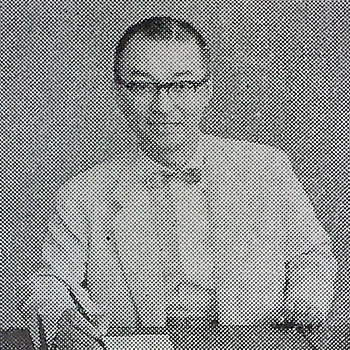
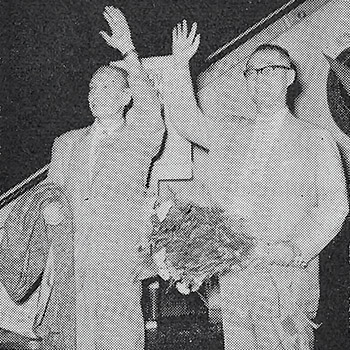
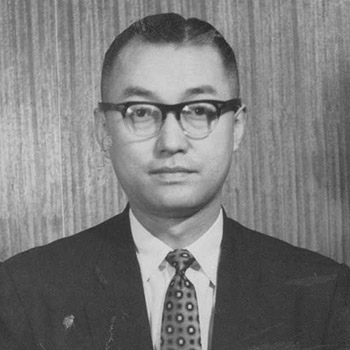
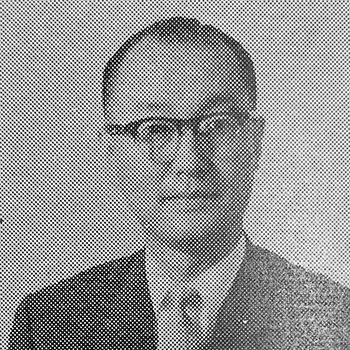
(Photos 1, 2 and 4, document scans courtesy of Chris Whelan)
The two years between the first three photos and the fourth look like they have aged Yoshimasa about 10 years. In that period, there was an incredible expansion of the product line into the 44 models, movie cameras, 35 mm, the Y-16 sub-miniature camera, consumer electronics with transistor radios etc, not to mention the litigation with Franke & Heidecke over the “Baby Grey” 44.
The photos below are from a circa 1960 brochure (cameras include the Pentamatic released in 1960). On the left is younger brother Jisaburō identified as “Managing Director” and on the right, Yoshimasa, identified as “President”.
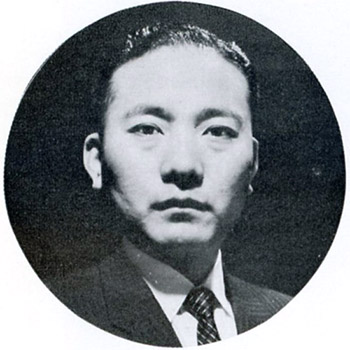
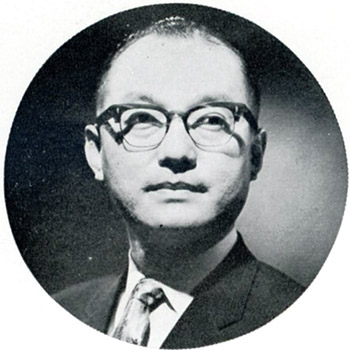
Note: Japanese names are usually written with surnames first. I have followed the European convention based on the first English language article above.
The Factory Team
Tatsuo Sekiguchi, a Japanese man currently living in Sydney, contacted me recently (2024) regarding his father’s Yashica cameras. These date from when he worked at Yashica on the camera production lines. In our exchange of emails, Tatsuo proceeded to tell me about his father, Hirohisa Sekiguchi, and his close friend, Junji (Jun) Nakamura, who were called “brothers” by other workers because they were always next to each other. This was at the Shimosuwa factory in the Nagano prefecture during Yashica’s heyday in the 1950s and 60s. His father worked there for 20 years. Tatsuo himself was born in the city of Okaya, next door to Shimosuwa (or Shimosuwa-machi, meaning Shimosuwa town).
As well as working on the production line together, Hirohisa and Jun had also been part of the Yashica-Mat prototype team.
It seems to have been a good environment to work in and a happy time for Hirohisa. The family photos include scenes from the production line (in there is a photo of “the Yashica-Mat and Rookie being assembled and repaired”) and there was also a Yashica Brass Band in which Tatsuo’s father played the clarinet. The right image shows a group of young workers posing in front of the Japanese and Yashica flags, presumably on top of the Yashica office block on the factory site (see Shimosuwa Factory):

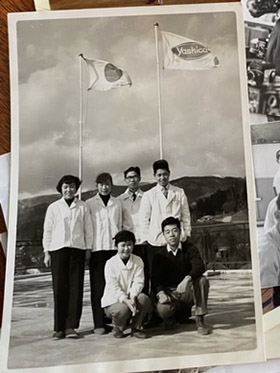
Young men from the factory enjoying socialising outdoors away from the workplace. The smaller key image on the right identifies Hirohisa and Jun, both circled in yellow. They obviously hit it off as friends, both inside and outside of work and in more recent years, even going to age care services together:
.jpg)
.jpg)
Volleyball was very popular in Japan from the 1950s on and a big focus of Yashica’s extracurricular activities was support for both men’s and women’s teams (see Volleyball further below). Jun was a member of the men’s team.
According to Tatsuo, Jun was favoured by the younger founding brother, Executive Director Jisaburo Ushiyama, and was the second Yashica employee to be sent to New York. He arrived there sometime between 1957 and 1960 and became a “fairly well-known repair technician”, eventually managing about four camera repair shops across the United States from the New York City (NYC) base. After Yashica went bankrupt, Jun studied the workings of Nikon, Minolta, Canon and Olympus cameras in addition to his knowledge of Yashica and opened a camera repair shop on 5th Avenue in NYC as a Japanese repairman certified by each manufacturer. The business was later sold to a Korean American man. After losing his Japanese American wife to cancer in Sacramento, California, Jun returned to his hometown, in Shimosuwa in 2000. Tatsuo’s father and Jun would hike and photograph in the Alps in the Nagano region.
By this stage Jun was in his 60s and unable to return permanently to the US for physical reasons but sometime later in 2000, or early 2001, Tatsuo, his father and Jun made a trip together to the west coast of the US. Tatsuo tells the story of when a former Japanese colleague from Yashica died alone in New York in around 2005, Jun went to New York to help with formalities. In Tatsuo’s words, “I felt that he had been very supportive of many of his fellow Yashica expatriates in the United States.” Jun died in 2023.
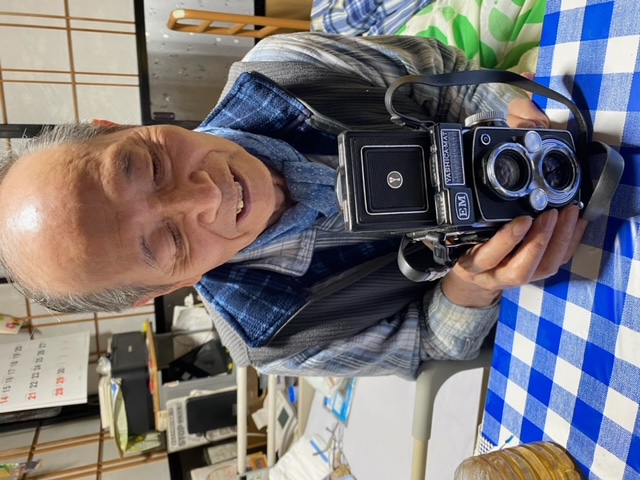
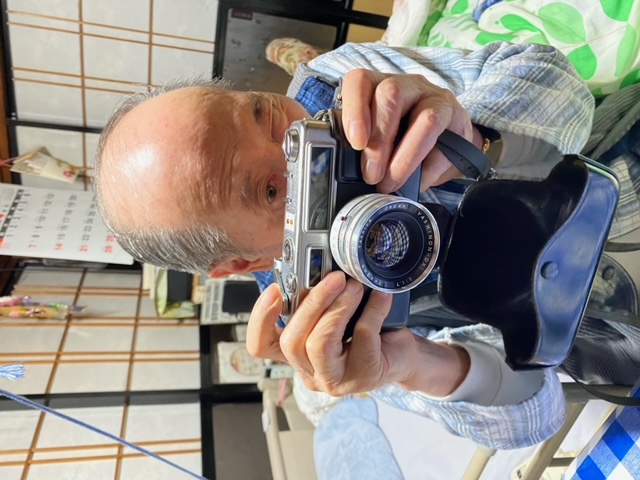
Tatsuo’s father will be 88 this year (2024) and after a couple of strokes, his memory from his time at Yashica has faded considerably but on a recent visit home by Tatsuo, his father was happy to talk about those times and handling his Yashica Mat-EM and other Yashica cameras again bought a tear to his eye:
The Company - Putting the Pieces Together
The TLR Company
The various wikis tell us that the company's origins predate the 1946 factory and the business was a small munitions related fuse making sub-contractor dating from the last months of the War. Camera-wiki.org says that it was founded as Yashima Seiki Seisakusho (Yashima Precision Works) in May 1945. Both the brothers' earlier War-time employment and the sub-contracting work was likely to have been with valve maker Kitazawa Industry Co., Ltd., (there is more on the early links to Kitazawa and munitions in The Factories below). After the War, Yashima is said to have produced parts for electrical equipment and clocks, or parts for electric clocks, depending on which wiki is believed. Yashica's own earlier reported description of “communications components and electrical testers and meters” sounds more plausible along with the expansion into “(watch) parts and optical instruments” but then in 1975, Yashica changed the description of its origins to producing “parts for electric clocks”. The question then arises, was this claim the origin for various sources to cite “parts for electric clocks” or did the US employees of Yashica Inc. use those sources to write their booklet? In 1949, with 8 employees and capital of $566 (presumably US dollars) it incorporated as “Yashima Seiki Co., Ltd.”, (“Yashima Precision Machinery Company” according to The Free Singapore Express article above).
With perhaps “optical instruments” being a tantalising clue, it is still not known why or how but in early 1953 (advertised from March 1953), Yashima Seiki produced its first camera, a basically specified Rolleicord copy TLR utilising 120 film with lenses supplied by Tomioka Optical Company, a relationship that would last until Yashima, by then Yashica, acquired the company in 1968. This was marketed as the Pigeonflex by Endō Kamera-ten (Endō Camera Stores), to become Endō Sashin Yōhin (Endō Photographic Supplies) in June 1953. The Endō company marketed and distributed Pigeon branded photographic products manufactured for it by others. Subsequent versions of the Pigeonflex were manufactured by Shinano Kōki and almost certainly, by others (this site has a page devoted to Pigeonflexes in general - The Pigeon Loft). In June of the same year, Yashima Seiki Co. changed its name to Yashima Kōgaku Seiki Co., Ltd., (Yashima Optical Precision Instruments Company). The change was also reflected in the company name which appeared under “Pigeonflex” on the nameplate.
Later in 1953, it introduced a mildly revised version of the Pigeonflex under its own name as the Yashima Flex and, it is claimed, in a very short time, this changed to Yashica Flex (“Yashi” from Yashima and “ca” from camera, a practice made popular by Leitz with the Leica). Although the various Wikis claim earlier for one and later for the other, in reality, this Yashica Flex, called the model B, and revolutionary Yashica Flex model S with built-in selenium cell exposure meter, were both probably released towards the middle of 1954 (there is ample evidence, see Yashica Flex B and Yashica Flex S, to support this proposition). A succession of Yashicaflex models followed and in 1956, the first “Yashica” named models appeared, although the “Yashicaflex” name would also continue in parallel for the next few years. Also in 1956, the company name was changed to Yashima Kōgaku Kōgyō Co., Ltd. (above company and date information based on Camera-wiki.org and other net sources with similar details). On subsequent boxes and when the name first appeared on the side of the Yashica-Mat, it was in the Anglicised form of Yashima Opt. Ind. Co., Ltd. (Yashima Optical Industries Company, Limited).
In April 1957, Yashima released the Yashica-Mat with crank film advance and control wheels for setting aperture and shutter speeds; effectively, a Rolleiflex clone, at least in appearance and basic operation. The same year in August, it established its first overseas subsidiary, Yashica Inc., in New York and released its first non-TLR camera model, the 8 mm “Yashica 8” movie camera in Japan in September. This was the beginning of diversifying into other key photographic market segments including the all important 35 mm camera types. By the late ‘50s, the TLR boom was well and truly over and the only Japanese company to persevere through to the 1980s with a “traditional” TLR was Yashica. (Mamiya made it to the 1990s with its more sophisticated, interchangeable lens professional models but these are in a different league to the other Rollei inspired copies.)
Movies & the Zunow Connection
As well as being the first non-TLR model, the Yashica 8 movie camera is noteworthy in other ways. Most significantly, the first version was supplied with a Zunow normal lens (13 mm) with Zunow wide angle and telephoto lenses being offered as accessories. This is the first chink in the web claims that Tomioka was Yashica's “exclusive” lens supplier. Then there are the conflicting release dates of both 1957 and Photokina in 1958 and the likelihood that both could be correct. And finally, the lens name “Yashinon” first appeared as “Yasinon”.
Click on the name or brochure scan below to find out more:
Yashica 8
.jpg)
Yashica 35 Fixed Lens Rangefinder Camera
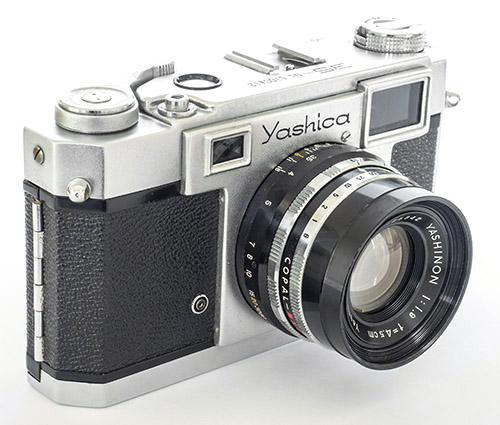
Production of the Yashica 35 “for the masses” seems to have commenced in early 1958 with release in April just before the take over of Nicca was finalised (see below) and development must have been underway for some time previously. It is Yashica's second non-TLR camera, first 35 mm and first fixed lens rangefinder, a path which eventually led to the successful and famous Electro 35 released in 1966. It's already a mature design with sophisticated lens construction in both f/1.9 and f/2.8 versions. As with the Yashica 8, the lens names started as “Yasinon”.
Click on the name or camera for the complete story:
Yashica 35
The Nicca Era
Whether simply a business opportunity, or with an eye to future SLR development, Yashima acquired the financially struggling Leica copy making Nicca Camera in 1958. A number of sources, including Mikio Awano (contributor to Sugiyama's book) writing in “Camera Collectors' News” of May 1985, say May 1958. Camera-wiki.org says June 1958, attributed to Lewis, Gordon, ed. “The History of the Japanese Camera” but problematic booklet “Yashica A New Horizon” discussed earlier suggests November 1958. I doubt November is correct, it is certainly not the release date of the Pentamatic as Yashica also claims.
In any case, Nicca's contribution to development of the Pentamatic SLR was acknowledged in a 1960 Pentamatic brochure (centre of centre panel). Many western websites claim that Nicca actually went bankrupt. The longer Japanese story is that to avoid any delay, Yashima bought the company before bankruptcy was declared and that Nicca became the wholly owned subsidiary, Taiho Optical Co., before finally being fully absorbed into Yashica 8 years later in 1966 (some sources, including Camera-wiki.org, say 1968 but Japanese Wikipedia and other Japanese sources, including Yashica's Japanese Pentamatic brochure linked to above, are quite explicit regarding the length of time and end date; 8 years and 1966). The lengthy merger period was said to be due to religious influences on company president Yoshimasa Ushiyama and a belief that merging immediately would not have been fortuitous for Yashica.
A naming legacy of that period is a pair of fairly rare f/2.8 13.5 cm and f/2.8 3.5 cm lenses marked both “Nicca Lens” and “Taiho Optical Co.” which have turned up very occasionally on auction sites. These are actually the companion accessory lenses for the Wards SLR 500 and 600 cameras (mix of Yashica J series parts) and were advertised in the Montgomery Ward 1965 Spring Summer Catalog. The pair is very unlikely to have been made by Nicca/Taiho or Yashica with the branding used on bought in lenses to avoid an obvious Yashica connection (the Wards standard lens is a Yashinon rebranded with the lens maker's “Tominon” name).
On 1 September 1958 (Japanese Camera Collectors’ News, November 1999, September also confirmed by Yashica's 1975 booklet), Yashima changed its own corporate name to one based on its product name, Yashica Co., Ltd. The changeover from Yashima Optical Industries to the new name on cameras with maker name, such as the Yashica-Mat, Yashica 35 and Yashica 8 movie camera, was completed during the same month - September 1958 is the only month in which either maker name can be found on cameras.
Note, contrary to some suggestions I have seen, the “Yashica” model name had been around since early 1956 and as “Yashica Flex”/“Yashicaflex” since 1954. As already noted, in 1957, Yashima established its New York subsidiary, “Yashica Inc.”, preempting what was coming. It did not arise out of TLR maker Yashima and 35 mm camera maker Nicca coming together, as also noted earlier, it was created from Yashima and camera. Also, many references, including Yashica itself, talk about “merger”, which in a technical sense it was, but make no mistake, by 1958 Yashima was already a very significant company and in reality, it bought a relatively small firm about to enter bankruptcy, regardless of how the management and ownership arrangements were structured for the next 8 years.
Some sources claim that the slightly radical Nicca III-L variant was released in June 1958, i.e. possibly after the Yashica acquisition. The evidence presents some mixed messages about this but it certainly confirms that Yashica continued to market the III-L until at least near the Yashica YF release. More on that on the Yashica YE & YF page of leica-copies-japan.com. The fate of the Nicca Type 33 is unknown - it appears in no Yashica related advertising or documentation and the only advertising material for it features the address of Nicca's earlier distributor.
Both the Type 33 (in a form more like its predecessor, the Nicca 3-F) and III-L were re-released in 1959 as the mildly revised Yashica YE and YF models respectively (the YE near the beginning with March often quoted, the YF maybe not until July or later). However, the real value of the Nicca acquisition was access to Nicca's focal plane shutter and other 35 mm camera expertise and resources for SLR development. Production of both rangefinder models seem to have ceased later in 1959 already, perhaps in preparation for the coming Pentamatic SLR, but advertised sales certainly continued into the second half of 1960.
As the precursor to Yashica's SLR models and also as another example of Yashica straying from its usual Tomioka lens partner for at least one of the accessory lenses as well as the little known f/2 standard lens option, the impact of the two rangefinders is more significant than just two relatively obscure rebranded Leica copies.
For the complete YE and YF story, click on the name or camera, another link at the destination leads to earlier Nicca history and models:
YE & YF
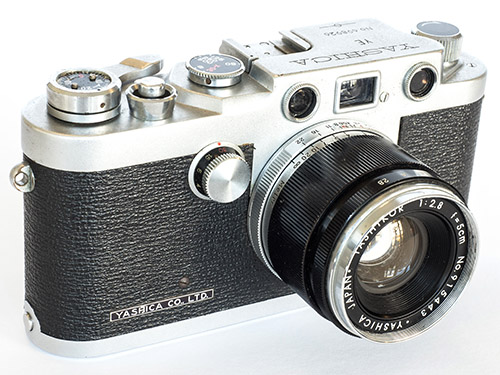
Other milestones in this period were the release of its first 4x4 TLR model, the Yashica 44, in 1958; first 16 mm sub-miniature model, the Y16, in 1959 and the first 35 mm SLR, the Pentamatic, in early 1960. Neither of the last two, whilst competent products, was particularly successful in terms of sales and Yashica went back to the drawing board with both, replacing the proprietary bayonet lens mount Pentamatic with the M42 screw mount Penta J in 1961 and the proprietary cassette Y16 with the Minolta cassette 16EE in 1964.
Pentamatic SLR & the Move to M42
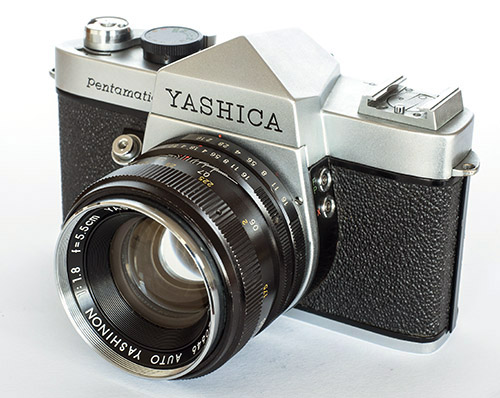
Rather than a story about Yashica's first SLR release in 1960, this is a tale about how a TLR company suddenly wanted to play in every niche in the market and didn't pay enough attention to the most important segment that emerged in the post-War period - the Japanese SLR. The opportunity to become one of the SLR design and market leaders had briefly been almost within grasp but had withered away nearly as quickly. Failure to make an early impact in the booming SLR market and capitalise on that may have contributed to Yashica's future problems more directly than is commonly recognised. Complete with its own unsolved mysteries, it is a story that deserves to be told more fully.
Click name or camera to discover more about Yashica's early SLR efforts:
Pentamatic
Zunow Acquisition?
By the end of the 1950s, lens maker Zunow, famous for its f/1.1 50 mm Leica screw/Contax/Nikon-S mount lens and maker of the “Zunow” 35 mm SLR, the first SLR with fully automatic aperture diaphragm and other features that made the Nikon F look like a copy, found itself in financial difficulties. No doubt that the commercially unsuccessful 1958 SLR had an adverse impact but the collapse was precipitated by the 1960 failure of first Neoca, a customer for Zunow's fixed rangefinder lenses, and secondly Arco, a customer for Zunow's cine lenses.
Yashica was also a confirmed customer of Zunow. As detailed above, the relationship started with the “Zunow” branded lenses of the Yashica 8 movie camera released domestically in 1957. English Wikipedia makes reference to the Pacific Rim Camera site which has examples of “Yashinon-V Zunow” cine lenses found on a Yashica T3 movie camera (“T3” on the camera, “8T3” in advertising). These are the standard lenses for that 1959 model. There may also be a link to one of the YL lenses, an early Lynx 1000 lens and a Pentamatic lens.
Many sites repeat the claim that Yashica acquired Zunow. In fact, Japanese Wikipedia, claims that Zunow went bankrupt and was acquired by Yashica in January 1961. Others, including Camera-wiki.org, have questioned this and suggest that Zunow simply shut its doors. There is also a third possibility, based on first hand experience and one which may stand alone, or also contain elements of the other claims. I have no doubts about its veracity, only I don't know if it is the full story, or part of the story.
In February 2007, Takeo Suzuki, CEO of Ace Optical and son of Zunow's former president, gave an interview (PDF in Japanese) which addressed the broad history of Zunow and what happened. It was given in the context of the ancestry of current day products. Up to the customer collapses and impending bankruptcy, the known facts seem to be consistent with other sources. However, he claims that Zunow had been in the midst of developing a 3x zoom lens for an 8 mm movie camera for customer Elmo and following negotiations, a new company, Ace Optical Co., Ltd., was formed in 1961 in 50-50 partnership. Whatever happened with the planned zoom is not known (presumably delivered) but the main product of Ace Optical seems to have been cine and broadcast wide conversion lenses with examples occasionally found on eBay under the Ace name. There was a very rare “Zunow” branded f/4.5 80-200 mm zoom that surfaced in the 1980s (I have photos in both Canon FD and Pentax K mounts) and there are present day made Zunow branded broadcast conversion lenses and accessories with a web page banner claim “Since 1935”. The present day Zunow brand seems to be owned by Phonon Inc., an audio equipment company incorporated in October 1997 and mentioned at the beginning of the interview.
Back in the early 1960s, whilst a remnant of Zunow operations apparently survived with a new identity, the interview makes it clear that the old Zunow and it's products were a closed chapter. Basically, he says, the camera world had moved on and the opportunities to innovate, like with the signature f/1.1 lens and the automatic aperture SLR camera, were no longer there for a small company.
Although Japanese Wikipedia talks about Zunow going bankrupt resulting in a Yashica acquisition, it does also mention Ace Optical, Phonon and links to the referenced interview (the Wikipedia link is broken, I obtained it from a different site). So rather than anything being clear cut, historically it remains rather murky. Regardless of whether Yashica acquired anything or not, it was unlikely to have gained any great advantage. Lenses which may have had a Zunow connection, coincidentally or not, were killed off at about the time of Zunow's demise.
Polaroid
There was also a commercial arrangement with Polaroid Corporation of the US with Yashica manufacturing the Pathfinder 120 instant camera for international markets outside of the US between 1961 and 1965:
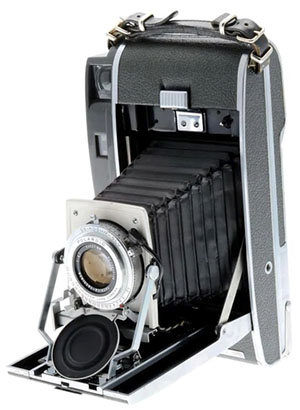 (Detail from larger web image)
The Pathfinder 120 was fitted with a “Yashica-Yashinon” lens in a Seikosha-SLV shutter whereas the equivalent US domestic market Pathfinder 110A was fitted with a Rodenstock lens in a Prontor shutter:
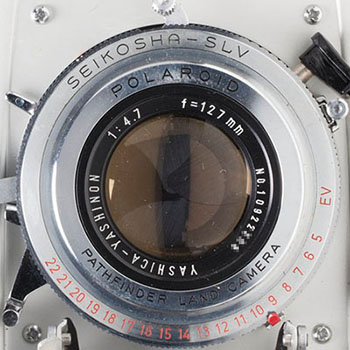 (Detail from larger web image)
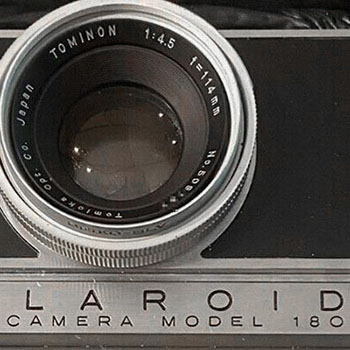
The Pathfinder series used 40 series roll film, were of steel construction and fitted with sharp lenses and a rangefinder. They were considered to be part of Polaroid's more professional range. Between 1962 and 1965, Yashica also manufactured the similar bodied Model 160, which was the international version of the earlier US domestic Model 150 (lens name not marked, only indicator is “Made in Japan”). The 1965 Model 180 featured a Tomioka Tominon lens, the name perhaps either suggesting that there was no direct involvement by Yashica with this model or that Polaroid didn't want to advertise that there was:
 (Detail from larger web image)
Other Models, Success and the Carl Zeiss Connection
1961 saw the release of Yashica's first half-frame camera, the Rapide, a quirky start followed by other unusual offerings such as the Sequelle, and later, the movie camera like Samurai models. In between, there were more main stream models too.
There was a flurry of 35 mm rangefinder releases but it wasn't until 1966 before Yashica found the magic formula with the various fixed lens Electro 35 rangefinder models, claimed to be the world's first electronically controlled camera. Eventually, a very big number were sold. Wikipedia claims 8 million, the source quoted is Ken Rockwell. The Yashica Guy has details and a photo of a gold commemorative camera engraved with 5 million presented to him and goes on to confirm the final 8 million figure.
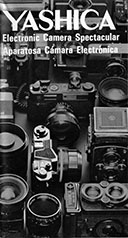
By the early 1970s, there was a complete range of mature and respected photographic products. This brochure features most of Yashica's various camera formats in production in 1973 including the Yashica Mat-124G and the last of the Yashica-Mat production.
 (Click on brochure for full PDF)
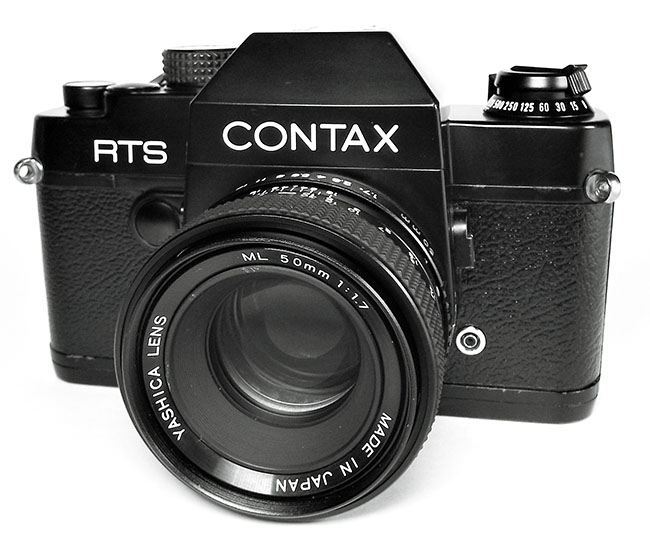
Yashica finally took its place, albeit tentatively, as a large and respected player in the modern Japanese camera industry until under Kyocera ownership, its demise as a camera manufacturer in the digital age (production ceased in 2005 and the “Yashica” brand sold to an unrelated Hong Kong based business in 2007). Along the way, it bought its lens maker, Tomioka, in 1968 and in 1973 developed a relationship with Carl Zeiss in an attempt to re-boot its aspiration to become a leading SLR manufacturer. Yashica licensed the CONTAX name (note capitalisation) for the premium versions of its new electronically controlled 35 mm models released in 1975 (the CONTAX RTS debuted at Photokina in 1974) which signaled a return to a bayonet mount for the SLRs. The first “Yashica” named model was the 1975 FX-1. Below is a CONTAX RTS with a Yashica ML lens typically found on the Yashica FX and FR series:
 (Image courtesy of Chris Whelan)
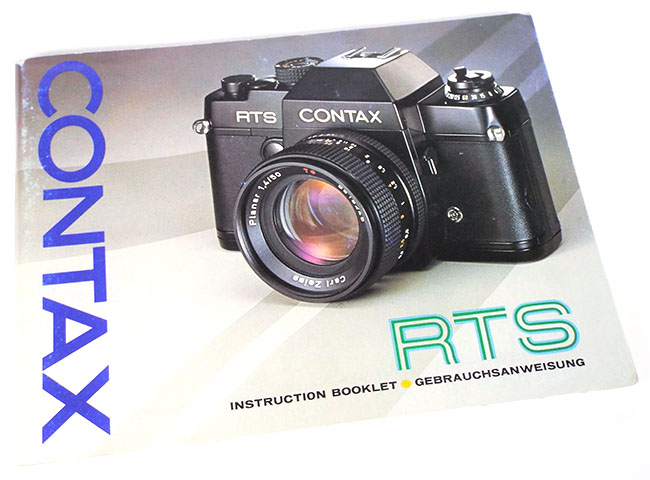
The cover of the CONTAX RTS user manual with matching Carl Zeiss Planar mounted:
 (Image courtesy of Chris Whelan)
Although some of the other post-War start-ups had also produced very good product, they didn’t have the initial business and marketing skills and perhaps luck of Yashica and disappeared quickly from the marketplace along with other older and less agile camera makers - the late 1950s and 1960s was a period of rationalisation and consolidation in the Japanese photographic industry.
A 12 page catalogue by Australian Yashica importer Swift & Bleakley Pty. Ltd. from around 1962 illustrates how quickly Yashica's focus had turned from TLRs which five years earlier had been its only product. The catalogue contains only the Yashica 635 and Yashica Mat-LM plus a Yashica-Mat used to highlight accessories (5 items listed, 3 of which are filters). There are also some 44 series accessories but no cameras. The total space given over to TLRs and their accessories is less than one page. The rest of the catalogue is given over to 35 mm cameras, movie cameras, binoculars and general photographic accessories.
Disaster & Ultimately, Failure
Although the 1983 takeover by Kyocera has been widely reported, one aspect of Yashica's operations not covered in the various English language wikis and many references is Yashica's bankruptcy in 1975 which ultimately led to Kyocera control. According to the Google translation of the Japanese Wikipedia Yashica entry, the company was beset by a “perfect storm” of embezzlement by its accounting manager, over-investment in new plant at Okaya, Nagano, and recession caused by the the 1973-1974 “oil shock”. There is also reference to issues with investment in a television receiver business. Reading from a different source which seems to be related to this entry, I understand that with government urging, Kyocera was involved in the initial 1975 bankruptcy bailout with the merger of Yashica into Kyocera finally occurring in 1983.
An earlier article by Richard Halloran of the New York Times which appeared in a number of regional US papers including the St Petersburg Times of 18 November 1974 and The Ledger of 21 November 1974, starts with:
TOKYO - Yashica, one of Japan's most widely known camera manufacturers, is skirting the edge of disaster because of poor management, troubles in the Japanese camera industry and overall economic pressures here.
The article notes that the problems began four years earlier when Yashica last paid a dividend and a director of the company was charged with having embezzled about $1.8m. Apparently, matters came to a head earlier in 1974 when company founder and previous president, Yoshimasa Ushiyama, now company chairman,
publicly accused Yashica's managers of doctoring financial statements to make the company's position look better than it was.
The company president denied the charges and Yoshimasa Ushiyama was voted out of office. According to a similar article in the Wall Street Journal uncovered by contributor Chris Whelan, the president, Yoshihiro Miyata, was responsible for the effective “sacking” of Yoshimasa Ushiyama. The New York Times article tells us that Yashica was running a deficit and using bank loans to stay afloat. The Nissho-Iwai Trading Company, which handled much of Yashica's trade, was asked by the Ministry of International Trade and Industry to help bail Yashica out. In December 1974, the trading company replaced Mr. Miyata with their own Shiro Kaneko (date and details confirmed in company booklet “Yashica A New Horizon”). I understand that this all occurred before Yashica actually became bankrupt.
The New York Times article goes on to note how Yashica, apart from a failed attempt at branching into desktop calculators, had not diversified into other products in the way that Canon, Minolta, Nikon and Olympus had. I think that is a little harsh - there is some evidence of other attempts, although perhaps half-hearted and certainly not overly successful outside its photographic endeavours. Yashica started from virtually nothing to become a TLR company, then towards the end of the 1950s, it began to reinvent itself as a manufacturer of all types of quality consumer still and movie cameras. That took a great deal of investment and determination. Its US catalogue from around 1959 already includes a Yashica YT-100 transistor radio. An article in the Singapore Free Press of 21 July 1960 notes that Yashica “has also become a household word in the sphere of radios and radio-phonographs.” Ads for these, tape recorders, hearing aids and microscopes (not related to “Yashima”, a different Tokyo company well known for microscopes) appeared in various editions of the paper until at least 1962. There are also “Yashica” branded binoculars and telescopes with one catalogue featuring 13 astronomical telescope models. We also have the evidence of the problems with the television receiver business mentioned above. So, from having expanded its TLR business into a full range of consumer cameras and other optical products, consumer electronics is where Yashica was heading but for one reason or another, it never reached its goal.
Kyocera ownership was not kind to Yashica. Profitability continued to be a problem and Kyocera embarked on many cost-cutting measures at a time when competitors were looking to technology for a competitive edge. As a result, Kyocera/Yashica was late to market with auto-focus SLRs and success largely eluded it (it's a little more complicated than that, initially, Zeiss was reluctant to adopt the light weight construction necessary for auto-focus lenses). After four models, the Yashica name pretty much disappeared.
However, there were some high points under Kyocera control too. The introduction of the excellent, if niche focused, CONTAX G series of electronically controlled, interchangeable lens, 35 mm rangefinder cameras in 1994 is noteworthy. For a last “hurrah” and returning to Yashica's 120 medium format origins, the impressive CONTAX 645 Auto Focus SLR system was released in 1999. Surprisingly, Kyocera's CONTAX N Digital, its first and only 35 mm digital SLR (DSLR), was also the first DSLR with a full-size 35 mm sensor. It was announced in 2000 and released in 2002 before the Canon EOS 1Ds made its debut. Unfortunately, it had some shortcomings and was withdrawn from sale in 2003.
The history of half-baked solutions and abandonment seemed to repeat several times during the 35 mm SLR period and not only just under Kyocera's stewardship. Film cameras plus Kyocera and CONTAX branded digital point and shoot cameras soldiered on for another two years.
Volleyball Parallels Yashica's Fortunes
Various Japanese sources refer to Yashica's involvement in volleyball competitions. Japanese Wikipedia tells us that volleyball had been popular in the Suwa area since 1951 and that Yashima established teams at the Shimosuwa factory gym in 1955 and in 1960, also at the Tokyo head office. The teams merged in 1963. I have only found mention of the women's teams but there were men's teams too, confirmed by the son of Yashica employee, Hirohisa Sekiguchi. The Yashica women's team was rated highly in the national league and it is noteworthy that the Japanese women's team won gold at the 1964 Tokyo Olympics (the men won bronze). In 1967, Japan's women won the World Championship with a team featuring many Yashica players.
Following Yashica's bankruptcy, the volleyball club (as it now was) was abolished in 1978 with the director and 13 women players moving to the newly formed NEC Electric Girls Volleyball Club, these days known as the NEC Red Rockets, which has recorded six championship wins in the intervening period up to 2015.
The Factories
Although offices were quickly established in Tokyo and elsewhere, Yashica's starting point and spiritual home was the Lake Suwa region of mountainous Nagano Prefecture on Honshu, Japan's largest and most populous island. Over the course of the company's life, it moved its main factory twice, the first time across Lake Suwa to Shimosuwa and then less than 2.5 km to Okaya. As the crow flies, Lake Suwa is about 160 km (100 miles) west-northwest from Tokyo. In the late 19th and first half of 20th centuries, the area was known for its silk reeling factories.
Silk production also involves dying which is very water intensive. Reliable valves are a key component and a local Nagano company, Kitazawa Manufacturing Works, and 1938 spin-off, Toyo Valve Industry Co., Ltd., developed world class products at a time when Japanese manufacturing was not known for high quality. During World War II, the Lake Suwa area attracted companies relocating away from industrial centres which were targeted by Allied bombing raids. The successful valve industry and relocated war-time industries provided a ready source of skilled workers and technicians and supporting activities for precision engineering based businesses to establish and flourish.
There are some well known companies which both drew on and contributed to the skilled employment pool. Seikosha (Seiko) established a watchmaking factory in the Suwa area in 1943 and there is still a Seiko factory there today as well as the world headquarters of the Seiko manufacturing company, Seiko Epson, in Suwa itself. Olympus (Takachiho Optical Co., Ltd., as it was then) relocated its war-time microscope and camera business to the Nagano area in 1943 and in 1946 even restarted production of the Olympus 6 camera at the Suwa plant before consolidating in other locations. Later to become a lens and camera maker, lens barrel maker Chinon was established in 1948 in nearby Chino in Nagano Prefecture and moved its head office to the city of Suwa in 1954. Cosina is another well-known Nagano lens and camera maker but didn't arrive until 1959. The Suwa region is also famous for music boxes. The company Sankyo Seiki started as a music box maker in 1946, became the biggest supplier in the world and today it is Nidec Sankyo Corporation (part of the Nidec Group), headquartered in Shimosuwa, with worldwide sales approaching US$1bn and products ranging from electrical components and motors to robotics. And it still produces music boxes. In Yashica's 1956 booklet, translated further below, the area is referred to as the “Switzerland of the East”.
Several sources link Yashica (Yashima) with Kitazawa (Kitazawa Industry Co., Ltd., from 1943), one academic work in English even claiming that “in the late 1940s, Sankyo Corporation and Yashica Corporation were spun off from Kitazawa Seisakujo”, but as far as I can make out, Japanese sources only make the link as the presence of the successful Kitazawa being an enabler and Yashica as an example of a beneficiary and the same for Sankyo.
(Note, the Yashica Story above refers to the Ushiyama brothers gaining experience making valves during the War and Japanese Wikipedia confirms that Yoshimasa worked for Kitazawa. Japanese Wikipedia also mentions that Kitazawa made 88 mm gun barrels for the military and a “timepiece timed fuse”. Many references claim that Yashima started as a sub-contractor making fuses for munitions and afterwards was said to make electrical equipment and parts for watches, Yashica's earlier description, or clocks according to the wikis and Yashica USA's 1975 brochure. “Spun off” may be overstating what happened but the links may have been stronger than is readily evident.)
1st Factory, Suwa, Nagano Prefecture (until 1956)
The Free Singapore Express article of 24 November 1960 (above) states that the Yashima company founder, Yoshimasa Ushiyama, established a factory at Suwa in 1946 (as noted earlier, other references claim that the origin was a small munitions related business originally established near the end of the War in 1945 - as a subcontractor, he and any employees may have worked on-site so there may or may not be a contradiction). On sale on a Japanese auction site, a framed Yashima Flex ad in English and claimed to be from an unnamed 1954 US publication (probably an English language publication for US personnel stationed in Japan), identifies the following addresses:
Head Office: 244, 4-KU OHWA, SUWA CITY, NAGANO PREF.
Tokyo Branch: 3-CHOME SHINJUKU, SHINJUKU-KU TOKYO
Presumably, the Head Office address was the factory location at the time. There is very little known about this facility and I have seen no photos. The 1975 booklet “Yashica A New Horizon” confirms that Yashica incorporated in December 1949 at which time the company had 8 employees so whatever factory existed would unlikely have been large. As production grew, it is possible that there was another interim move, perhaps from earlier premises to the address above or that production was spread over a number of smaller sites.
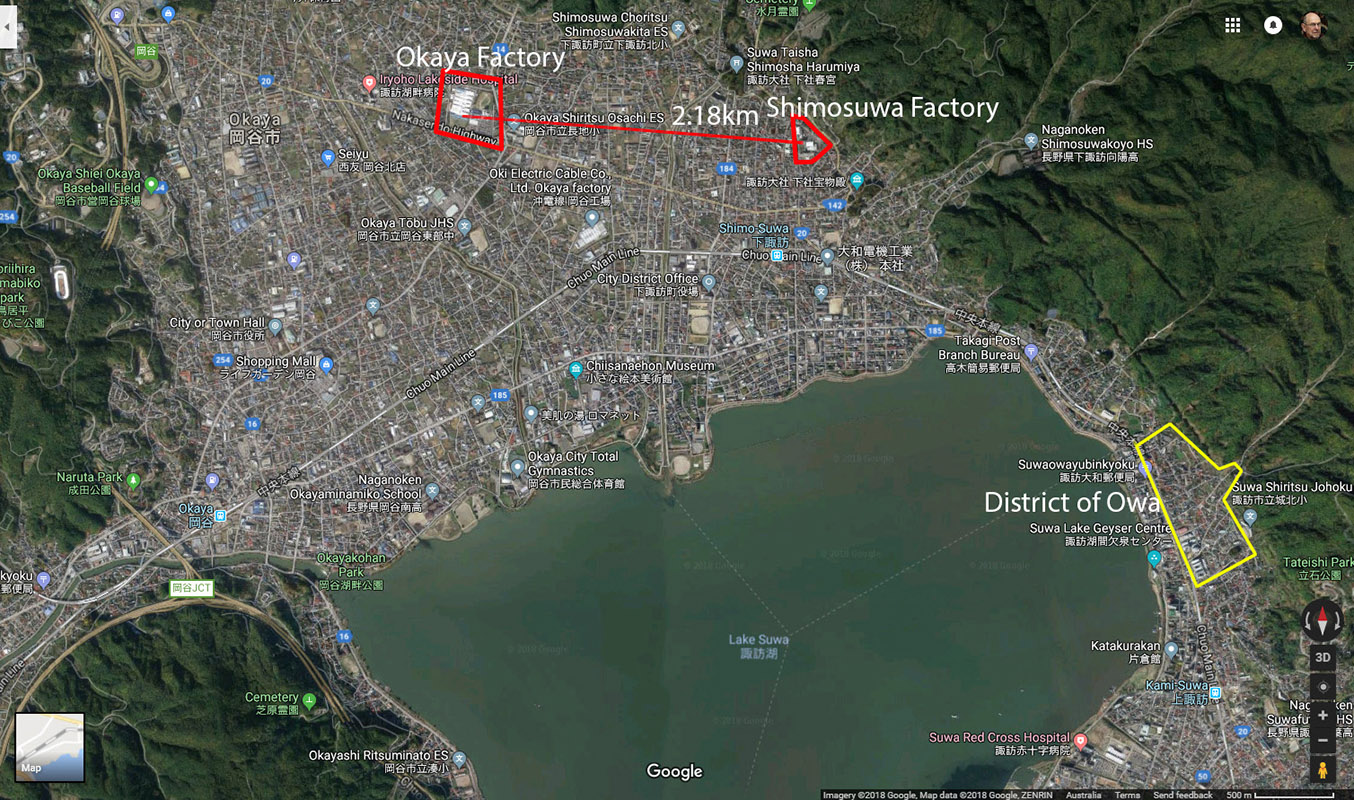
Plugging in various permutations of the above factory address into Google Maps does not compute for me. Contributor Chris Whelan has noted that “Ohwa” these days is most likely translated as “Owa”. The Japan Postal Code site describes Owa as a district of the the “city of Suwa-shi in Nagano province” but I cannot get more granularity than that. The Owa district is on the eastern shore of Lake Suwa and is marked in yellow on the satellite image in “Lake Suwa Factories Today” further below.
2nd Factory, Shimosuwa, Nagano Prefecture (from 1956 to 1972)
The 1956 Yashima booklet, detailed in the next section, refers to the “new factory” and “new Yashima optical factory” with photos of operations and an artistic rendering of the factory site (rather idealistic and inaccurate, particularly regarding the newer buildings, rather like an early concept drawing - perhaps the only elevated view available). Japanese Wikipedia identifies the location as one of the old Katakura Industries Co., Ltd., silk reeling factories in the town of Shimosuwa, on the opposite side of the lake to the city of Suwa, and that Yashima took it over in 1955. Another smaller 1956 brochure has a double page spread of the same rendered factory image and along with the Yashica Rookie user manual, confirms the Shimosuwa location:

(Document scan courtesy of Chris Whelan)
The significant addresses are:
Yashica Head Office: Nihonbashi-Muromachi, Chuo-ku, Tokyo
Suwa Plant: Shimosuwa Town, Nagano Prefecture
The actual factory location is shown on the Google map at the end of The Factories section. A brochure featuring the factory circa 1960 refines the head office address to Nihonbashi Muromachi 1-8, Tokyo.
Below is a later aerial photo of the factory site. The image is is taken from an interesting brochure which also features factory operations and production lines. The viewpoint is turned 90 degrees clockwise from the above artistic rendering and shows the back of a new multi-storey office building in the top left quadrant and to the left of that, a new curved roof hanger-like building (which according to one brochure, appears to at least in part be an auditorium featuring basketball and volleyball floor markings and elsewhere there is reference to the company gym). Note the actual location of the second chimney (left one) has moved, or almost certainly, the artist got it wrong or it was still in planning at the time. The office block sits in the area of the two storey flat roofed building and twin flagpoles at the bottom of the above image (most likely, an early impression of what the office block might look like). The front of the office block is shown in the next image.

(Document scan courtesy of Chris Whelan)
The road behind the factory (top of picture) is National Route 142. Below that on the Yashica factory's perimeter is a road, or route, called “Old Nakasendo” (not visible). Sometimes Route 142 and Old Nakasendo deviate with road improvements, as behind Yashica, sometimes they are the same. Presumably, Old Nakasendo, follows part of the route of the Nakasendo highway originating from the 8th century. The modern Nakasendo Highway, National Route 20, on which Yashica's new Okaya plant was located (a couple of kilometres to picture left) is a different road (the two do meet, some way below picture bottom).
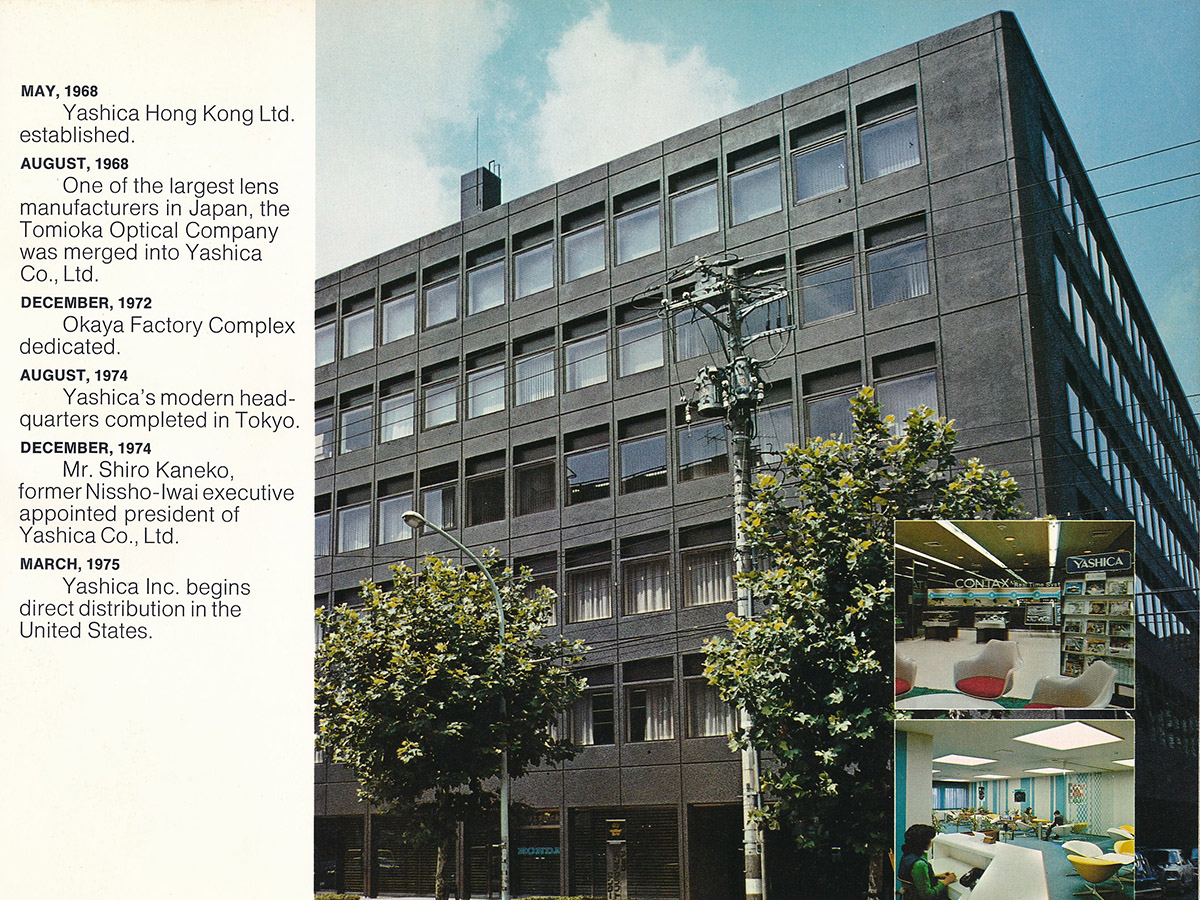
This is the office block on the Shimosuwa factory site. The image is from the circa 1959 brochure printed in the US but it also features in several Japanese brochures and is also visible in the photos below.

The panoramic view under is from the back cover of another brochure, circa 1960, featuring the factory and company's operations, and looks over the top of the factory towards Lake Suwa.

The aerial photo below of the full Yashica site is from a 1964 brochure or later (the Yashica Mat-EM is a featured model). The viewpoint is similar to the first artist's impression and the panorama above. Note that the central office block now has a three storey extension added along its right hand side and this continues along the back of the building in an “L” shape.

(Document scan courtesy of Chris Whelan)
3rd Factory, Okaya, Nagano Prefecture (from 1972 to Kyocera times)
According to Japanese Wikipedia, in 1972, Yashica opened a new factory (see Disaster, Almost Failure above) on the former Katakura silk mill site in neighbouring Okaya City, also on Lake Suwa in Nagano Prefecture. The site had been bought from Okaya City in 1959. The translated Wikipedia entry seems to be suggesting that Yashica “transferred completely” to the new Okaya factory, i.e. ended operations at its Shimosuwa facility.
Contributor Chris Whelan notes that the translated 1972 manual for his Yashica TL Electro-X ITS SLR lists both the “Suwa Plant” at the Shimosuwa site and the “Okaya Plant” but that the 1973 Yashinon Lenses & Accessories booklet (for 35 mm SLRs) only mentions the Okaya facility, seemingly confirming the Wikipedia translation. Both booklets now list Yashica headquarters as:
HQ, 6-27-8 Jingumae, Shibuya-ku, Tokyo Pref. 150
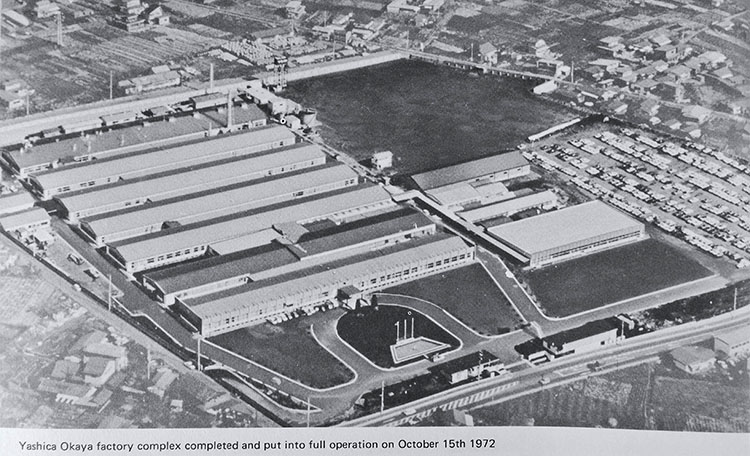
Below is an aerial photo of the Okaya factory that appears in a UK Yashica importer Photax catalogue:
(Document copy courtesy of Chris Whelan)
The caption underneath reads “Yashica Okaya factory complex completed and put into full operation on October 15th 1972”. According to the “Yashica A New Horizon” booklet, the factory was “dedicated” in December 1972.
Today, Kyocera lists a Nagano Okaya Plant amongst its Japanese assets. It's clear from the Google Map image (see further below) that this was Yashica's factory and although as a westerner, I find it hard to reconcile the exact address as given in the 1970s with the address as given today, the telephone number at least is unambiguously the same. The site is marked on the Google map of the Lake Suwa area factories, also further below.
Sagamihara Factory, Kanagawa Prefecture (unknown beginning to 1974)
Both booklets also refer to another production facility, the “Sagamihara Factory” in coastal Kanagawa Prefecture, the capital of which is Yokohama, not far from Tokyo (Sagamihara itself is actually inland, northwest of Yokohama and southwest of Tokyo). I have no knowledge about the purpose, or operations, of this facility nor have I seen earlier references to it. However, there is subsequent mention to turmoil surrounding its closure in 1974. The New York Times reported on 22 October 1974 that the head of the union at the plant had attempted ritual suicide after learning that Yashica would dismiss 900 workers from other plants to offset the redeployment and voluntary redundancy of the 900 workers in Kanagawa that he had negotiated in good faith. In the highly protected Japanese labour market, this was undoubtedly seen as an act of treachery by the Yashica management team led by then president Yoshihiro Miyata at a time when embezzlement, mismanagement and poor decision making were about to lead the company into bankruptcy. Apart from acting as a whistle blower, founder and deposed chairman, Yoshimasa Ushiyama, seemed to have no reported role in these matters.
Head Office, Tokyo (from August 1974, or maybe earlier)
According to the “Yashica A New Horizon” booklet, the new Tokyo Head office on Meiji-dori Avenue, Shibuya, was opened in August 1974. Chris Whelan tells us that it is now called the Kyocera Harajuku Building and its address is listed as 6-27-8 Jingumae Shibuya-ku Tokyo 150-0001. As noted earlier, that address already appears in booklets Chris has dated to 1972 and 1973 and which seem to align with opening of the Okaya factory and closure of Shimosuwa. On the left, the photo from the 1975 booklet, on the right, my 2019 photo shows the same building in its refurbished white colour:
.jpg)
(Left image courtesy of Chris Whelan)
(Click on images for larger view)
Other Sites
How, or where, the Japan based factory(s) operated after the opening of the Okaya plant is not very visible. Previously, Yashica acquired Nicca Camera Co. Ltd. in 1958. Nicca was located in Denenchofu, Otaku, Tokyo, with earlier user manuals specifying 1-1232 and the Type 3S/4 manual, 1-1263. For the next eight years, the remains of Nicca were known as the subsidiary Taiho Optical Co. but I have not seen its Nicca address listed in any Yashica documentation, although a Japanese blogsite suggests it was used as a “swamp works”, or maybe “skunk works”, presumably for development work and projects. In 1968, Yashica also added Tomioka to its acquisitions. Its main plant was in Osoki, Ome City, Tokyo and most of its earlier history was centred on the Tokyo area. The current headquarters and main factory of successor company, Kyocera Optec Co., Ltd., is at 3-1778 Osoki, Ome City, Tokyo so it is probably still the same site.
Lake Suwa Factories Today
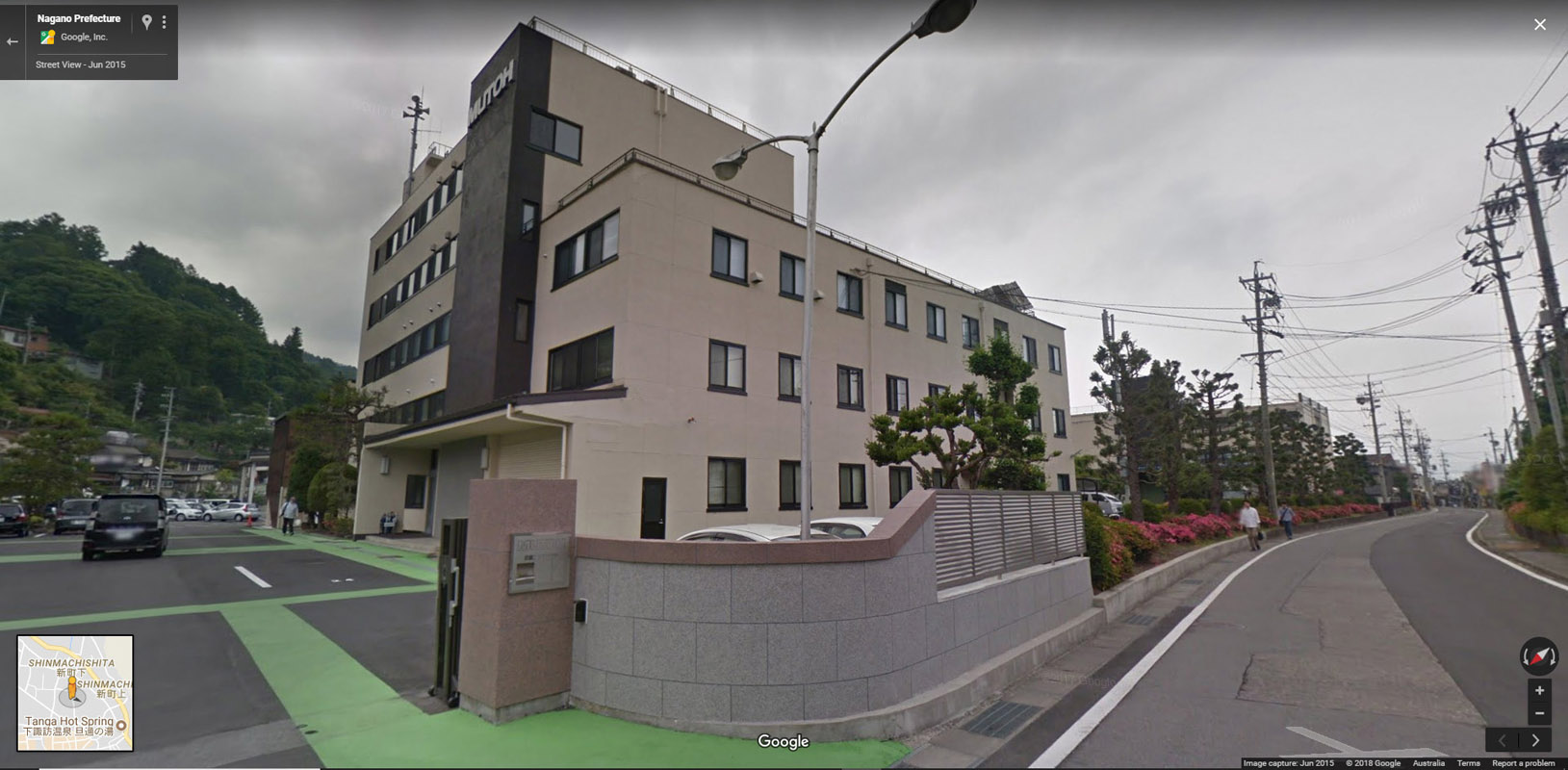
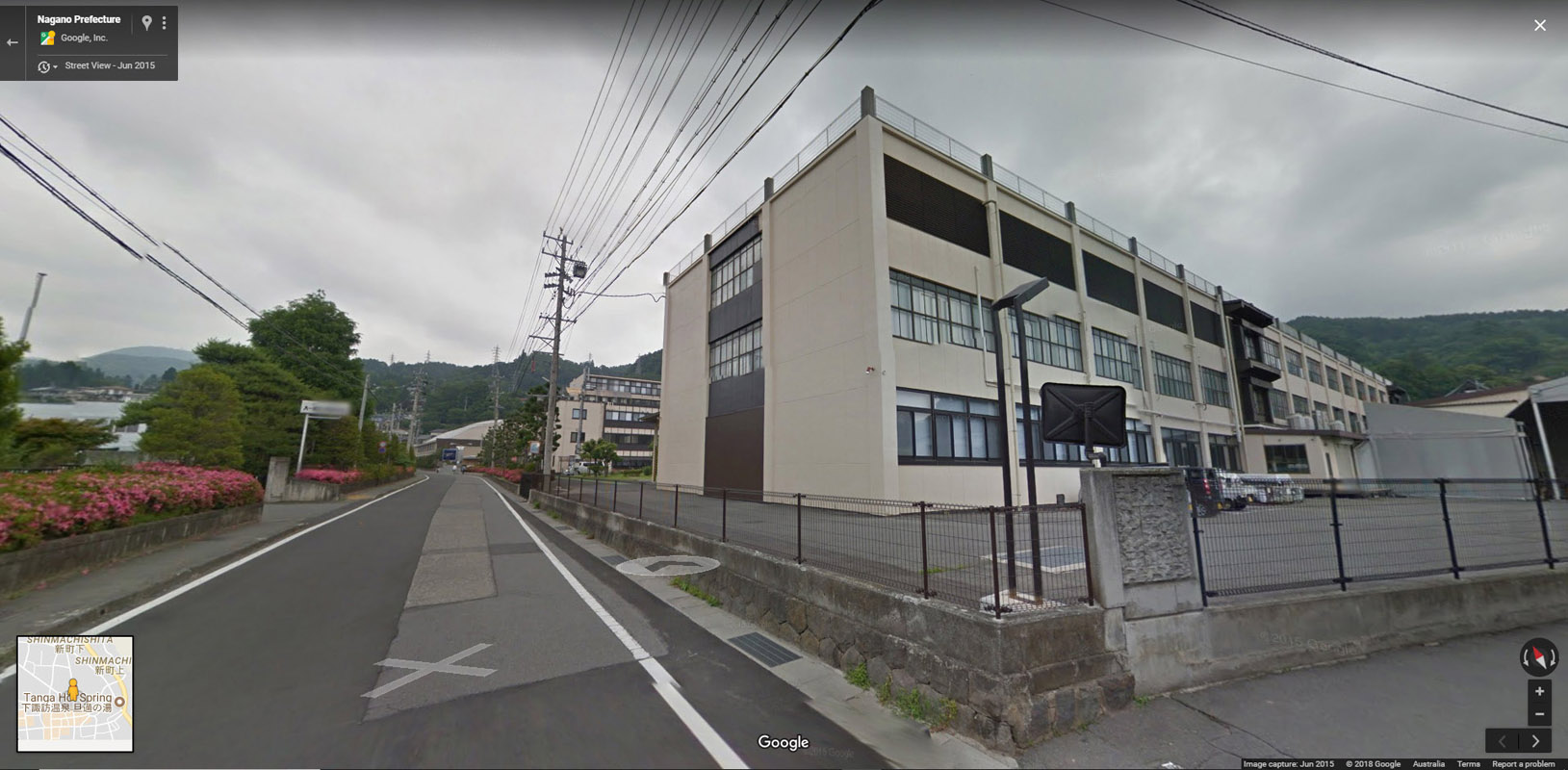
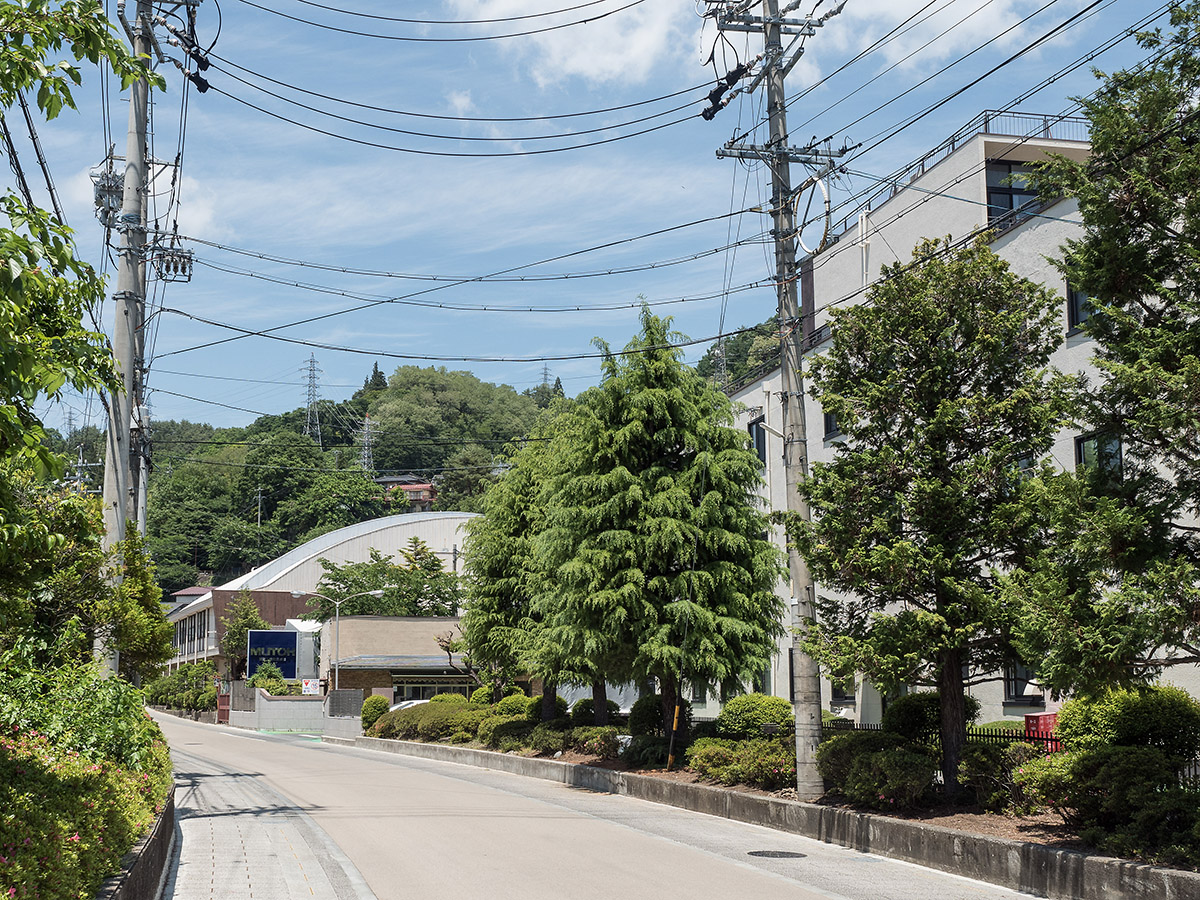
As a post script, for several years Chris Whelan and I have tried to find the exact location of the Shimosuwa factory that featured in Yashica booklets etc from 1956 until 1972. We've finally done it and I can advise that the hangar shaped building at the site apex still exists as well as the long “white” three storey building at the opposite end as also does the often featured office block in the middle with “Yashica” emblazoned on the front. This now has a more muted “Mutoh” name, a Japanese company with world-wide offices and well known for large format inkjet printers.
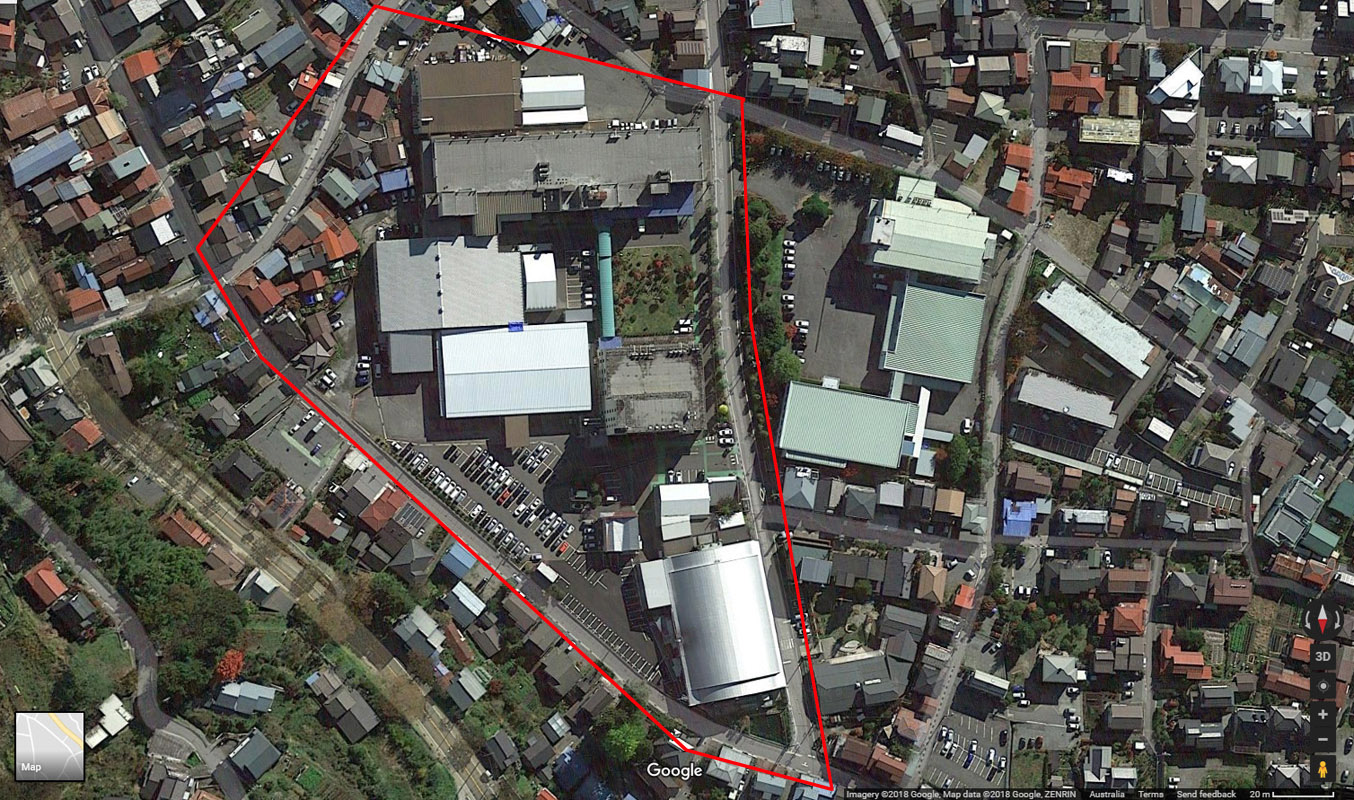
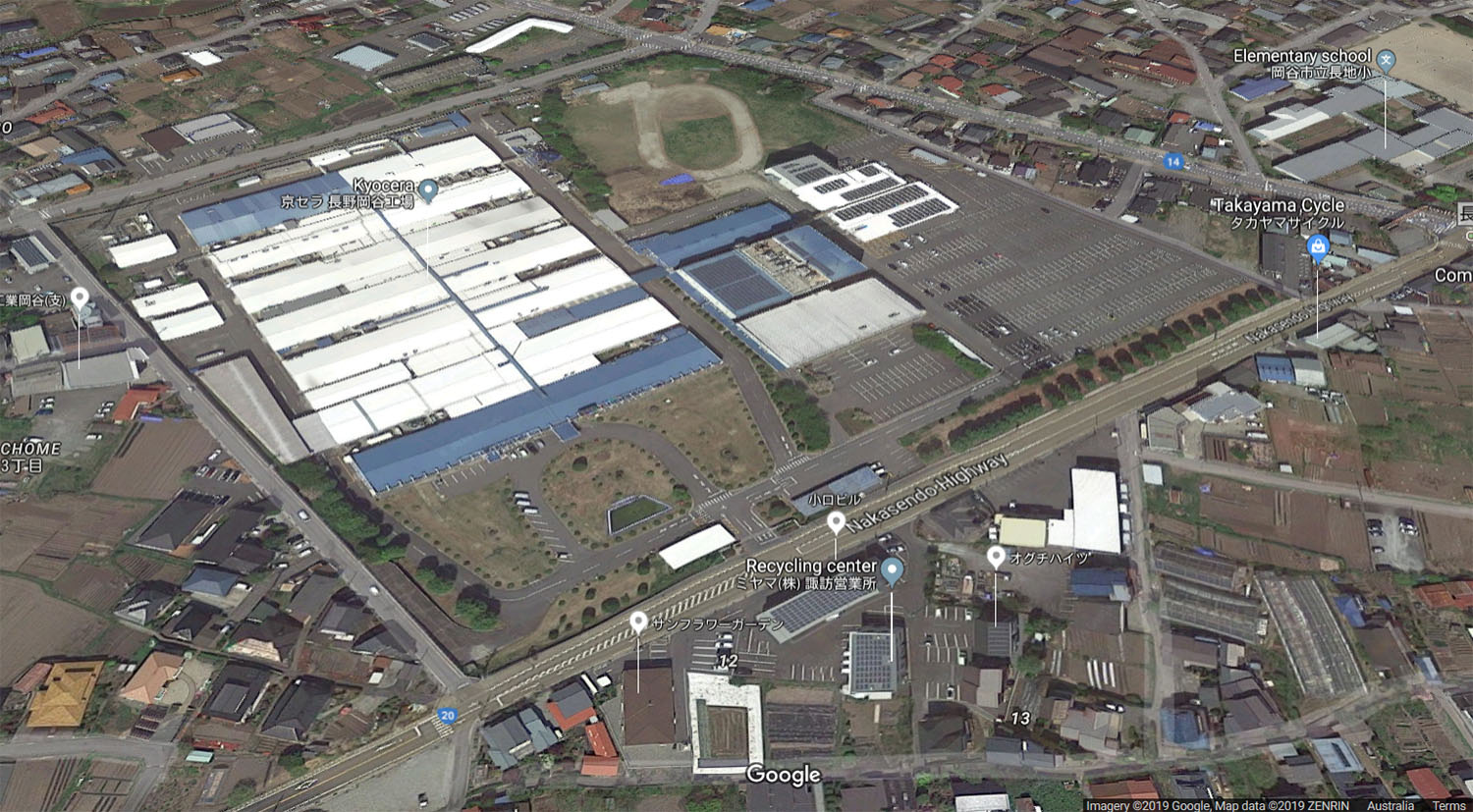
Below are Google Street View and Google Map satellite images of the Shimosuwa site today and the relative locations of the three Lake Suwa area factories. Image 1 is of the office building complete with the extension on the side that first appeared in the circa 1964 site image above. Looking along the road on the right, the long three storey building at the Lake Suwa end is just visible. Image 2 is from the rear of the three storey building looking back in the opposite direction towards the rear of the office block and the hangar-like building in the distance. Image 3 is a satellite view of the Shimosuwa site with Lake Suwa (south) towards the top of the image. Image 4, north to the top, shows the relative locations of the Shimosuwa factory on the right and the “new” Yashica Okaya factory on the left, now the Kyocera Nagano plant. This is on the Nakasendo Highway which also runs behind the Shimosuwa site, as identified above. They are about 2.18 kms apart. On the eastern shore of Lake Suwa, outlined in yellow is the district of Owa, Suwa (Suwa is on the south-side of the lake but extends halfway up the eastern shore as well), somewhere in which we presume the original Yashima factory was located. There is every possibility that the actual site has been redeveloped years ago.
(Google Street View and Map images)
(Click on images for larger view)
My 2019 photos of the office block and from alongside the office, looking towards the hangar-like building:
.jpg)
(Click on images for larger view)
Note that the outer two awning/carport like structures between the office building and the fence that were there in Yashica's day have been removed.
This a 3D satellite image of the current Kyocera Okaya plant and the layout is clearly still largely the same as the circa 1972 aerial view of the new Yashica factory shown further above:
 (Google Map image)
(Click on image for larger view)
Below is my panorama of the front building taken in 2019. The shrubbery has grown, rocks planted and the building on the right has been redeveloped but the trapezoid shaped pool and three flag poles (there in the Photax catalogue image above but not visible in the Google Map satellite image) are there on the extreme left. The photo was taken inside the perimeter (with permission) at the start of the horseshoe shaped drive on the right just in from the security checkpoint:
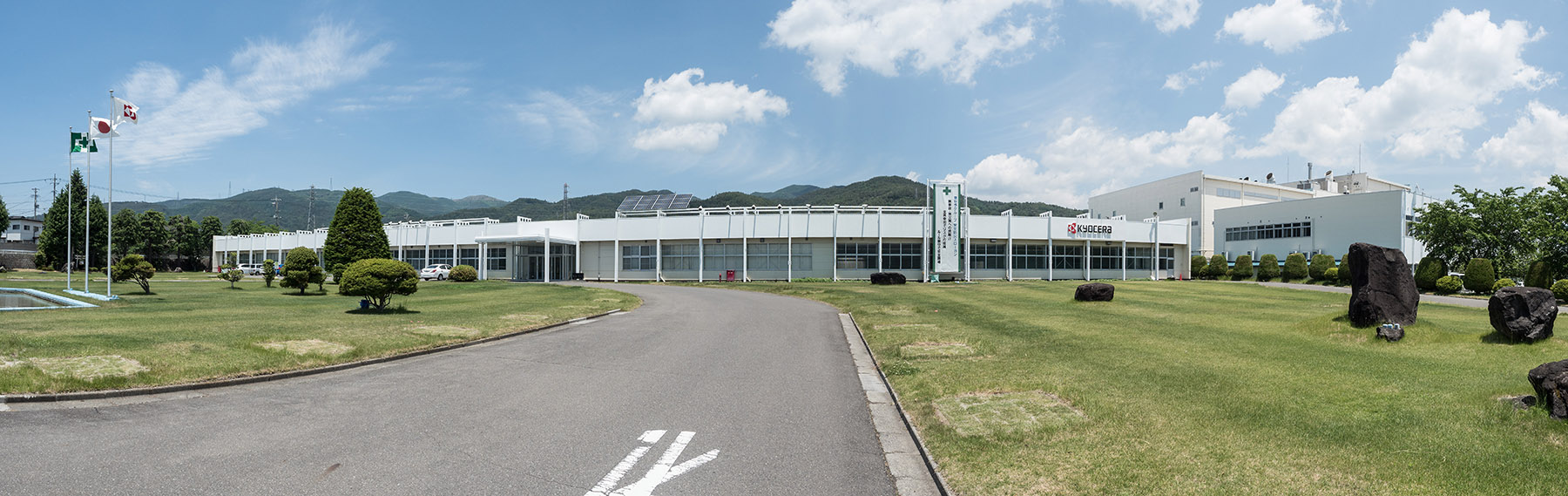
(Click on image for larger view)
1956 Booklet
The 28 page Yashima booklet (including covers) below has a publishing date of 15 December 1956 and advertises the Yashicaflex C, Yashicaflex A2 and Yashica Rookie and quotes a December 1956 US review of the Yashica C and LM. It also offers a fascinating glimpse into the “new” Shimosuwa factory and marketing of the day:
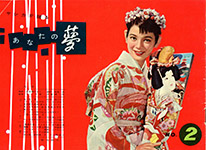
(Click on cover for full downloadable PDF)
Below are selected translations from the booklet, very kindly done by Haruko Eaton. The translations, including layout, are pretty much as given to me with any editorialising by me in italics:
______________________________

News from Service Department
Majority recommended by friends
Purchase reason for Yashica users
Results of survey on choosing Yashica shows that majority of buyers have been recommended by their friends as shown on the graph. It proves that Yashica has reputations of superiority from our customers using our products not just from our advertisements.
A: Recommended by friends (45.3%)
B: Recommended by shop (29.6%)
C: Chose by themselves (20.2%)
D: Other (4.9%)
Photograph above – Service department Osaka
Photograph below – HQ service department
Date published 15 Dec 1956
______________________________
Birth of Twin Lens Reflective Camera
Our new Yasu optical factory is situated on 10000 tsubo (approx. 8.155 acres) of vast land alongside of beautiful Nagano Suwa lake known as Switzerland of the East. We are proud of our practical production system being one of the best in camera industry, but let us show you here just a small part of more than 3000 precise procedures we do.
Production Procedures
Material Warehouse Factory Receiving, Dye cast, Press

Plate coating factory Quality Control Parts Warehouse
 Lens factory (Tomioka) Shutter factory (Copal etc)
Assembly factory Final QC Shipping
.jpg)
(Click on image for larger view)
Images from bottom right, anti-clockwise (note corresponding image numbers):
Main picture: Overview of new factory
1: This is a shot of our machinery factory. We produce various parts in this clean and bright environment.
2: Production of lens is done very carefully because it is, after all the soul of a camera, and after strict selection of raw material, lenses are produced going through hundreds of steps.
3: Shutters are made out of more parts than you'd expect. This is a part of our QC department.
4: Finished parts mentioned above are brought to the assembly department. They are assembled going through many hands on a conveyor belt.
5: Completed twin lens reflex cameras are transferred to QC department and there, focus adjustment is performed using collimator.
6: After passing strict resolution measurements and final inspections for finished products, our twin lens reflex camera is born.
______________________________

Yashica
From US camera published in December
This splendid camera has superior lens just like expensive counterparts have, also it's advantage is that the price is very reasonable. Yashica has proved that anyone can afford good quality twin lens reflective camera. Yashica C has the same functions as more expensive cameras.
Without being too relaxed with the positive feedback, we would like to keep producing better cameras.
(Background US article text also mentions Yashica LM and another camera but with the text cut-off, presumably the Yashica A)
______________________________
1957 Review of the Japanese Photographic Industry
The April 1957 edition of US magazine, Popular Photography, included a “Special Section” titled “The Japanese Photo Industry”. It starts with “In Japan the People Love Photography” and notes the widespread Japanese adoption of photography as a pastime and a way to keep moments alive, much as in the 1953 article above.
The magazine had visited Japan and various factories and found that the focus on quality control was evident everywhere, including at the delivery of the raw material stage. Comments were made about operations at factories, those about Yashica on page 149 are quite interesting. The number one slogan was “quality through happy employees”. To this end, music was piped throughout the factory and varied in style through the day to suit the mood of the worker. Semi-classical in the morning was to help workers forget about their personal situations. This was followed by Western semi-classical and in the lunch hour, there was classical such as Bach or Beethoven. In the afternoon, there was a period of popular Japanese tunes followed by “juke-box jazz”. “Sections of the plant's interior walls are painted in pink and light blue for effect. And when the day's work is over, every employee can take a dip in the plant's own hot spring.”
Page 154 discusses the establishment of the Japan Camera Inspection Institute (JCII) in 1954 and its government backed industry-wide role in quality control of photographic and optical exports. In the beginning, the seal of approval was a small circular paper certificate with “PASSED”. JCII was later renamed the Japanese Camera Industry Institute (retaining the same acronym), and was responsible for the oval gold “PASSED” quality stickers common on Japanese export cameras from the mid 1960s to late 1980s.
Japanese manufacturers belonged to the Japan Camera Industry Association (JCIA). JCIA established the Japan Camera Information and Service Center in New York “in the shadow of the Empire State Building” (page 158) at an address I believe was 329 Fifth Ave, the address also used by Yashica for its first brochure featuring the Yashica A, C and LM trio. The Center's role was marketing, product information, liaison, servicing and spare parts support for its members.
Late 1950s, Beginning of 1960s Factory Operations
Similar to the 1956 Booklet above, the following two brochures (also linked in The Factories above) provide glimpses of factory operations, the first perhaps from the late 1950s or later (some of the images are shared between the two), the second probably 1960 but no later than 1961:
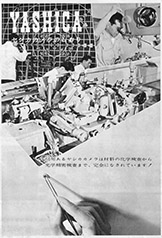
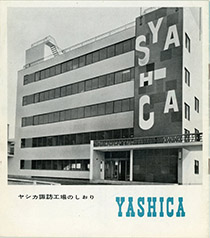 (Left brochure scan courtesy of Chris Whelan)
(Click on covers for brochure PDF files)
Hong Kong Production
Whilst it is well known that Yashica started assembly of 35 mm cameras in Hong Kong to reduce labour costs in an ever more aggressively competitive market, it is not so well known that some TLRs were assembled there as well (originally pointed out to me by Leigh Harris). So far, only very late model Yashica Ds have been found which places them in the 1970 to 1973 period. Like the 35 mm cameras, these examples have an “H” prefix for the serial number. The locking knobs on the base have “Hong Kong”, or in two cases simply “Japan”, instead of “Made in Japan” (see Yashica D in “66 Models”). Whether any of the Yashica Mat-124Gs were assembled there is not known but I have not found any obviously identified in this regard. Where visible, the locking knobs all have “Made in Japan”.
I have found very little information about Yashica's Hong Kong operations. Both Contax NX and late Yashica Mat-124G user manuals have the following Kyocera address listed amongst worldwide offices and subsidiaries; UNIVERSAL OPTICAL INDUSTRIES LTD. 14/FL. Piazza Industrial Building, 133 Hoi Bun Road, Kwun Tong, Kowloon, Hong Kong.
Brazil Production
Correspondent Tony Kwong first alerted me to this episode of Yashica history. Why, when and how Yashica first established a presence and then a production facility in Brazil is still a little hazy but some of it I have pieced together. The assembly of cameras was most likely related to import restrictions and/or tariffs. Brazil was not a major trading country and imports hurt the balance of trade and the economy. From the article at the top of this page, it is known that South America was already a significant export market for the Japanese camera industry in 1953. From 1908 until after World War II, Brazil was a major destination for Japanese emigration with now the largest concentration of Japanese descent people outside of Japan.
We also know from Brazilian immigration records that Yashima company president, Yoshimasa Ushiyama, obtained a visa in 1957 and therefore we can reasonably assume that he visited the country for some reason, or at least planned to.
There was a Yashica commercial address, Yashica do Brasil Indústria Comércio Ltda., registered at Rua Yashica, 65 (65 Yashica Street), Sorocaba, São Paulo, Brazil. The Google street view shows a low two storey building with “Kyocera” on it and offices at the front and some other buildings behind a concrete block wall which from above look like a small factory or warehouse complex with four main buildings. It has a 70's look about it. The Kyocera website today lists this as the Head Office of KYOCERA do Brasil Componentes Industriais Ltda. at the full address, Rua Yashica 65, Jardim Bela Vista, 18016-440 Sorocaba, State of Sao Paulo, Brazil.
A Yashica Mat-124G user manual lists the following address amongst worldwide offices and subsidiaries; YASHICA DO BRASIL INUSTRIA E COMERCIO LTDA., Rua Cruz e Souza 59, Aclimacao, São Paulo. A later Contax NX user manual lists; KYOCERA YASHICA DO BRASIL-INDUSTRIA E COMERCIO LTDA., Av. Bernardino de Campos No. 98, 5-Andar Paraiso, São Paulo, Brazil. These other addresses may have been offices used by Yashica at the time, the first is now up-market residential, the second, an older office tower.
Brazilian correspondent Mario Nagano has agreed that it was the government's response to Brazil's economic issues that prompted Japanese companies to establish factories there, listing other examples such as Nissin Foods (1965), Toyota (1969), Makita (1981) and Seiko Watches (1981). These preceded the later periods of hyper-inflation in the late 1980s to mid-1990s and government bans on “superfluous imports” such as cars, electronics, watches and cameras.
Thanks also to Mario and his story about the Sterilair air sterilisation device (on the Accessories, Other page) invented by a Brazilian physicist and manufactured by Yashica do Brasil, my research has uncovered a little more background into Yashica's operations. According to a number of sources, the Sterilair device was championed by company vice president, Mitiko Ogura, who later left to take charge of a separate Sterilair company which still exists today. A contemporary newspaper article about Mitiko from around 1990 fills out the detail.
Mitiko was the daughter of Japanese immigrants who left Japan during the War and studied engineering at Brazil's Mackenzie Presbyterian University in the 1970s. In 1974, Hiroshi Funayama, from Yashica Japan, went to Brazil to find an executive to set up a production facility. In 1975, remarkably for a woman then and especially at the age of 25, Mitiko became director of Yashica do Brasil and in a decade and a half, grew it to become the largest photographic company in the country. Photo of Mitiko Ogura from the article:
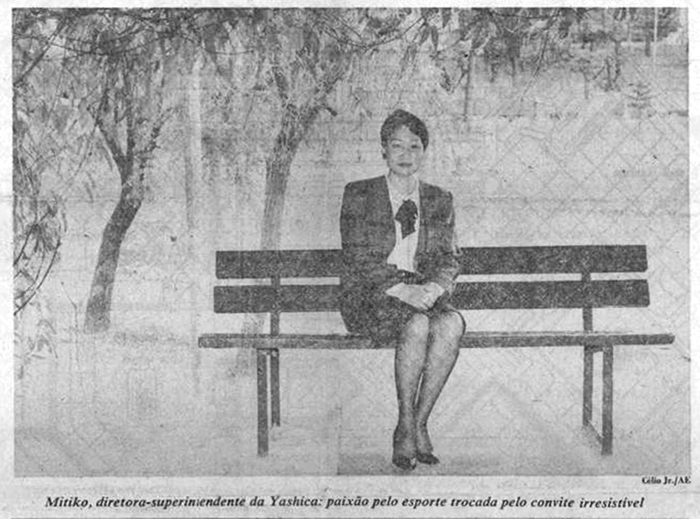
Note, as well as the “superintendant director of Yashica” description under the photo, Mitiko has been variously described as “director”, “vice-president” and the “director of Sterilair Division” (of Yashica). That may be a sequence of positions, something to do with translations from Portugese to English or a mix of cultural understandings (Portugese, English and Japanese). However, the references all suggest that she was the one running Yashica do Brasil from 1975 until her departure.
A search of the net doesn't bring up much information about cameras but there are quite a few examples of images of Yashicas with “Brasil” engraved on the bottom. Of the 35 mm cameras, the earliest seems to be the ME1 from around 1977 followed by the MF-1 and then MF-3 in about 1985 (first and last identified in Camera-wiki.org and all three noted in the “Yashica/Kyocera Battery Chart” floating around the net). The Battery Chart also identifies the MF-3 Super “Carnival”, MF Motor and Motor J, all from 1987, DF 100AF (1990), YK-35 (1991), MG-3 (1992), MG-Motor (1994) and a number of other models all the way through to 2007. Correspondent Mario Nagano also sent me photos and auction links for the Yashica FX-D Quartz SLR with “Brasil” on the base plate (post 1980) and also a link to the already-mentioned MG-Motor. It seems that some of the cameras may have had unique names, and maybe specs, for the Brazilian market.
There is also a unique TLR model, the Yashica Mat-124B (see Yashica Mat-124B in “66 Models”). Its presence is identified in the Yashica/Kyocera Battery Chart with the word “Brazil” next to it - somehow, I have missed this model in the past. The Mat-124B is based on the Mat-124G body but features wise, it recreates the Yashica-Mat which was discontinued in 1973. The differences to the 124G are that the CdS exposure meter assembly has been deleted and replaced by a plain nameplate unit with the new name and the M/X flash sync switch has also been omitted (M sync would not have been missed in the 1980s). The battery compartment cover is retained but not the compartment itself. The locking knob has “Brasil” engraved on it. None of the cameras that I have seen so far have have lens numbers and all have the later Mat-124G slotted battery compartment covers so I would say they are almost certainly from 1979 or later (i.e., after the ME1). Compared to 124G serial numbers, I would have guessed a release in 1980 or 1981 which matches the Yashica/Kyocera Battery Chart 1981 claim. Production may have finished towards the end of 1983 or the beginning of 1984.
These turn up on the Brazilian auction site from time to time but not in great numbers. Usually, there are quite a few more 124Gs but these seem earlier, all, or almost all, with plain battery covers from 1979 or earlier. There is a smattering of other models as well, earlier Yashica-Mats being well represented and even the odd Yashicaflex.
Marketing Campaigns
“Yashicaflex Photography” and Other Japanese Marketing Initiatives
Contributor Chris Whelan now has a number of the Japanese language books, “Yashicaflex Photography” as well as one for the Yashica 8 movie camera (there are at least two versions, the later one with “2” on the cover) and I have one also plus the equivalent “Yashica Mat Photography”. They are part user manual, part full photography guide with all manner of techniques including lighting, setting up a darkroom and film processing. They contain photos by well known Japanese photographers and of popular personalities. The first Yashicaflex Photography covers the Yashicaflex models S and A-II and was first published on 10 August 1955. The 20 October 1955 reprint added the model C. It is some 170 pages compared to the English language Yashicaflex Directions for Use Model A & C from a similar time which covers a few more models but is simply a fold out sheet.
Chris' collection includes books for the Yashicaflex B (new model) and Yashica A III (more of a booklet than book). They have the same title, follow the same style but are limited to one model each. There is also a 158 page 1958 Yashica D version, the description of which I found on an auction site and a book for the 1958 Yashica 35. Later user manuals seem to be like the export versions.
Yashica also produced some early advertising booklets which were more of a general photography guide than standard sales brochure. Examples from 1956, 1957 and 1958 are on the Brochures page.
As it grew, the export market clearly became more important for Yashima/Yashica but the company's initial success was based on its growth in its home market and it appears that the company went out of its way to promote photography for the masses and develop a lasting relationship with its customers. Perhaps this is the main reason why after Yashima adopted the “Yashica” name for export models, it continued with “Yashicaflex” models in Japan (albeit, called “Yashica” in advertising).
The Cowboys are Coming!
Almost from the start of the introduction of “Yashica” named models into the US in the second half of 1956, US ads and brochures featured the heavy serif style font associated with the “Wanted” posters and US wild west as popularised in Hollywood westerns. In 1958, Yashica created a new focusing hood logo using this font and also used it for the name between the lenses. There is little doubt that the prime focus was shifting to the US market.
The Yashica Sailor Boy
Marketing Paraphernalia contains various examples of Yashica promotions but the most enduring was the Yashica Sailor Boy which in various forms seemed to last from its introduction as a plastic figurine in 1962 to probably 1970 in cloth patch form. Whether he contributed to Yashica's success is an unknown but Yashica clearly thought that it was on a winner.
Early Export Markets
Little seems to be known about Yashima's early marketing push. We can speculate that in the early 1950s, the domestic market was still somewhat constrained economically and that as cashed-up servicemen began leaving Japan after the Korean War, companies like Yashima would have been seeking alternative markets to sell to, particularly for their more expensive models. Obviously the US, as the world's greatest consumer society, would have been at the forefront of planning. However, there is one much smaller market which has been a real surprise; Sweden.
In parts of Europe, post-War import restrictions were in place for a long time. Here is a note on a UK importer Photax brochure from 1961:

(Document image courtesy of Leigh Harris)
USA
The first evidence of a US push is a review of the “Yashicaflex” (actually a Yashicaflex S, but the “S” is never mentioned) in the March 1956 edition of Popular Photography. The review seems to be introducing the brand to the magazine's readers for the first time:
.jpg)
(Document image courtesy of Tom Heckhaus)
(Click on article for larger image)
The Chicago Trade Show report in the June 1956 edition of Popular Photography noted:
"A Yashica-flex Automatic camera with crank-operated film transport and shutter-cocking facilities, M-X synchronisation and shutter speeds from 1 to 1/300 second was presented by Intercontinental Marketing Co., at $79.50."
An early forerunner to the Yashica-Mat, or more likely, a prototype?
A forum discussion on photo.net in 1999 refers to an ad for the Yashicaflex S and AS models found in a 1955 magazine. I have found no other US references to Yashicaflex. The first confirmed ads for any Yashica model are in November 1956 for the Yashica A, C and LM which state: “Three months ago, many camera store owners had a preview of the Yashica cameras.” A book, Yashica Guide by Richard Lowell, claims that the Yashica name was first introduced to the American public in September 1956, presumably as the Yashica A, C and LM. Next to the initial November 1956 ad below, found in several publications, is a different one from December 1956 which was re-run at least the following month as well.
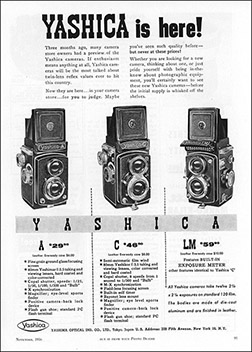
 (Second ad is detail from larger web image)
(Click first ad to view both sides as PDF, click second ad for larger image)
This is an early brochure for the “new” Yashica A, C and LM. Printed in Japan but with US address already, 329 Fifth Avenue, New York. I believe that this is the address of the Japan Camera Information and Service Center set up by the Japan Camera Industry Association. Note that there is no reference to Yashica Inc. yet (see 1959 brochure below) which I believe was at 234 Fifth Avenue.
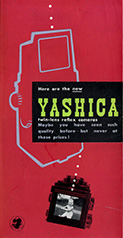
(Scan provided courtesy of Tom Heckhaus)
(Click on cover to view full brochure as PDF)
The Yashica-Mat was released in April 1957 and in the same year, Yashima established the subsidiary, Yashica Inc., in New York. The ad below still refers to the US address as “Yashima Optical” but at the new 234 Fifth Avenue address.
.jpg)
(Click on ad for larger image)
From this point forward, there are regular ads for the three Yashica models plus the new Yashica-Mat. In 1958, the Yashica 635 and Yashica 44 TLRs and Yashica 8 movie cameras started appearing.
Below is a USA Brochure from about 1959. Two things to note are the range of cameras already in addition to the TLRs and the prices of TLRs both in comparison to each other and to the 35 mm and other cameras. In terms of the quality of negative obtainable from them, the TLRs were absolute bargains.
(Click on cover to view full brochure as PDF)
Sweden
Whilst the focus on the US is expected, why this small European country? The evidence from ads is that Yashica cameras were being actively marketed in Sweden from 1954, that is less than 2 years after the Pigeonflex first saw light as a camera to be marketed by someone else. The first ad found is for the Yashima Flex and Yashica Flex S in the December 1954 edition of Swedish photography magazine Nordisk Tidskrift för Fotografi (the Yashima Flex and Yashica Flex S together is strange, the Yashima Flex is thought to be from an earlier period):
.jpg)
(Document image and information courtesy of Göran Årelind, also appears in Model Names and 66 Models)
(Click on ad for larger image)
Molander & son AB (aktiebolag or company) was the first Swedish importer of Yashima models. This ad was followed by the Yashicaflex B (old model) and Yashicaflex S (note the new single word form) in the March 1955 edition of competitor photography magazine, Foto:

(Document image and information courtesy of Göran Årelind, also appears in 66 Models)
Next, in May 1955, came a Yashicaflex AS ad (probably for an AS-II) but the ad below is actually from August 1955:
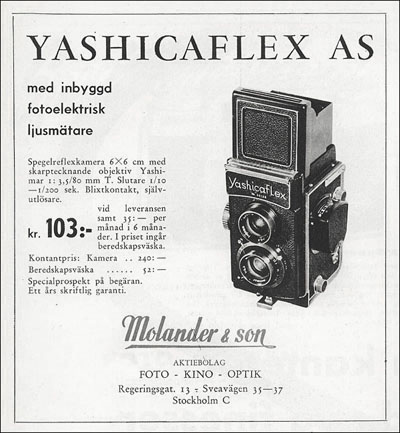
(Document image courtesy of Göran Årelind, larger image appears in 66 Models)
And then in April 1956, the MolfoReflex (by trim, probably released in 1955):
.jpg)
(Document image courtesy of Göran Årelind, larger image appears in 66 Models)
The MolfoReflex is unique as the only known rebadged Yashica model (see also MolfoReflex in 66 Models). It seems that maybe only a couple of ads were run, the second one in June. The “Generalagent” (importer/ distributer) is identified as Molfo Aktiebolag (company), the name “Molfo” is likely to simply be a contraction of “Mol”anders and “Fo”toagenturer (Molanders Photo Agency), a subsidiary company of Molander & son. This company had no other connection to Yashica products.
Molander & son's Yashicaflex S and AS ads, now combined with other photographic products, continued into 1956. In 1957, it was the Yashicaflex S by itself and in the last ad in August, Molander called it the “Yashica S”. In December, Molander was advertising the Yashica-Mat and by May 1958, also the Yashica A, C and LM. However, a different importer, A. B. Fritz Weist & Co., began advertising the Yashica-Mat, Yashica A, C and LM in April 1957:

(Document image courtesy of Göran Årelind)
Below is a Yashica TLR brochure, printed in Sweden in 1961. Note, that the trim details of the Yashica-Mat on the cover and inside are of earlier versions.
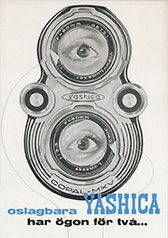
(Original brochure provided courtesy of Göran Årelind)
(Click on cover to view full brochure as PDF)
The Yashica commitment to Sweden was substantial, here is a 1959 ad and Göran's translation below it:

(Document image courtesy of Göran Årelind, also appears in Yashica 44 Series)
YASHICA are Swedish-controlled quality!
Factory manager Werner Falkner at our facility in Jacobsberg – Sweden's second largest plant for photographic products – has the responsibility for the quality control of all Yashica cameras imported to Sweden.
He is the one who knows the most about Yashica cameras, how high and consistent the quality really is of these cameras. This is documented in more than 16,000 tested cameras, plus the same number of pleased Yashica-owners all over Sweden.
Swedish Yashica inspection consists of 23 check-points including: mechanics, film-feeding (with film in the camera) optical (in autocollimator) and exposure times. For film-cameras, also magnifier control of film-feeding and stroboscope-check of film-speed and, finally the finish of the camera.
All Yashicas have 1 year Swedish warranty!Look at the camera……..look at the price:
Yashica 44 is a super modern mirror-reflex camera with the smooth format 4x4.
Small, light and easy to handle with advanced technical features.
Crank-feeding, of course, shutter with 10 speeds and advanced optical lenses that guarantee extremely good results, both with B/W and color film.
The price is a sensation………268:-
Sweden's most sold mirror-reflex camera is
YASHICA Ask Your photo-dealer for a demonstration!!
The establishment of such a facility and number of cameras sold is impressive in the context of Sweden's population, 7.5 million in 1960. The Yashica 44 price is interesting, it is even more expensive than the Yashica 635! I don't know if this facility lasted very long though, it is not listed in later Yashica documents.
Evidence may also surface about early export activity in other countries but for the moment, Sweden is unique regarding Yashicaflex models. Having been neutral in World War II, in the early 1950s, Sweden was in a relatively healthy state whilst much of Europe was still rebuilding and coping with the start of the Cold War.
Whatever the reasons, Sweden is interesting from a Yashica point of view. However, I didn't know this. Like many people, I knew a little bit about the existence of the MolfoReflex and that was all. Correspondent and now significant contributor, Göran Årelind, is of course Swedish and he has done some very good research into the MolfoReflex background, the Yashica TLR presence in Sweden and the general Swedish TLR marketplace in the 1950s and early 1960s. That is 50 to 60 years ago - not a simple task!
The end result is this excellent document: 
Göran sees this as a work in progress, particularly regarding the MolfoReflex material. I also have to add that Göran's contributions have been used elsewhere on the site and it is his Swedish ads, along with the Dutch ad provided by Norman Beierle, that have narrowed down the release dates of the Yashica 44A and Yashica 44LM to the middle of 1959.
Belgium
I know little else about Belgium apart from the fact that I have a Belgian brochure that is probably from late 1955. It lists three models; Yashicaflex models A-I, AS-II (mistakenly claimed to have Heliotar lenses) and S.
 (Click on cover to view full brochure as PDF)
Denmark
Leigh Harris has pointed me to a guy in Denmark that has scanned ads and other bits and pieces from Danish magazines dating from 1912 to 1990. This is the link to the relevant page. I don't know yet whether Denmark received any special attention or it was broadly representative of western Europe. Following reluctant cooperation and then Nazi occupation, Denmark had escaped World War II relatively unscathed compared to other European countries. I don't know whether that is relevant or not.
The first Yashica ad is in April 1957 for the Yashica C and LM. There is a separate ad in the same month for the Yashica-Mat (its month of release) and the Yashica A. There are combined ads for all four models in June and December. Similar ads appear in March and October 1958. After that, there is no mention of the Yashica C and LM. In 1959, the focus is on the Yashica 44. An ad in September 1961 lists the Yashica A, D, Mat, Mat-LM, 44A and 44LM. There are no more Yashica TLR ads. I don't know if Yashica TLRs left the market, simply weren't advertised or whether the owner of the site felt that the ads didn't introduce anything new. Certainly, ads for TLRs in Sweden also petered out in the mid to early 1960s.
Clearly, when Yashima unleashed its export drive into the US with first the Yashica A, C and LM followed closely by the Yashica-Mat, the move into Europe wasn't far behind. Whereas the knob wind models were slightly slower to arrive than in the US, it seems that the Yashica-Mat hit key world markets simultaneously in April 1957, quite a marketing feat back then.
Australia
I am embarrassed to say that I know little about Yashica's activity in my home country. The earliest connection is this photograph from NSW State Library archives. It is of a Yashica Flex S taken in Sydney in October 1954 (see also Yashica Flex S entry) and appears to be a product shot of some sort. Was it to do with marketing in Australia or elsewhere or nothing to do with Yashima (Yashica) at all?
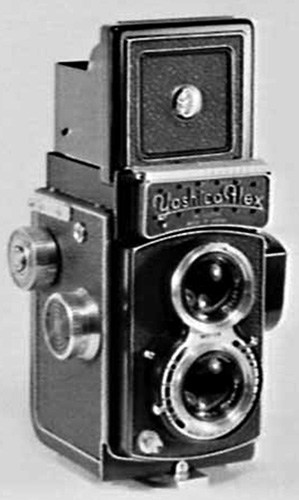 (The image is from the collections of the State Library of NSW and displayed in accordance with the Library's policies as at 24 Mar 2014)
The full page ad below appeared in the 24 July 1958 edition of the “Australasian POST”, a general interest periodical. The magazine was much more likely to feature pictures of bikini clad girls than articles about photography. It had quite a large readership and was often found in waiting rooms and barber shops. What I find intriguing is that there is no other information than the picture of the Yashica-Mat on the Yashica background - no specs, no contact details, no importer. What does it mean? Could you buy one or was it part of some sort of awareness raising marketing campaign? The serial number, 7074x (last digit could be 0, 6, 8 or 9) and Lumaxar 80 lenses put the camera in mid-1957 production. There is no ® mark so the camera is likely to be a Japanese domestic example. In other words, I assume the image was supplied by Yashica Japan.

I am not conscious of TLRs having a large popular following in Australia in the 1950s and 60s let alone later, however, that is just an impression, not necessarily a fact. The brochure below by Australian importer Swift & Bleakley, circa 1962, pays little attention to TLRs:
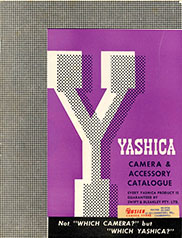 (Click on cover to view full brochure as PDF)
Yashica Worldwide Offices
The 1975 booklet “Yashica A New Horizon” notes the establishment of the following subsidiaries:
- Yashica Inc. in New York in August 1957
- Yashica Europe GmbH in Hamburg in August 1961
- Yashica Hong Kong Ltd in May 1968
This is Kyocera's list of Yashica international offices on the back of a post-1983 Yashica Mat-124G user manual.
