Yashica TLR Models (66 & 44)
See “66 Models” and “44 Models” for photos, descriptions and trim details of individual models.
Contents
(Scroll down or click on links)
Models & Variations
Yashica TLR Models & Specifications Table
Table of Release Date, End Date & Production Quantity Sources
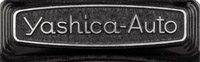
Identifying Models & Variations by Nameplate
Yashica 66 TLR Family Tree
The Game Changers
The Longest Running Models
Models & Variations
How many models and variations are there? There are at least 31 released 66 models, including the Pigeonflex and and MolfoReflex (rebadged Yashicaflex A-I) and 3 released 44 models. Added to these is the Yashicaflex AS-I which is in Yashima documentation but I have not found an example of yet. That is strange but then again, I have found only one example of the Yashicaflex A-III. So maybe 32 released 66 models. There is also the Yashica Hi-Mec. I think that this was probably never released as a model and is a pre-production version of the Yashica LM. So I would not count it as part of the released models total but nevertheless, two have been found for sale so in all other respects, I have treated it as any other model. I also think that the Yashica Auto 44 didn't make production although there is Sugiyama's photo and one possible eBay sale. I have treated it the same way as the Hi-Mec, i.e., not included in the count of released models but as a model just the same.
So in summary, I think that there are 32 released 66 models (one to be confirmed yet) and 3 released 44 models. Not included in the total is one 66 and one 44 model which are probably pre-production versions of models that changed at the last minute.
If you include the two pre-production models and add in variations for models with early and late body types, changes in shutter type, shutter release method on Yashicaflex A series and lenses and different colour combinations on some models, there are at least 64 models and major variations of the 66 series. Based purely on known colour combinations, there are 17 model and colour variations of the 44 series. In total across both ranges, there are at least 81 variations or more in models, shutters, lenses or major appearance differences.
After you read the “Bodies & Trim” and relevant models sections, you will understand that by also factoring in changes to focusing hoods, logos, spool knobs, film winding knobs, focusing knobs and scales, locking mechanisms, sync location, control wheel trim, “Yashica” between the lenses, screws in the back visible or not etc etc, the possible variations are seemingly infinite.
Although it hurts my head to think about it, as an example, there are about 17 major and minor variables with the Yashicaflex S (one of the most revised models) not including lens caps or number of calibration holes in the exposure meter flaps. Most changes were introduced one at a time with the next supply of parts to the production line. It was all orderly but different to the modern practice where changes are saved up for the new model, or a Mark II or Mark III version is introduced.
Yashica TLR Models & Specifications Table
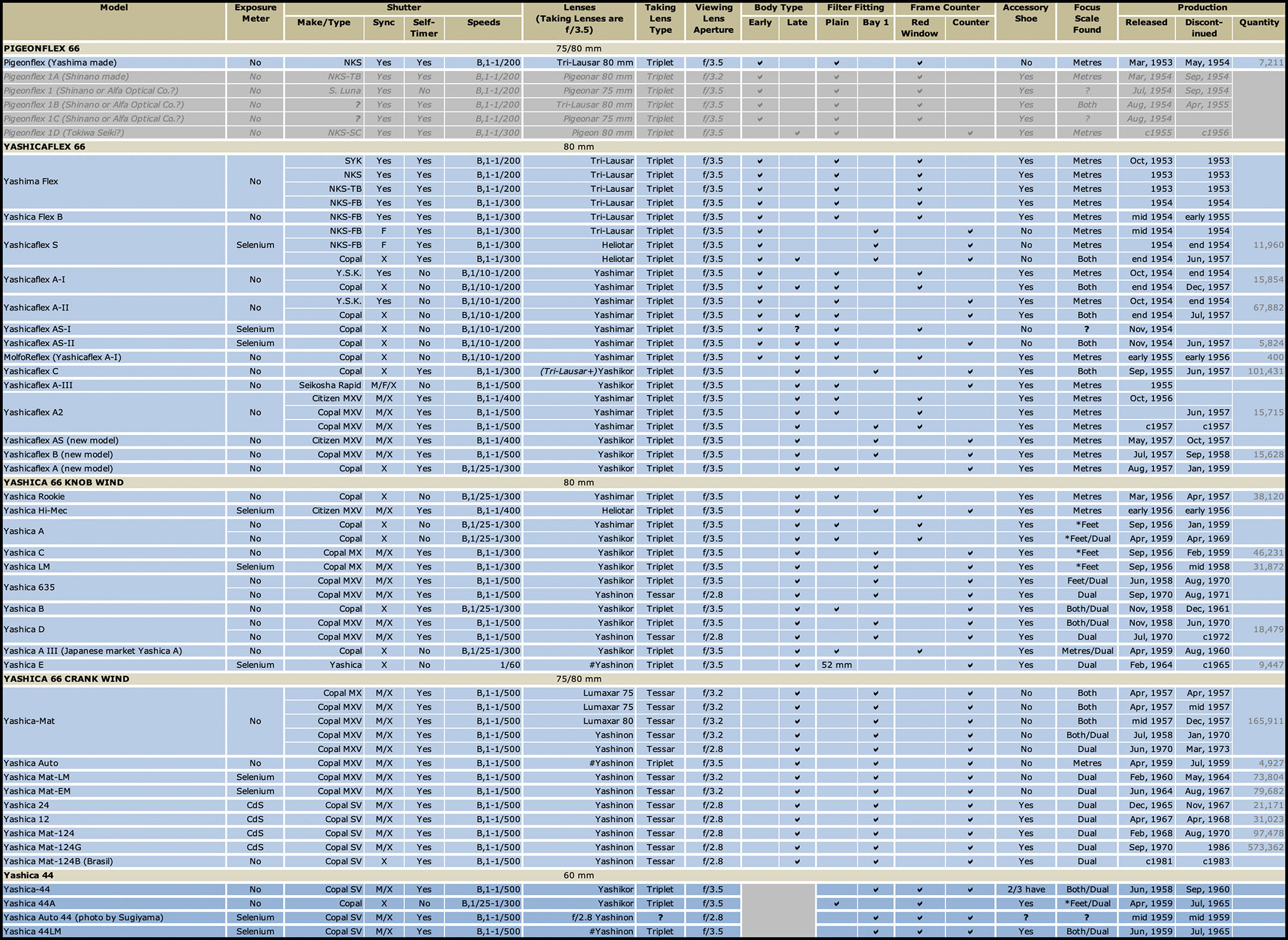
(Click on table for full screen view)
For acknowledgement of sources, refer to “Notes” below.
Notes
General
The “Quantity” information in grey text in the “Production” columns is presented as a matter of interest but is from a single source and it has not been able to be verified. Information about the Shinano made Pigeonflex models in italicised grey text originates from Camera-wiki.org but has been amended to reflect examples found - see The Pigeon Loft page. Also on the Pigeon Loft page, I suggest that some of the models credited to Shinano have possibly been made by Alfa Optical Co.
Some models underwent shutter and/or lens changes (discussed elsewhere) and I have shown the specs for these on separate lines. I have found examples of all models and shutter variations except the Yashicaflex AS-I and the Yashica Auto 44. The Yashicaflex S has Bay 1 filter mounts in both early and late forms and the sometimes called “early Yashicaflex S” with plain filter mounts is actually either a Yashicaflex AS-I or AS-II. Confusingly, the Yashicaflex A (new model), Yashicaflex AS (new model) and Yashicaflex B (new model) have similar names to earlier models - “(new model)” is not part of the official name. The full official name for Yashicaflex models would be, e.g., “Yashicaflex model B”.
Flash Sync
“Yes” in the “Sync” column means that flash sync is fitted but I don't know the specific type. On the earliest Yashica Flex model S examples and possibly the model B and late Yashima Flex with NKS-FB shutter, it is for short duration “F Class” bulbs which are pretty close to “X” sync but still have a delay (see also Flash Sync). DO NOT USE “M” SYNC TOGETHER WITH THE SELF-TIMER see also the “Ownership” section.
Taking Lens Type
Popular perception has been that all Yashinon lenses are 4 element Tessar types. Some have questioned that and there are a couple of Japanese websites that are more forceful in putting the argument that some Yashinons are triplets. On the Lenses & Shutters page, I have explained why the evidence seems to confirm that the Yashica Auto, Yashica E and Yashica 44LM Yashinons, all with f/3.5 viewing lenses, are in fact triplets. In the table, I have marked these lenses “#Yashinon”.
Focus Scale Found
This column represents what I have found (over 4,000 in total) and in terms of total production numbers, the sample is very small. For me, its main purpose is to indicate whether a model is export focused, home market focused or both.
Where “Both” is shown for Focus Scale, both metre and feet scaled examples are spread through the serial number range. Markets for cameras with scales in feet were initially US Service personnel and then US export (later, the UK too and the odd few for Australia and similar destinations). The destination for cameras with scales in metres could be either Europe or the domestic Japanese market or both but for models where most cameras have focusing scales in metres, it is safe to assume that the main focus was the domestic market. There are four models, noted below, which I have marked as “*Feet”. They have focusing scales almost all in feet but the few metric examples are clearly Europe bound and there is no evidence of Japanese versions, at least in the period covered.
Leaving out the domestic Yashica A III variants released in 1959 which all have focusing scales in metres, the early Yashica A examples predominantly have scales in feet before changing to dual scale. There are five exceptions with at least four and possibly all five featuring the 10 flag DIN film speed reminder scales associated with European export. There are another six with the later dual DIN/ASA scales which could also have been destined for European export. The Yashica LM and C have focusing scales overwhelmingly in feet, the only exceptions have the European export 10 flag DIN film speed reminder scales. In other words, the early Yashica A and all Yashica C and LM cameras were export only models.
There are only five examples of the Yashica 44A with focusing scales in metres, four very rare Burgundy and one later black. I think that these are all European export versions and that the Burgundy examples are all from Sweden. Sugiyama claims a 1960 release date which I think would be correct for Japan - by that stage, the focusing knobs would have been dual scale.
The Yashicaflex AS (new model) and B (new model) generally have metre scales but there are now five Yashicaflex B (new model) examples in my database with feet. All have 3340xxx serial numbers suggesting a small batch. Yashica Ds have both feet and metre examples prior to dual scale knobs. Yashica 635s are a smaller sample but I have found only feet scaled examples before the introduction of dual scale knobs, including an example in a Japanese language brochure. Yashica-Mats have both feet and metre scaled examples but the balanced is very heavily skewed towards feet. The sample size of the Mats is relatively large and also heavily skewed towards earlier examples – sales probably dropped off as successive metered versions were released.
Production Data
Production figures are simply as quoted in “Collector's Pictoral Encyclopaedia & Value Guide to 6x6 TLR Cameras” by Karl F. Kahlau (with the author's kind permission). I have omitted his Yashima Flex figure of 26,828 which seems high to me. He actually calls it a “Yashimaflex B” and as there is no figure for the Yashica Flex B, I wonder if they could have got mixed up or combined. Although I have included it, the Pigeonflex figure could be low - his period only covers the second Pigeonflex variation of two, and perhaps even three, Yashima made types.
In “Yashica/Kyocera and the Problem with Dates”, I pointed out that many of the release dates found on the net are the same or similar and can be traced to “Yashica/Kyocera supplied documentation” or, words to that effect. I also noted that it is possible to easily prove that there are some major issues with the accuracy of the release dates. However, when it is the only game in town, it is still a useful starting point. I have used two broadly similar resources referring to this source information, both an archived web page by Alan R. Corey called “A Partial History of Yashica TLRs” and the book “Collector's Pictoral Encyclopaedia & Value Guide to 6x6 TLR Cameras”. In most cases where there is a difference, I have preferred Karl's book. However, I have also been guided by other sources.
The trouble is that nobody really understands what all the various dates mean. Start dates can be announcements, start of production, “release” (whatever that means) or on-sale. End dates can be end of production, end of marketing or end of stock clearance. Then there is the difficulty of understanding some of Yashica's model naming strategies, particularly regarding the Yashicaflex models. We know that the Yashica/Kyocera documents referred to have been produced afterwards, probably by decades, so that also leaves a lot of questions. Who in the company put them together, the office boy or someone responsible with a good understanding of the data and history? Did these documents originate in the US, Japan or elsewhere etc?
My approach is to use a database of several thousand cameras to compare serial numbers, features and trim and find as many user manuals, brochures and ads as I can. These help inform me regarding whether dates are plausible or not. Elsewhere I have noted that claims that the Yashica A was released in 1958 or 1959 are nonsense and the hard evidence puts it at least as early as December 1956 and very probably September 1956. There are other examples and these are dealt with individually in the “66 Models” and “44 Models” pages and also the “Yashicaflex A Series” and “Yashica 44 Series” pages. I also believe that Yashica serial numbers from September 1957 include a date code and I have added that to my arsenal of tools but the problem is to know how to relate start and end end of actual production to release and discontinued dates. Production probably starts before release but how much before and at the end, there may be considerable stock inventories. The Yashica C and LM were still listed in the Olden Camera and Lens Company, Inc. of New York catalogue of 1960 even though by serial number and trim, it looks like production stopped in 1958 and they are not included in a 1959 Yashica full range brochure. Old stock? In the absence of any other plausible dates, I have used the raw production dates in several cases.
In the end, the “Released” and “Discontinued” dates in the above table contain consideration of all the main sources and my own research. Where, for example, one of Karl's dates appears verbatim, I haven't just cherry picked that as a likely candidate, I have examined it against all possibilities to make sure it is the best fit. That doesn't necessarily make it correct.
I have included the table below to provide some transparency about the available source data and to acknowledge the sources themselves:
Table of Release Date, End Date & Production Quantity Sources
.jpg)
(Click on table for full screen view)
The entries highlighted in dark grey indicate those where I have disagreements (Sep 1956 and Corey's Oct 1956 for the Yashica LM are close enough). I have already commented on Karl F. Kahlau's Pigeonflex and Yashimaflex quantity data above. I also believe that his Yashicaflex AS-I data actually applies to the Yashicaflex AS-II (his Yashicaflex AS-II and AS-III seem to apply to the 1957 Yashicaflex AS). The date differences are dealt within individual model entries and elsewhere. Note that his MolfoReflex data is not from his table of Yashica/Kyocera supplied information. Sugiyama is interesting. His information is sparse, there are even some models available in Japan missing, e.g. the early Yashica Flex B, but it essentially matches what I have, with two small riders. He correctly described the 1953 Yashima Flex as the forerunner of the Yashicaflex but then dates the Yashima made Pigeonflex as 1954 whilst the Shinano made Pigeonflex next to it is described as being from 1953. I believe that is probably a transcription error of some sort. He dates the Yashica 44A from 1960 (advertised in Europe in mid-1959) but as I have mentioned elsewhere, despite the existence of a Japanese brochure advertising all three 44 models, the physical evidence from my database is that there were no Japanese market 44As in 1959 so indeed, a delayed Japanese release is possible.
I have to say that I am disappointed by all the various -wikis. Their older camera maker history is often quite well researched and properly referenced and Camera-wiki.org has the only easily accessible Pigeonflex data. However, cameras are being featured by enthusiastic and well meaning camera owners but without adequate guidelines, supervision and moderation. Later Camera-wiki.org dates are rare and without source reference and could be plucked from anywhere, probably another site. Camera-wiki.org and Wikipedia Japan both claim that the Yashica Mat-LM was released in 1958. There are no references but it does match the Yashica/Kyocera Battery Chart. By trim, ads and the style of serial numbers, the date is easily proven to be out by 1 to 2 years, then there is the date code which confirms it.
The Mat-LM does highlight a general problem though. Karl quotes the release date as September 1959. Feasibly, this may have been an announcement date. The serial number of the camera in the user manual is November 1959 by my calculations and it would be expected that the manual would be prepared prior to release. Again relying on my serial number theory, production didn't actually commence until February 1960. The earliest ads I have found, all mentioning “new”, are from 1960. I have gone with the 1960 date but who knows for sure?
Identifying Models & Variations by Nameplate
Yashima Pigeonflex to Yashicaflex
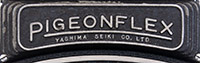

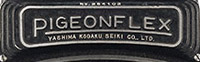
Yashima made Pigeonflexes 1953. Number 2 reflects maker name change, number 3 is less curved.
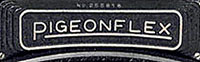
Like number 3 above but without maker name. Almost certainly Yashima made, last type. Cameras identical to earlier types. The Shinano made IA has a similar nameplates to this but is more curved in the earlier Yashima style, has 5 digit serial numbers instead of 6 and except for the first examples, the serial number is on the front under the name instead of on the top edge.
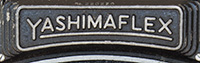


1953 Yashima Flex, 1st type is extremely rare, 2nd type is typical. 1954 Yashica Flex model B.
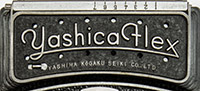
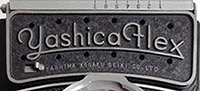
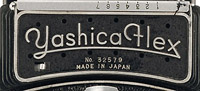
1954 Yashica Flex model S with NKS-FB shutter. 1st and 2nd types are extremely rare (with maker name same as Pigeonflex), only difference is catch type. Usually with Tri-Lausar lenses but a 2nd type has been found with Heliotars. 3rd type with serial number and “Made in Japan” started with Tri-Lausar lenses and then changed to Heliotar lenses.
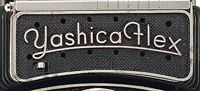
Yashicaflex S
with textured nameplate and typically found with later body, Copal shutter and Heliotar lenses.
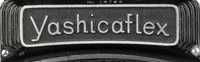
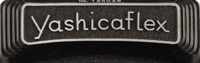
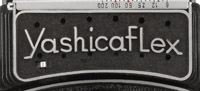
1st type with visible screws is used on October 1954
Yashicaflex A-I and A-II, models with early body still. 2nd type is used on same models with later 1955 body plus Yashicaflex A-III, Yashicaflex A2 and 1957 Yashicaflex AS. 3rd type is Yashicaflex AS-I and AS-II introduced November 1954.
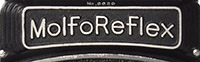
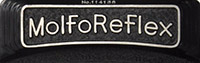
Early 1955 MolfoReflex with visible screws and early body. Later MolfoReflex with new body type.
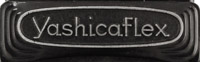

First 1955 Yashicaflex C and later revised oval surround.
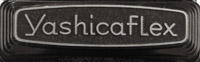
Used on 1957 Yashicaflex B (new model) and Yashicaflex A (new model).
Yashica Knob Wind
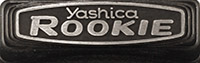
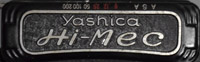
First
“Yashica” models from first half of 1956. Rookie was a domestic release of Yashica A with dual format capability, Hi-Mec may have been a pre-production version of the Yashica LM.
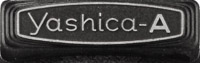
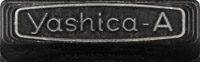

The Yashica A and C together with the Yashica LM below were export only models launched simultaneously in the second
half of 1956. First Yashica A type is more curved on top and bottom, probably changed in 1957. Also used for domestic market Yashica A III of 1959 (same as Yashica A except no hood logo). Yashica C echoes Yashicaflex C.
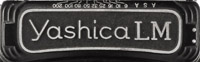
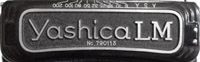
Later Yashica LM nameplates
display the serial number.
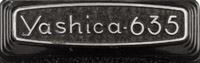
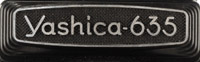
Released mid-1958. Received new textured background in 1970 at the same time as black Yashica Mat-124G locking knob adopted.

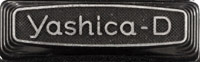

Both cameras released 2nd half 1958. Yashica D received textured nameplate at same time as Yashica 635.
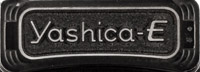
1964 but might be 1963.
Yashica Crank Wind

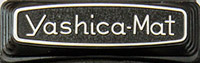
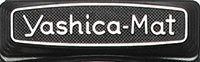
Released
April 1957. Camera in 1st user manual used single word form of name. 1st production version shown here has more curved surround like first Yashica A. Changed later in 1957 with introduction of Lumaxar 80 lenses. Last textured type introduced in 1970, same as Yashica 635 and Yashica D.
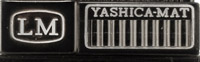
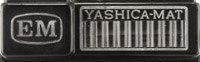
1959 budget domestic market Yashica-Mat, 1960 Mat with meter and 1964 Mat with meter and improved read-out.
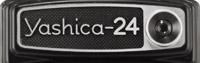
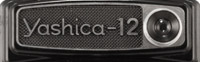
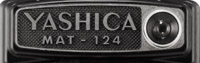
Released in 1965, 1967 and 1968 respectively. Still basically Yashica-Mats but with coupled CdS exposure meters, Copal SV shutters replacing the MXV type and the first models to receive f/2.8 viewing lenses.
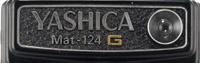
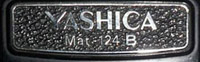
Released in 1970 and sometime after 1980 respectively. The Yashica Mat-124G introduced gold plated contacts
and some minor improvements to the Yashica Mat-124, the most important of which were internal light baffles and an improved exposure meter switch. The Yashica Mat-124B was assembled in Brazil and took away the gold plated contacts along with the exposure meter (the battery compartment cover remains).
Yashica 44 Models
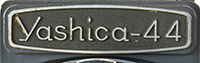
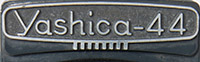
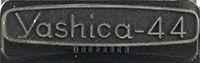
1958 crank wind Yashica 44
and 1959 knob wind Yashica 44A, note flush shiny “teeth”. Late grey examples of 44A have recessed painted “teeth”.
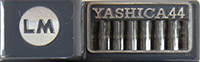
1959
Yashica 44LM.
(Image Acknowledgements: 3rd Yashica-Mat and Yashica Mat-124B are from larger web based images. 4th Pigeonflex is courtesy of Rick Sweeney. MolfoReflex are courtesy of Göran Årelind. Hi-Mec is courtesy of Jean-Marie Bussiere. 1st Yashica-Mat is courtesy of Sandu Baciu. 1st and 2nd Pigeonflex, 1st Yashimaflex, 1st Yashica Flex S, Yashica 44, 1st Yashica 44A and Yashica 44LM are mine. All the rest are courtesy of Tom Heckhaus)
Yashica 66 TLR Family Tree
The following table is a simplistic view of Yashica's 66 models grouped by feature set and year of introduction (not all models shown). There is no suggestion that this represents Yashica's grand design, its meant to be illustrative only:
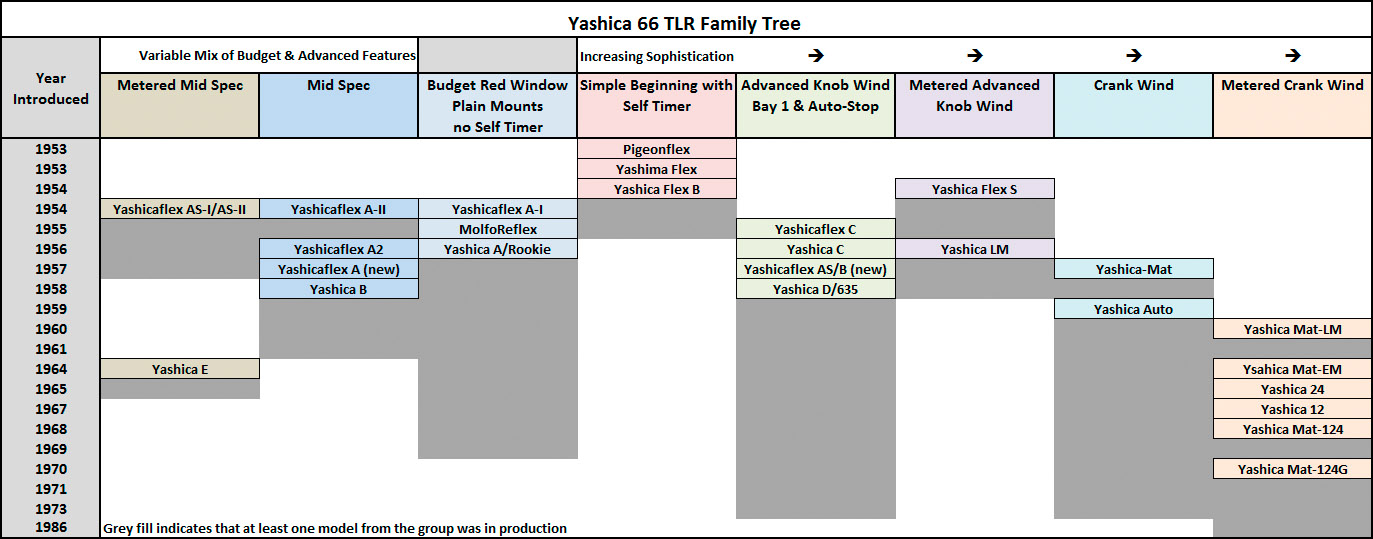
(Click on table for full screen view)
The Mid Spec Line includes cameras with different mixes of basic and advanced features and in that sense, are not really developments of previous models, more a repositioning based on popular features and price. The Yashica E doesn't fit well into any category but I have put it where it is based on features of limited interest to enthusiasts and pricing not far from the Yashica A. There are no entirely unique models, the Pigeonflex DNA remains dominant throughout. As with any biological tree, the closer to the source, the more in common that the cameras have. Note that cameras released in 1953 are only found with the older, short strap holder body. Except for the Yashica Flex B which had a comparatively short life, cameras released in 1954 are found with both the early body and the later body with long strap holders, a change that occurred sometime in 1955.
Note that whilst “A” in a name originally signified a budget model and “B” seemed to indicate a mid-spec model, later iterations are not so clear. Perhaps the Yashicaflex B (new model) was considered to be mid-spec compared to the Yashica-Mat but why was its Yashica twin called the “Yashica D” and why was the Yashica B a re-badge of the Yashicaflex A (new model)? Then there is the Yashicaflex AS (new model) with Citizen shutter that just seems to be an early version of the Yashicaflex B (new model).
The Game Changers
Everyone has their own reasons for believing that a model is special. Although there were other important models and all were interesting, for me, three models standout as game changers:
Yashima's Pigeonflex
The first of the line, the beginning of 33 years of TLR production. Nothing special compared to its peers but it got the basics right and its heritage was there at the end. The line evolved from this basic start, there was no need to go back to the drawing board and begin again. Without a decent product, Yashima's move into camera production may have been still-born. The Yashima Flex represented the blossoming of the fledging company's vision but as a camera, it was still a Pigeonflex.
Yashica Flex S
It brought bayonet lens mounts to Yashicas as well as auto-stop film winding and a film counter. These were merely playing catch-up with some of its better specified competitors and would hardly have made it stand out. The inclusion of a selenium cell exposure meter was a first for Japanese cameras. This makes this model iconic in my eyes. It also drew attention to Yashima as a new and innovative camera manufacturer and is perhaps the point at which Yashima's future was assured.
Yashica-Mat
It's easy to dismiss this simply as a cheap Rolleiflex clone. For Yashima, it was a culmination in design. Fitted with 4 element Tessar design Lumaxars, and later Yashinons, and crank wind, it also introduced control wheels and revised trim details seen on subsequent models. It was a very competent camera and the price was breathtakingly affordable compared to the Rolleiflex and even other Japanese competitors. Yashima sold a truckload of the the early Mats. The basics hardly changed for subsequent models which simply added various styles of exposure meter and film type options. With the Yashica Mat-124G, it was the equal longest production run.
A Special Case - Yashica Mat-124G
I did say three. I don't consider the 124G to be a game changer, more a part of the end game. However, I do think it is iconic. It is the last of the line but it was in production for 16 years, almost half the life of Yashica TLR production. It sold in enormous quantities and was perhaps the model most widely used by professionals. Some say that its quality isn't as good as some earlier models, such as the Yashica 12 and Mat 124, but whether that is true or not doesn't matter. When people that remember the period think of a Japanese TLR, they think of the Yashica Mat-124G.
The Longest Running Models
The following models survived for 5 years or longer. In order of longevity (some of the discontinued dates may be a little rubbery):
| Models | Released | Discontinued | Life |
|---|---|---|---|
| Yashica Mat-124G | 1970 |
1986 |
16 years |
| Yashica-Mat | 1957 |
1973 |
16 years |
| Yashica D | 1958 |
1972 |
14 years |
| Yashica 635 | 1958 |
1971 |
13 years |
| Yashica A | 1956 |
1969 |
13 years |
| Yashica 44LM | 1959 |
1965 |
6 years |
| Yashica 44A | 1959 |
1965 |
6 years |